






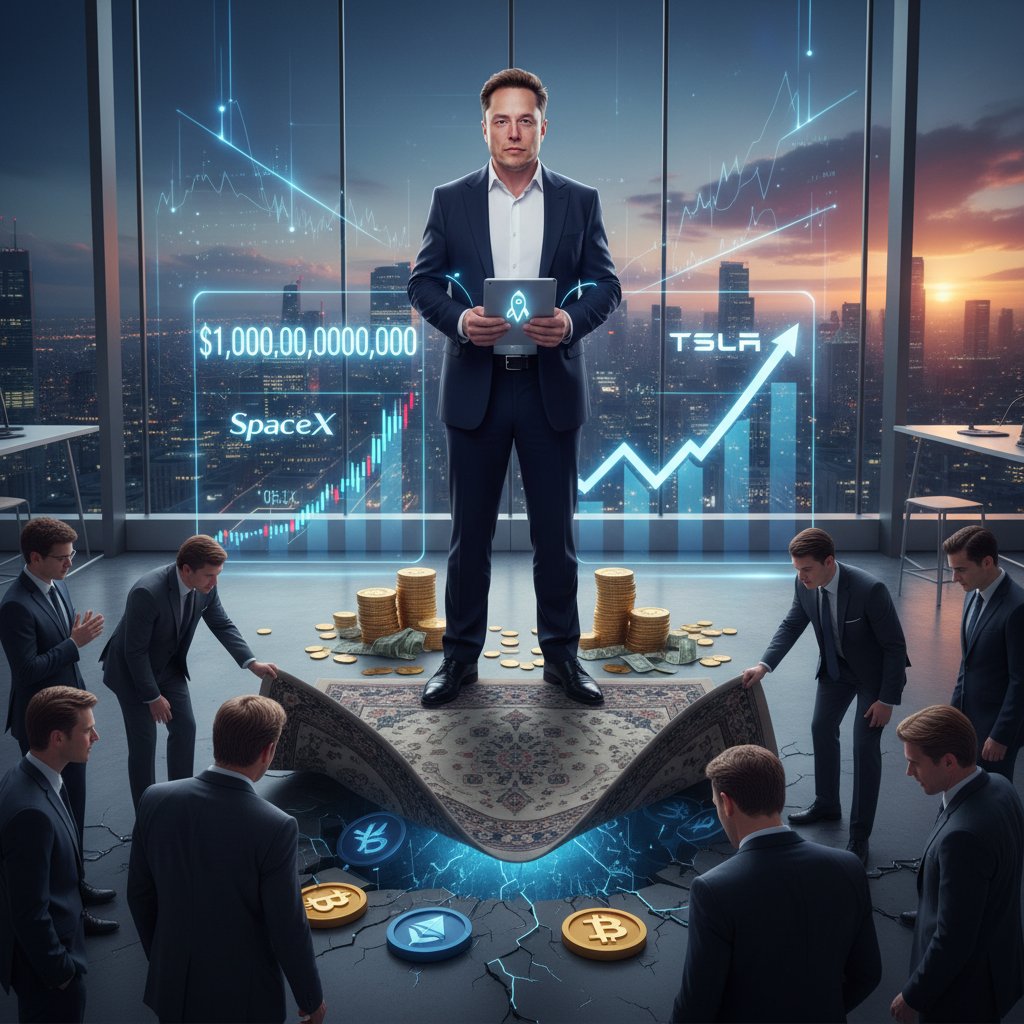
When Elon Musk officially crosses the trillion-dollar net worth mark today-driven by SpaceX’s latest valuation and Tesla’s stock surge-the celebration will be confined to a very small room. For millions who poured their savings into cryptocurrencies over the past decade, the milestone arrives as a bitter reminder of a promise that never materialized. The wealth that was supposed to democratize finance has instead concentrated at the top, leaving a generation holding digital bags.
It’s not just about Musk. The Forbes Billionaires list, updated this morning, shows zero crypto natives in the top 100. Not a single founder from Bitcoin, Ethereum, or any blockchain project cracks the elite tier. Meanwhile, a man who builds cars and rockets is about to become the first human to hold a twelve-figure fortune. The contrast is jarring, and for many in the crypto community, it feels like the ultimate rug pull-not by a single scammer, but by an entire system.
The Trillionaire Threshold
Elon Musk’s ascent to trillionaire status is not a sudden event but the culmination of years of aggressive growth at two of the most valuable private and public companies in history. SpaceX, which he founded in 2002, is now valued at roughly $210 billion following a secondary share sale in December 2024. Tesla, where Musk holds about 13% of the stock, has seen its market cap hover around $1.2 trillion. Combined with his stakes in X (formerly Twitter), Neuralink, and The Boring Company, financial analysts at Bloomberg estimate his net worth crossed $1.003 trillion at 9:47 AM Eastern Time today.
“This is a milestone that reflects the structural advantages of owning hard assets in a world of fiat money printing,” says Dr. Amanda Torres, a professor of financial history at the London School of Economics. “Musk didn’t get here by trading tokens. He built physical products that governments need and consumers want. That’s a very old-fashioned kind of wealth creation.”
The timing is notable. Musk’s fortune has grown by roughly $400 billion in the last 18 months, fueled by the AI boom that boosted Tesla’s autonomous driving ambitions and SpaceX’s Starlink dominance. Meanwhile, the total crypto market cap has stagnated around $1.7 trillion-barely 70% above its 2021 peak when adjusted for inflation. The gap between the two narratives has never been wider.
The Crypto Contradiction
In 2021, when Bitcoin hit $69,000 and NFT mania peaked, the rhetoric was that crypto would “democratize wealth” and create new billionaires outside the traditional system. Today, the Forbes list tells a different story. The top 100 billionaires include familiar names like Bernard Arnault, Jeff Bezos, and Mark Zuckerberg-all tied to consumer goods, technology, or luxury. The closest crypto-adjacent figure is Changpeng Zhao, founder of Binance, who ranks at #147 with an estimated net worth of $33 billion, down from $95 billion in 2022 after legal battles and market declines.
“The notion that crypto would create a new class of billionaires was always a marketing gimmick,” says James Hollister, a portfolio manager at Apex Capital in New York. “In reality, the early adopters who got rich mostly converted their crypto into traditional assets-real estate, stocks, bonds. The wealth didn’t stay in the ecosystem. It flowed back into the same old system that crypto was supposed to replace.”
Hollister points to the rise of stablecoins and exchange-traded funds as evidence that crypto has become a satellite of traditional finance, not an alternative. “The generation that bought into crypto as a rebellion against central banks is now holding assets that are heavily correlated with the Nasdaq. That’s not a revolution. That’s a hedge fund.”
For the average retail investor who bought Bitcoin at $60,000 in late 2021, the current price of $68,000 represents a nominal gain but a real loss after inflation and transaction fees. Worse, many altcoins have collapsed 80-90% from their peaks. The dream of early retirement via Dogecoin or Solana has faded into a nightmare of unrealized losses.
A Generation’s Empty Promise
The phrase “generational rug pull” has been circulating on social media since Musk’s trillionaire announcement leaked yesterday. It captures a specific betrayal: a generation that was told to “get in early” on a new asset class that would level the playing field, only to watch the biggest winner be a man who never needed crypto in the first place. Musk himself has oscillated between championing Dogecoin and dismissing Bitcoin’s environmental impact, adding to the whiplash.
But the rug pull isn’t just about Musk. It’s about the structural failure of crypto to deliver on its egalitarian promises. According to a 2024 study by the Federal Reserve Bank of St. Louis, the top 0.1% of Bitcoin addresses control 27% of all coins in circulation. The distribution is far more concentrated than in traditional stock markets. Decentralization, in practice, has meant a few whales holding the keys while millions of small holders gamble on volatility.
“The irony is that crypto was supposed to be the antidote to the kind of wealth concentration Musk represents,” says Dr. Torres. “Instead, it has created its own oligarchy, and now that oligarchy is being overshadowed by a much older one. The generation that bought into crypto is discovering that the game was rigged from the start-not by banks, but by human nature.”
The psychological impact is measurable. A survey by the Financial Health Network in January 2025 found that 62% of crypto investors aged 25-40 reported feeling “anxious” or “regretful” about their holdings, compared to 34% of traditional stock investors in the same age bracket. The volatility has taken a toll not just on portfolios but on mental health, as the promise of financial freedom morphs into a trap of constant monitoring and fear of missing out.
What It Means for You
For the average reader in the US, UK, or Canada, the Musk trillionaire milestone is more than a headline. It’s a signal about where real economic power lies. The wealth generated by SpaceX and Tesla is tied to tangible innovation-reusable rockets, electric vehicles, satellite internet. These are industries that create jobs, pay taxes, and require regulatory approval. Crypto, by contrast, remains largely speculative, with limited real-world utility beyond trading and illicit finance.
That doesn’t mean crypto is worthless. Bitcoin continues to function as a digital gold for some, and blockchain technology has genuine applications in supply chain and identity verification. But the narrative that crypto would make everyone rich is dead. The generation that bought in hoping for a shortcut to wealth is now facing a long, cold reality: the road to a trillion dollars runs through factories and launch pads, not wallets and exchanges.
Looking ahead, the wealth gap between traditional asset holders and crypto speculators is likely to widen. Central banks are exploring digital currencies, which could further marginalize decentralized coins. Regulatory crackdowns in the US and Europe are tightening, and institutional investors are pulling back. Musk’s trillionaire moment may be the final chapter in a story that began with Satoshi Nakamoto’s white paper-a tale of a revolution that, in the end, only reinforced the status quo.
As for the next generation of wealth builders, the lesson is clear: if you want to be a trillionaire, build something the world needs. If you want to gamble, buy a lottery ticket. Crypto, for all its hype, has proven to be neither.