







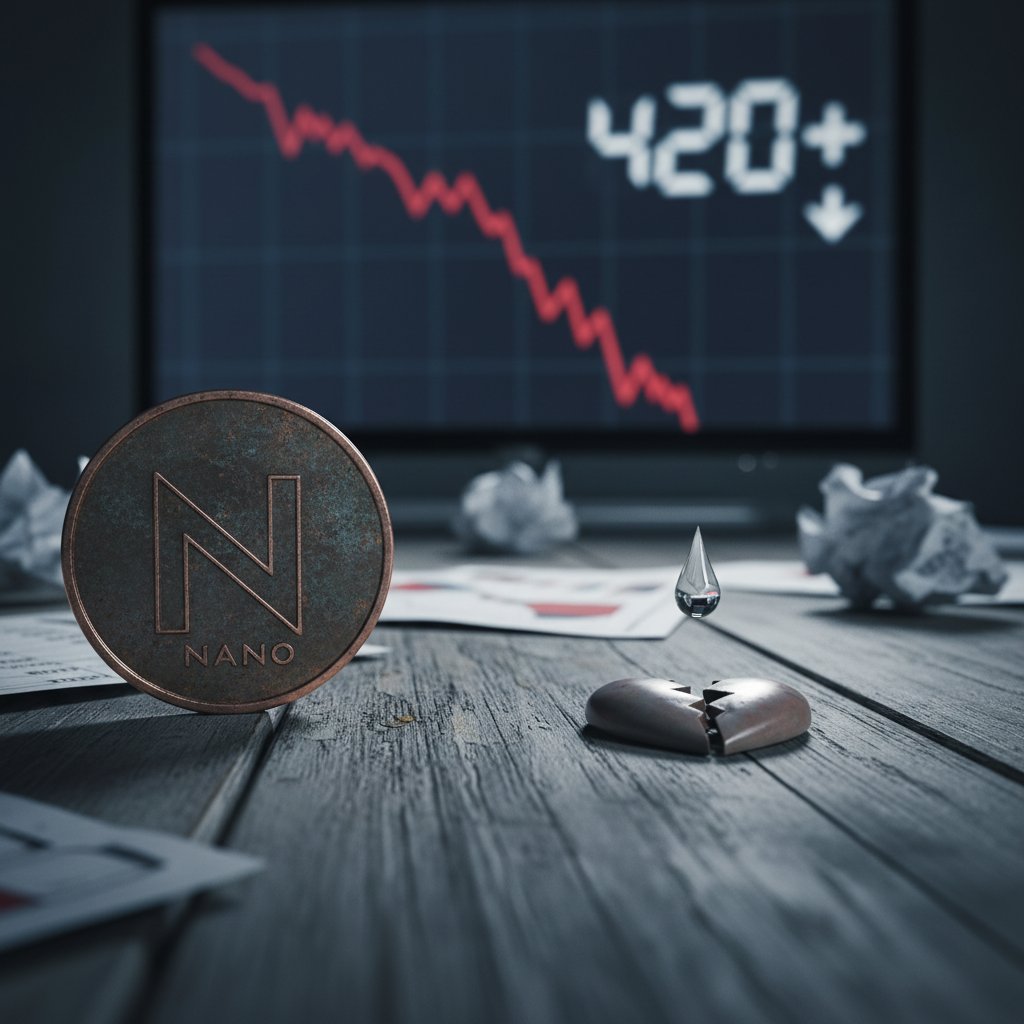
How does a cryptocurrency that once commanded a top-20 spot and a passionate Reddit army now find itself languishing outside the top 420? That’s the question haunting Nano (XNO) holders as the token’s market cap falls to roughly $45 million-a staggering 97% decline from its all-time high of $33.69 in January 2018.
Once celebrated as the “feeless, instant” payment coin, Nano now ranks at 422nd on CoinMarketCap as of this week. For context, that places it behind obscure tokens like Pundi X and Mango. The fall from grace is not just a price story; it’s a cautionary tale about hype, technological promise, and the unforgiving nature of crypto markets.
From Reddit Hero to Market Afterthought
In late 2017, Nano (then called RaiBlocks) was the darling of r/CryptoCurrency. Its block-lattice architecture promised zero transaction fees and near-instant confirmations-a direct challenge to Bitcoin and Ethereum. The community was fervent. Memes flooded forums. Subreddit subscribers grew by the thousands. By January 2018, Nano hit its peak market cap of over $5.5 billion.
But the crypto winter of 2018-2019 hit hard. Nano’s price collapsed, and while Bitcoin eventually recovered, Nano never did. The project survived a major exchange delisting from Binance in 2019 and a series of network attacks in 2021 that slowed transactions. “Nano’s technology is elegant, but its governance and marketing have been almost non-existent,” explains Dr. Sarah Lin, a blockchain researcher at the University of Cambridge. “Without continuous development or a strong narrative, it’s easy for investors to move on.”
The Reddit hype cycle, it turns out, is fleeting. Once the community moved to newer projects like Solana and Avalanche, Nano was left behind.
The Numbers Tell a Grim Story
Let’s break down the data. Nano’s current price hovers around $0.30, down from its all-time high. Its trading volume is a mere $2 million per day-a fraction of what it once was. Compare that to Dogecoin, another meme-adjacent coin, which still sees over $500 million in daily volume. Nano’s developer activity on GitHub has slowed significantly, with only a handful of commits in the last quarter.
“The user base has shrunk dramatically,” says Mark Thompson, a crypto analyst at CoinMetrics. “Nano was designed as a pure currency, but it never achieved network effects. Adoption is nil. Merchants that once accepted it have dropped it. Without use cases, the token becomes a zombie.”
The project’s treasury, once flush with funds from the original distribution, is reportedly running low. The Nano Foundation has laid off staff and reduced its marketing budget. The subreddit r/nanocurrency, which peaked at 200,000 subscribers, now sees fewer than 50 active users at any given time.
What This Means for Crypto Investors
For the average investor, Nano’s decline is a harsh lesson in the importance of fundamentals over hype. “Just because a coin has great tech doesn’t mean it will succeed,” warns Thompson. “You need a strong team, continuous development, and real-world adoption. Nano had the first, but not the last two.”
The broader market has moved on to smart contract platforms, decentralized finance, and layer-2 solutions. Nano’s singular focus on peer-to-peer payments, while noble, has left it in a niche that is increasingly crowded by stablecoins and central bank digital currencies. Even the “feeless” advantage is being challenged by newer chains like Solana and Fantom, which offer low fees and programmability.
For those still holding Nano, the outlook is bleak. Liquidity is thin, and a recovery seems unlikely without a major catalyst. “I’d advise investors to assess their opportunity cost,” says Dr. Lin. “Holding a token that’s outside the top 400 is a speculative bet, not an investment.”
The Road Ahead: Can Nano Bounce Back?
Is there any hope? Some die-hard fans point to the upcoming V27 protocol upgrade, which promises improved spam resistance and faster sync times. The Nano Foundation is also exploring partnerships with point-of-sale systems in developing countries. But these efforts are small compared to the marketing blitz of competitors.
“Nano could still find a niche in microtransactions or remittances,” says Thompson. “But it needs a miracle-or a major exchange relisting-to regain relevance.”
For now, the story of Nano is a sobering reminder that in crypto, what goes up can come down-and keep coming down. The Reddit darling that once stood among the top 20 now sits in the crypto graveyard, waiting for a second act that may never come.
“Nano’s technology is elegant, but its governance and marketing have been almost non-existent. Without continuous development or a strong narrative, it’s easy for investors to move on.”, Dr. Sarah Lin, blockchain researcher, University of Cambridge
“The user base has shrunk dramatically. Nano was designed as a pure currency, but it never achieved network effects. Adoption is nil.”, Mark Thompson, crypto analyst, CoinMetrics