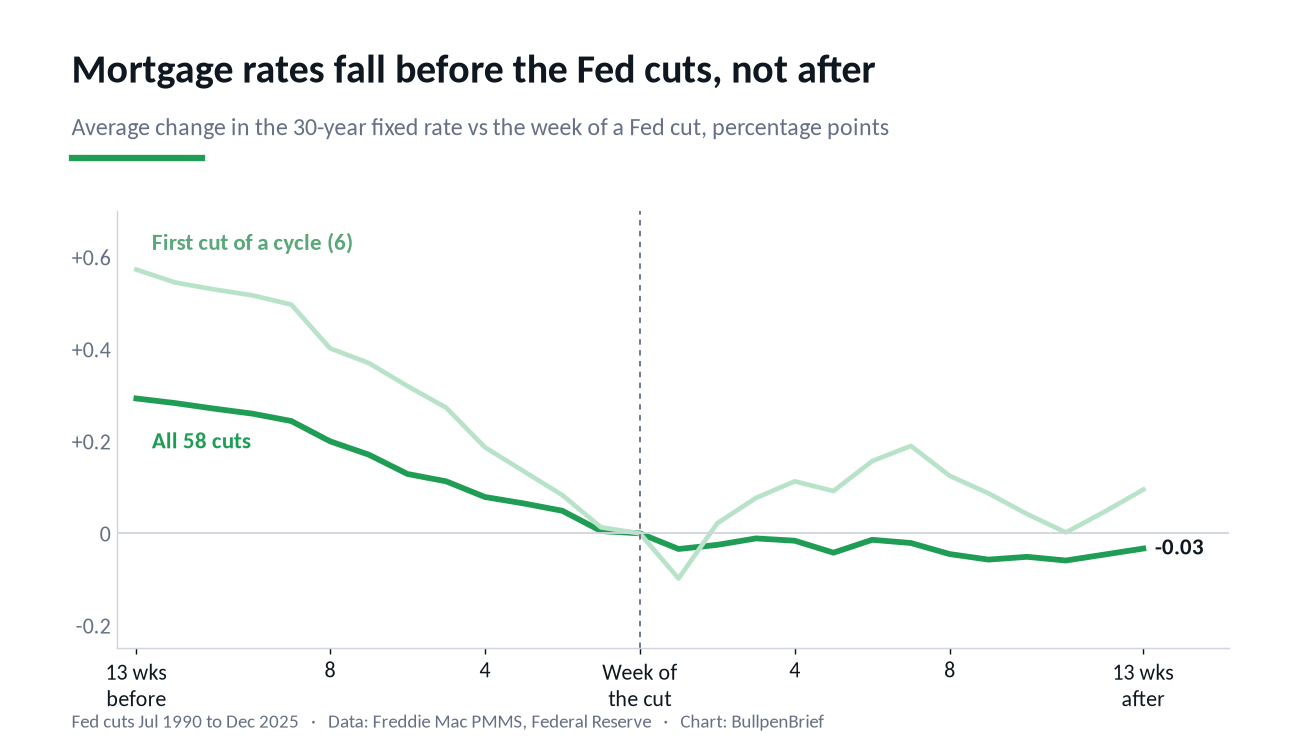



If you’ve been waiting for mortgage rates to tumble after the Federal Reserve started cutting interest rates, you’re probably frustrated. And you’re not alone. The Fed has lowered its benchmark rate by a full percentage point since September, but the average 30-year fixed mortgage rate has actually risen during that same stretch. It’s sitting near 7% again, according to Freddie Mac. That feels backwards. It’s the kind of math that makes you wonder if the whole system is rigged.
It’s not rigged, exactly. But it is complicated. And the short version is this: the Fed doesn’t directly control mortgage rates. It controls a very short-term rate that banks charge each other overnight. Mortgage rates, on the other hand, are tied to the 10-year Treasury yield, which is driven by a different set of forces. Think of the Fed as the driver of a car, and mortgage rates as the temperature inside the car. The driver can turn the steering wheel, but the AC has its own thermostat. And right now, that thermostat is stuck on warm.
The Fed vs. the Bond Market: A Tale of Two Rates
The disconnect between Fed policy and mortgage rates is one of the most misunderstood concepts in personal finance. The Federal Reserve sets the federal funds rate, which is what banks charge each other for overnight loans. That rate influences everything from credit card APRs to auto loans. But home loans are different. Most mortgages are packaged into bonds and sold to investors, and those investors demand a yield that compensates them for inflation, prepayment risk, and the possibility that the economy will stay strong.
That yield is the 10-year Treasury note, which acts as a benchmark. When investors expect higher inflation or stronger growth, they sell Treasuries, pushing yields up. And mortgage rates follow. So even if the Fed is cutting, mortgage rates can rise if the bond market is betting that inflation will stick around. That’s exactly what’s happening now. The economy has been surprisingly resilient. Job growth is still solid. Consumer spending hasn’t collapsed. And inflation, while down from its peak, is still running above the Fed’s 2% target. The bond market is pricing in a “higher for longer” scenario, and mortgage rates are reflecting that.
Recent economic data, such as the ISM Manufacturing report, has shown that the factory sector is still struggling, which normally would push rates down. But the services side of the economy remains hot, and that’s keeping the bond market on edge. The result is a tug-of-war between Fed cuts and market expectations. Right now, the market is winning.
What This Means for Your Monthly Payment
Let’s get concrete. A 30-year fixed mortgage at 7% on a $400,000 loan means a monthly payment of about $2,661 for principal and interest. At 6%, that same loan costs $2,398 a month. That’s a difference of $263 every month, or more than $3,100 a year. For a family stretching to buy a home, that’s real money. It’s the difference between affording the house and renting for another year.
And it’s not just buyers who feel the pinch. Homeowners who bought or refinanced during the pandemic at 3% or 4% have no incentive to sell. They’re locked into their low rates. That’s kept inventory tight, which in turn has kept home prices elevated. The typical home price is still near all-time highs, even with rates this high. So you’ve got a double whammy: high prices and high rates. The only thing that’s lower is affordability. It’s at a four-decade low.
Look, if you’re a first-time buyer, the math is brutal. But the alternative, waiting for rates to drop, carries its own risks. If rates fall, demand could surge, pushing prices even higher. You might end up paying more for the house even though the rate is lower. That’s the housing market’s version of a no-win scenario.
Why Refinancing Still Doesn’t Make Sense for Many
If you’re already a homeowner, you might be wondering if you should refinance. The rule of thumb is that refinancing makes sense when you can lower your rate by at least 1 percentage point. With current rates above 7%, that means you’d need a rate of 6% or lower to justify the closing costs. Unless you bought or refinanced in the last year, your rate is probably below 6% already. So for most homeowners, refinancing is a non-starter. The only people who might benefit are those who bought at the peak of the market in 2023, when rates touched 8%. For them, a 7% rate could be a savings opportunity. But even then, the closing costs and fees can eat into the benefit.
There’s also a psychological factor. Rates went from 3% to 7% in two years. That kind of shock makes people reluctant to lock in anything above 5%. They’d rather wait for a bigger drop. But waiting costs money every month. It’s a tough call.
What Happens Next: A Forward Look
So where do we go from here? The bond market is currently pricing in another Fed cut or two in 2025, but that could change quickly. If inflation reaccelerates, the Fed might pause or even reverse course. If the economy slides into a recession, rates could fall sharply. The wild card is the fiscal situation. The federal deficit is huge, and the government is issuing a lot of debt. That puts upward pressure on Treasury yields, which means mortgage rates are unlikely to plunge back to 3% anytime soon. The more realistic scenario is that rates settle in the 5.5% to 6.5% range over the next couple of years, still high by pandemic standards, but historically normal.
For buyers, the best advice is to focus on what you can control: your credit score, your down payment, and your budget. Don’t try to time the market. If you find a house you can afford at today’s rates, buy it. If rates drop later, you can refinance. If they don’t, you’re still in the game. The worst thing you can do is sit on the sidelines waiting for a perfect moment that may never come.
Frequently Asked Questions
Why don’t mortgage rates fall when the Fed cuts rates?
Mortgage rates are tied to the 10-year Treasury yield, not the federal funds rate. The Fed’s rate cuts affect short-term borrowing, but long-term rates are driven by inflation expectations, economic growth, and investor demand for bonds. If the bond market expects inflation to persist, yields can rise even as the Fed cuts, pushing mortgage rates higher.
Will mortgage rates ever go back to 3%?
It’s unlikely in the near future. The 3% rates of 2020-2021 were a historic anomaly caused by the pandemic and massive Fed bond-buying. For rates to return to that level, the economy would need to enter a deep recession with deflationary pressures, or the Fed would need to restart quantitative easing. Neither is on the horizon. A more realistic range is 5% to 6.5% over the next few years.
Should I buy a house now or wait for rates to drop?
If you find a home that fits your budget at current rates, buying now is a reasonable move. Waiting for rates to drop carries risk: if rates fall, home prices could rise as demand picks up, and you might end up with a similar monthly payment. Also, there’s no guarantee rates will fall significantly. The best strategy is to buy when you’re ready financially, not when the market seems perfect.