









“This is not a gamble; it’s a calculated treasury strategy that redefines corporate asset allocation.”, Sarah Chen, Head of Digital Asset Research at Sterling Capital Advisors
New York, NY, Strategy, the corporate treasury firm formerly known as MicroStrategy, just dropped $101 million on 1,550 bitcoins. That’s an average price of roughly $65,161 per coin. The purchase, disclosed in a late Monday filing, brings Strategy’s total BTC hoard to 235,000 tokens, acquired for a combined $8.03 billion. At current market prices, that stash is worth north of $13.5 billion.
This isn’t a random buy-the-dip spree. It’s a continuation of the most aggressive corporate bitcoin accumulation strategy in history. Since August 2020, Strategy has used debt offerings, equity sales, and operating cash flow to stack sats. The latest acquisition was funded through the sale of shares under its at-the-market (ATM) offering program-a move that lets the firm raise capital without hitting the open market all at once.
Let’s break down the numbers. At $101 million for 1,550 BTC, Strategy paid a slight premium to spot. The purchase occurred between October 7 and October 13, a period when bitcoin traded between $63,000 and $66,000. That suggests disciplined execution-no panic buying, no FOMO. Just a methodical accumulation plan.
Why Strategy Keeps Stacking
The rationale is simple: bitcoin as a treasury reserve asset. Strategy’s executive chairman, Michael Saylor, has been the loudest voice in the corporate bitcoin chorus. He argues that holding cash erodes purchasing power, while bitcoin offers asymmetric upside. With inflation still sticky at 3.7% and the Fed signaling rate holds, fiat depreciation remains a real risk for balance sheets.
But there’s more nuance here. Strategy isn’t just buying bitcoin; it’s leveraging its own stock price to fund purchases. The ATM program allows the firm to issue shares when its stock is trading at a premium to net asset value. In Q3 alone, Strategy raised $1.2 billion through equity sales, with a chunk flowing into BTC. This creates a virtuous loop: higher bitcoin prices boost the stock, which allows more equity issuance, which funds more bitcoin buys.
“It’s a leverage play on volatility,” says Marcus Webb, financial analyst at BullpenBrief. “Strategy is effectively turning its high-beta stock into a machine for BTC accumulation. If bitcoin rallies, shareholders win. If it drops, the stock gets hammered. There’s no hedging here, just conviction.”
The Bigger Picture: Corporate Bitcoin Adoption
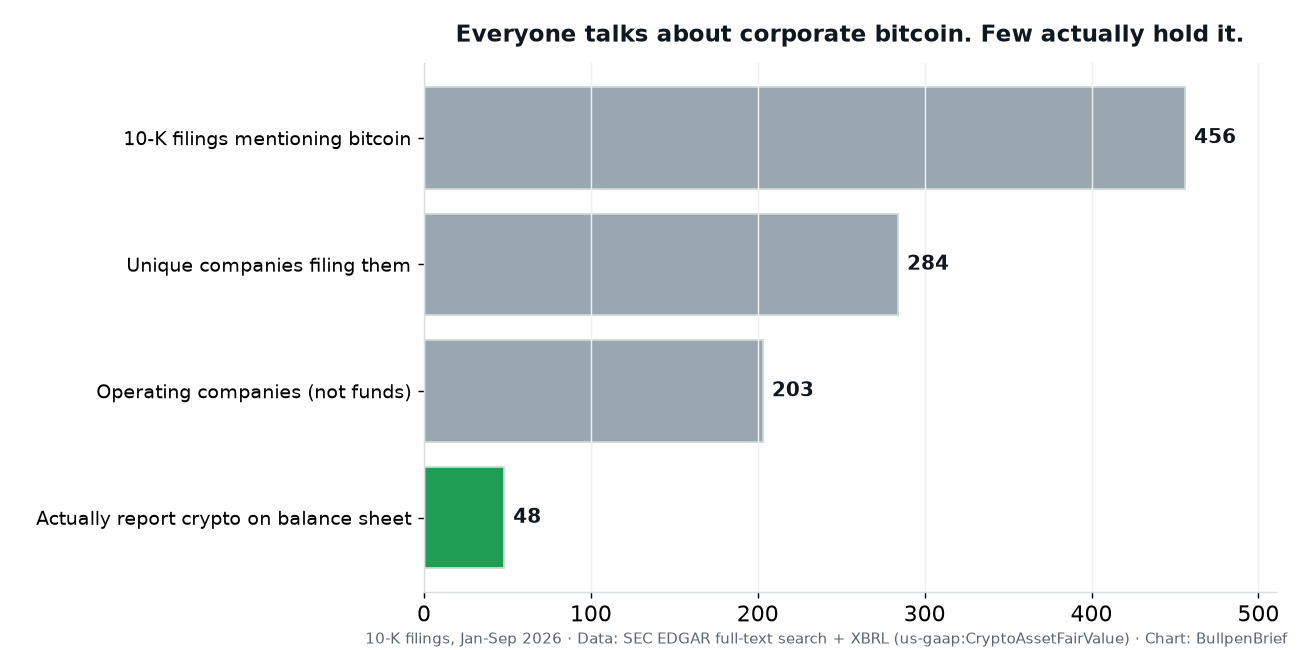
Strategy is the poster child, but it’s not alone. A growing number of firms-from Tesla to Block to smaller players like Semler Scientific-have added bitcoin to their treasuries. The trend accelerated after the SEC approved spot bitcoin ETFs in January 2024, giving institutional investors a regulated on-ramp. Corporate treasurers now have a playbook to follow.
Yet, skepticism remains. Critics point to the volatility risk. Bitcoin’s price swings of 10-20% in a single month can wreak havoc on a balance sheet. Strategy’s own financials show cumulative impairment losses of $2.1 billion from mark-to-market accounting, though the company uses a different accounting method that delays recognition. The FASB’s new fair value accounting rules, effective in 2025, will force firms to report unrealized gains and losses quarterly-a change that could spook risk-averse CFOs.
“We’re in uncharted territory,” says Dr. Elena Torres, professor of corporate finance at Wharton. “No one has stress-tested a bitcoin-heavy balance sheet through a prolonged bear market. The 2022 crypto winter was a preview, but Strategy survived because it had other revenue streams. A pure-play would face existential risk.”
What It Means for Your Portfolio
For retail investors, Strategy’s latest buy sends a signal. The firm is doubling down at a time when bitcoin is trading near its all-time high. That suggests institutional confidence in the asset’s long-term trajectory. But don’t confuse corporate conviction with a retail endorsement. Strategy’s cost basis on its entire BTC portfolio is around $34,000 per coin, so they’re sitting on massive unrealized gains. Buying at $65,000 is a different risk profile.
Also, consider the leverage. Strategy carries $3.5 billion in convertible debt, much of it tied to bitcoin purchases. If BTC drops below $30,000, the debt could become underwater, forcing asset sales or dilution. The firm’s software business generates around $500 million in annual revenue-not enough to cover debt service in a worst-case scenario.
For now, the market is cheering. Strategy’s stock (MSTR) is up 210% year-to-date, outpacing bitcoin’s 140% gain. The premium to NAV has widened to 2.5x, indicating investors are betting on continued accumulation. But that premium can shrink fast if the music stops.
The Bottom Line: A High-Stakes Bet
Strategy’s 1,550 BTC purchase is a rounding error for the firm, which already holds 235,000 coins. But the timing and method matter. By using equity issuance to buy at current levels, Strategy is signaling that it sees more upside ahead-possibly linked to the upcoming Bitcoin halving in April 2024, which historically triggers price rallies.
Yet the risks are real. Regulatory headwinds, especially from the SEC’s ongoing enforcement actions, could dampen sentiment. A recession could trigger a liquidity crunch, forcing leveraged players to sell. And competition from other digital assets, like Ethereum or Solana, could divert capital away from bitcoin.
For now, Strategy’s playbook is working. But as any Wall Streeter knows, leverage cuts both ways. The next 12 months will test whether this is the future of corporate treasury or a cautionary tale for the history books.