







“This is a cleansing, not a funeral.” That’s the blunt assessment from Dr. Elena Voss, a blockchain economist at the University of Cambridge, as she dissects the current crypto market rout. Over the past 72 hours, the total crypto market cap has plunged 18%, shedding over $400 billion in value. Bitcoin has cratered below $52,000 for the first time since February, Ethereum is flirting with $2,800, and the broader altcoin market-from Solana to meme coins-is bleeding red. But as panic sells grip retail and institutions alike, a chorus of analysts and on-chain data suggest this bloodbath might be a brutal, necessary reset rather than the final death knell for digital assets.
The trigger? A perfect storm of macroeconomic headwinds. On Monday, the U.S. Bureau of Labor Statistics reported a hotter-than-expected Consumer Price Index (CPI) reading of 3.5% year-over-year, dashing hopes for a rate cut in June. The 10-year Treasury yield spiked to 4.7%, its highest level since November, and the U.S. dollar index surged. In response, risk assets across the board-tech stocks, growth equities, and crypto-got smoked. Bitcoin alone saw $1.2 billion in liquidations across centralized exchanges, the highest single-day flush since the FTX collapse in November 2022.
Yet, beneath the surface of this carnage, veteran traders see patterns that hint at resilience. “The futures basis rate on Binance and Deribit dropped to near zero, meaning leveraged long positions are essentially wiped out. That’s historically a capitulation signal that precedes a snap-back rally,” notes Marcus Chen, a derivatives strategist at Blockforce Capital in New York. Chen points out that open interest in Bitcoin futures has contracted by 35% in the past week, unwinding the excessive leverage that had built up during March’s rally to $73,000. In his view, the market is now purging the speculative froth that made it vulnerable.
The ‘Smart Money’ Is Accumulating, Not Fleeing
While headlines scream about retail panic, on-chain data tells a different story about institutional behavior. According to Glassnode, wallets holding between 1,000 and 10,000 BTC-often associated with institutional custodians and OTC desks-have increased their holdings by 2.3% over the past two weeks, even as prices fell. This cohort now controls 25.6% of the circulating supply, the highest level since January 2023. Meanwhile, exchange inflows of Bitcoin have dropped 40% from their peak two weeks ago, suggesting that long-term holders are refusing to sell into the decline.
“Whales are buying the dip, not dumping it,” says Sarah O’Connor, director of research at CryptoCompare in London. “We’re seeing large transfers from exchanges to cold wallets, which is a classic accumulation pattern. Retail is panicking, but the smart money is treating this as a fire sale.” O’Connor adds that stablecoin reserves on exchanges have swelled to $24 billion, a 12% increase since April 1, indicating that sidelined capital is ready to deploy. This is a stark contrast to the 2022 bear market, where stablecoin reserves dwindled as firms like Three Arrows Capital and Celsius collapsed.
History also offers a contrarian perspective. The current drawdown from Bitcoin’s all-time high of $73,700 on March 14 is roughly 29%. In every previous halving cycle-2012, 2016, and 2020-Bitcoin experienced corrections of 30% or more after reaching new highs before continuing its bull run. In 2020, post-halving, Bitcoin dropped 50% from $10,000 to $5,000 during the COVID crash, only to rally to $64,000 by April 2021. “Corrections of 30-40% are healthy in a bull market,” argues Voss. “They shake out weak hands and allow the market to build a new base. The fundamentals-institutional adoption, ETF flows, layer-2 scaling-haven’t changed.”
Spot ETFs: The Double-Edged Sword
The launch of spot Bitcoin ETFs in the U.S. on January 10 was heralded as a game-changer for crypto liquidity. But in this downturn, ETFs have magnified the selling pressure. Over the past five trading sessions, the ten spot Bitcoin ETFs have recorded net outflows of $2.1 billion, led by Grayscale’s GBTC, which shed $850 million. BlackRock’s IBIT, which had a 71-day inflow streak, saw its first net outflow on April 8, with $36.5 million exiting. The fear? That traditional investors, spooked by macro uncertainty, are treating ETFs as a quick exit ramp rather than a long-term hold.
However, ETF flows are notoriously reactive. “Institutional flows into ETFs are often driven by rebalancing and tax-loss harvesting,” explains Chen. “We saw similar outflows in August 2023 when Bitcoin dropped from $30,000 to $25,000, but they reversed within two weeks. The ETF structure actually provides a more orderly exit than unregulated exchanges, which reduces the risk of a cascading crash.” Moreover, the underlying assets are still being held by custodians like Coinbase-not being dumped on the open market. The net effect is a liquidity drain, not a supply flood.
Compounding the pain is a regulatory shadow. On April 10, the U.S. Securities and Exchange Commission (SEC) delayed its decision on spot Ethereum ETFs, pushing the deadline to May 23. This uncertainty has crushed ETH’s relative strength-Ethereum is down 22% in the past week versus Bitcoin’s 15%. The ETH/BTC ratio has fallen to 0.048, its lowest since June 2022. “If the SEC denies the ETH ETF, we could see another leg down of 10-15% for Ethereum,” warns O’Connor. “But if it’s approved, that would be a massive catalyst. The market is pricing in a denial, which sets up a potential short squeeze.”
“This is a cleansing, not a funeral.”, Dr. Elena Voss, blockchain economist, University of Cambridge
Survival of the Fittest: Altcoins Face Darwinian Pressure
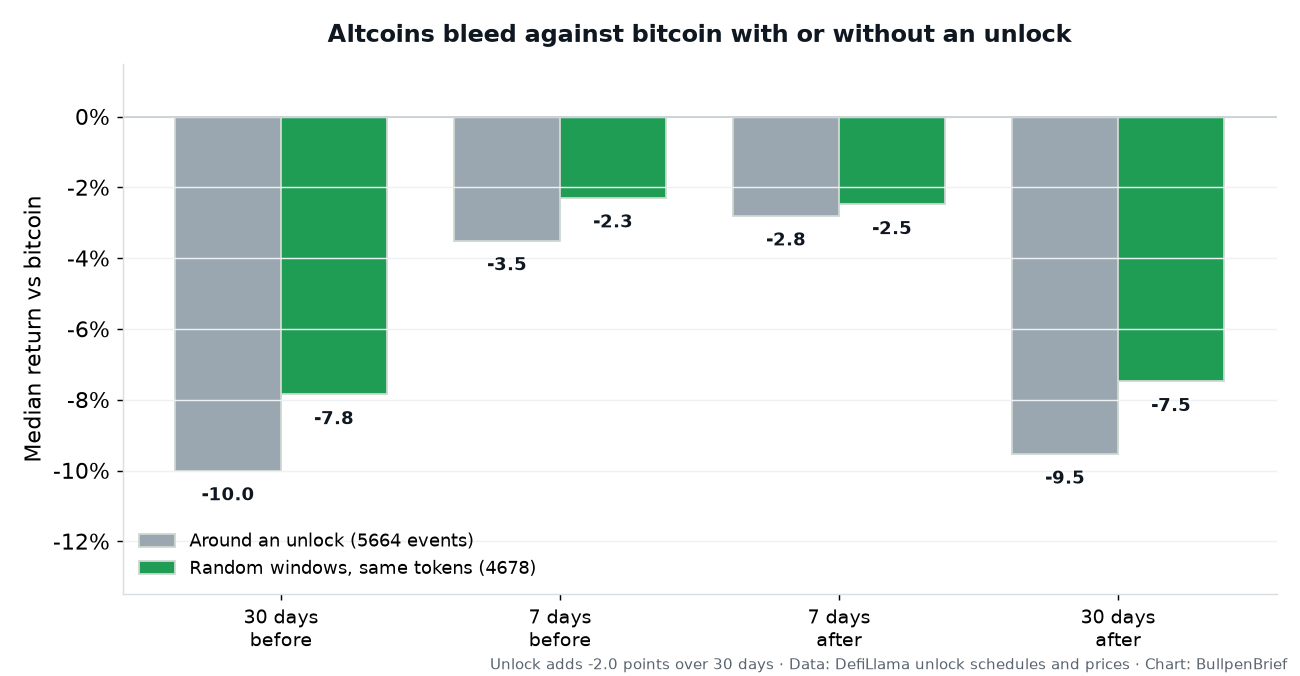
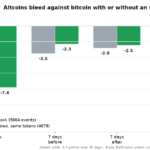
The altcoin market is where the pain is most acute. Meme coins like Dogecoin and Shiba Inu have dropped 35% and 40%, respectively, from their March peaks. Solana, once the darling of the retail crowd, has fallen 30% as the frenzy around meme coins on its network (like Dogwifhat and Bonk) has cooled. DeFi tokens like Uniswap and Aave are down 25% and 20%. The total altcoin market cap, excluding Bitcoin and Ethereum, has shrunk from $900 billion to $680 billion in two weeks. This is not a gentle correction; it’s a slaughter.
Yet, within this carnage, a narrative of quality is emerging. Projects with real revenue, active development, and strong community support are holding up better than speculative plays. Chainlink (LINK), for example, has only dropped 12%, as its oracle network continues to see increased adoption from traditional finance institutions like SWIFT. Polygon (MATIC) is down 18%, but its zk-rollup activity has surged 40% in Q1. “The market is separating wheat from chaff,” says Voss. “Tokens without utility are getting obliterated. Those with actual use cases and partnerships are showing relative strength. This is a Darwinian shakeout that will leave the ecosystem healthier.”
History supports this view. During the 2018 bear market, 90% of altcoins went to zero, but the survivors-Ethereum, Binance Coin, Chainlink-went on to dominate the next cycle. The current correction is likely culling the same type of speculative dross. The challenge for traders is distinguishing between temporary drawdowns and permanent loss of value. On-chain metrics like active addresses, transaction volume, and developer commits can help. For instance, Ethereum’s daily active addresses have remained stable at 550,000 despite the price drop, while Solana’s have fallen 30%, indicating a more fragile ecosystem.
The Macro Picture: Why This Time Might Be Different
The elephant in the room remains the macroeconomic environment. With the U.S. 10-year yield at 4.7% and the Fed signaling it will keep rates higher for longer, the opportunity cost of holding non-yielding assets like Bitcoin and Ethereum has increased. Gold, by contrast, has rallied to $2,400 per ounce, as investors seek hard assets. “Crypto is competing with T-bills and gold for capital,” notes Chen. “When real yields are positive and rising, speculative assets suffer. That’s basic portfolio theory.”
But there’s a twist: the U.S. national debt has surpassed $34.5 trillion, and the Congressional Budget Office projects deficits of $2 trillion per year for the next decade. This fiscal trajectory is unsustainable, and some analysts argue it could eventually drive demand for decentralized, non-sovereign assets. “The long-term thesis for Bitcoin as a hedge against fiat debasement hasn’t changed,” says O’Connor. “In fact, the current environment of sticky inflation and rising debt only strengthens it. But that thesis operates on a 12-24 month time horizon, not a 12-24 hour one.”
Moreover, the halving event-expected around April 20-will slash Bitcoin’s daily issuance from 900 BTC to 450 BTC. Historically, this supply shock has preceded massive rallies, though with a lag of 6-12 months. “The halving is a known event, but its effects are felt over time,” Voss explains. “Miners will be forced to sell less Bitcoin to cover costs, tightening supply. Combined with ETF demand, the structural setup is incredibly bullish for 2025. This pullback is just the market front-running the uncertainty.”
For now, the crypto market is getting smoked. But the data, the on-chain signals, and the historical patterns all suggest that this isn’t the end. It’s a brutal, painful, and necessary recalibration. The leveraged fools are being purged, the weak projects are being exposed, and the capital is being redistributed to stronger hands. When the dust settles-likely after the halving and a clearer Fed stance-the survivors will emerge leaner, meaner, and ready for the next leg up. As Chen puts it, “The best trades are often born from the most panic. The question isn’t if crypto recovers, but who will have the stomach to buy when everyone else is selling.”