





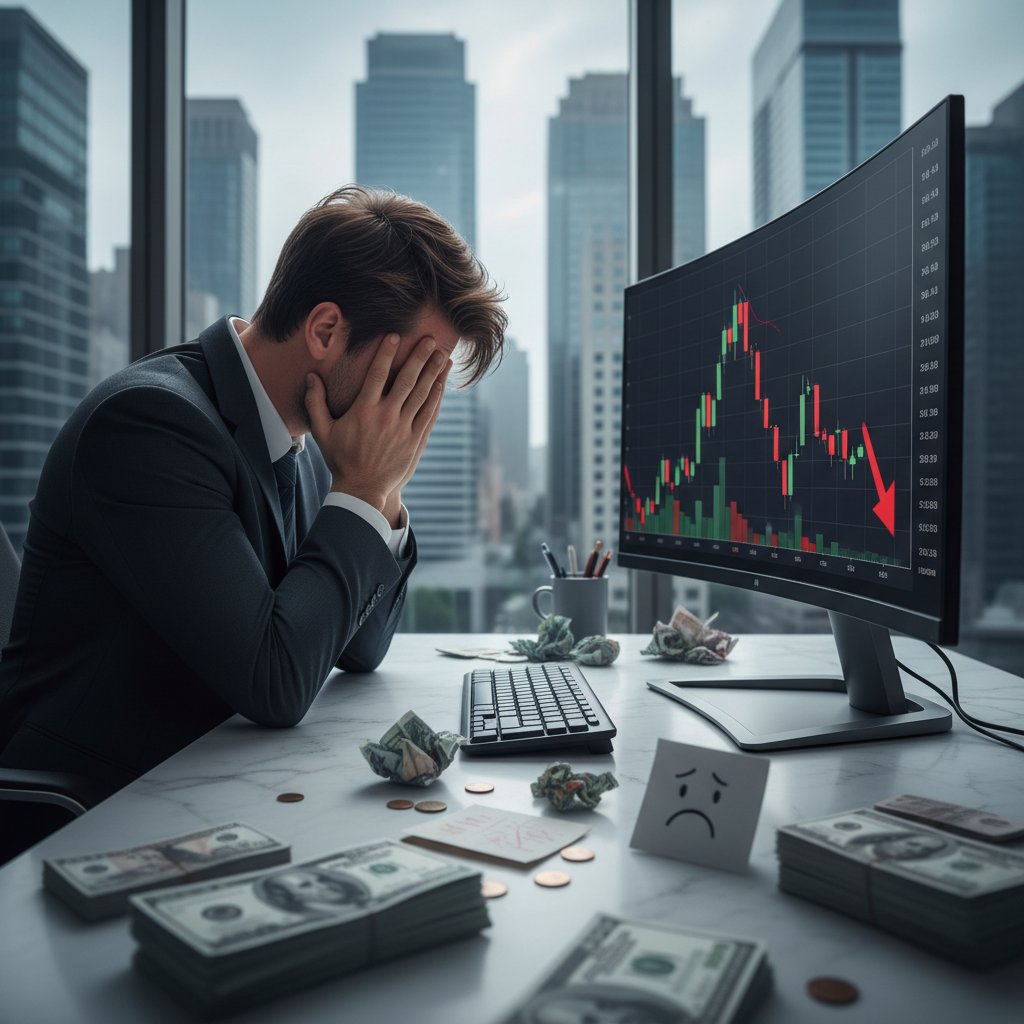
It’s the question every trader asks during a drawdown, muttered through clenched teeth after another red candle: “Am I doing well?” And then, with a furiously typed cry into the void: *cries furiously*. That raw, unfiltered sentiment-posted on social media, echoed in chat rooms, whispered on trading floors-captures the emotional whiplash of a market that refuses to stay calm.
Right now, that question is more than rhetorical. It’s the pulse of a market where retail investors are caught between hope and despair, watching their portfolios swing 2-3% in a single session. The S&P 500 has dropped 8% from its July peak, the VIX has spiked above 22, and the 10-year Treasury yield is flirting with 5%. For the average investor, ‘doing well’ suddenly feels like a foreign concept.
The Emotional Rollercoaster of Volatile Markets
October has historically been a cruel month for stocks, and 2023 is living up to the reputation. The S&P 500 fell 4.5% in the first three weeks alone. The Nasdaq composite is down 6.2%. Small caps? Off nearly 10%. The pain is broad, deep, and personal. Every day brings a new headline-hawkish Fed, geopolitical tensions, earnings misses-and every red day chips away at confidence.
But here’s the reality check: Year-to-date, the S&P 500 is still up 10%. The Dow is up 3%. So the answer to ‘Am I doing well?’ depends on your time horizon. If you panic-sold in September, you’re not doing well. If you held through the summer, you’re still in the green. Yet the visceral cry of *cries furiously* tells you that emotions, not numbers, are running the show.
“The gap between actual portfolio performance and perceived performance is enormous right now,” says Dr. Sarah Klein, a behavioral finance professor at the University of Chicago. “Recency bias is making investors forget the gains of the first half. All they see is the red of the last six weeks.”
That matters because emotionally driven decisions-selling low, chasing the next shiny thing, abandoning a well-laid plan-are the fastest way to underperform. And the data backs it up: DALBAR’s annual study shows the average investor underperforms the S&P 500 by nearly 3% per year, largely due to poor timing driven by panic.
What ‘Doing Well’ Actually Means for Your Portfolio
Let’s get numerical. Suppose you invested $10,000 in the S&P 500 at the start of 2023. As of last Friday, that’s worth about $11,100-a gain of $1,100. But if you bought in at the July peak, you’re down about $800. Two investors, same index, completely different answers to ‘Am I doing well?’ That’s the key: it’s all about your entry point, your time frame, and your strategy.
“Investors need to separate noise from signal,” says Mark Thompson, senior market strategist at Bullpen Capital. “A 2% down day is noise. A 20% drawdown from peak is signal. Right now, we’re in noise territory, but the volume is turned up.” Thompson points to the 20-day moving average of the S&P 500: it’s still above the 200-day, a technical indicator that the long-term trend hasn’t broken. ‘Doing well’ from a structural standpoint means staying invested through the volatility.
But the *cries furiously* crowd isn’t looking at moving averages. They’re watching their Robinhood account in real-time, refreshing at 2:30 PM when the afternoon sell-off hits. The emotional toll is real. A study by the Journal of Financial Planning found that investors who check their portfolios daily report 23% higher anxiety levels than those who check quarterly. Frequency of checking correlates directly with perceived performance-and mostly on the downside.
Expert Advice: How to Assess Performance Without the Panic
So what should you do when the market has you asking ‘Am I doing well?’ in all caps? The first step: stop asking that question in the middle of a correction. The second: use a proper benchmark. Compare your portfolio not to the all-time high, but to a relevant index over a 12-month rolling period. If you’re beating the S&P 500 by even 1%, you’re doing well. If you’re down 5% while the index is down 8%, you’re doing well.
“The biggest trap is measuring yourself against an arbitrary peak,” says Dr. Klein. “Humans are wired to compare to the recent high. That’s a cognitive error. Instead, compare your returns to the risk-free rate, or to a target-date fund, or to your own financial goals. That’s the only valid yardstick.”
“I tell clients to set a ‘panic threshold’-a pre-agreed level where you actually take action,” adds Thompson. “For most, that’s a 20% decline from portfolio peak. Until then, the strategy is to do nothing. Absolutely nothing. The irony is that doing nothing is usually the best way to do well.”
That’s hard advice to swallow when your FOMO turns to FUD. But history is clear: the market’s best days often cluster near the worst. Missing the 10 best trading days in a decade can cut your returns in half. So ‘doing well’ over the long haul demands enduring short-term tears.
The Bottom Line: Don’t Let Fear Drive Decisions
To the trader who typed ‘Am I doing well? *cries furiously*’-you’re not alone. You’re part of a generation of investors who entered markets after the 2020 crash, who have never faced a real bear market. This correction feels like the end of the world, but it’s only the end of a seven-month rally. The S&P 500 still trades at 19x forward earnings, above the 10-year average of 17x, but not bubble territory. Corporate earnings are still growing, albeit slowing. The economy isn’t in recession-yet.
Forward-looking implications: The coming weeks will test resolve. The Fed meets in November, and another rate hike is priced in. Earnings season has been mixed, with big tech carrying the load. Geopolitical risk from the Middle East adds an unpredictable variable. But here’s the real takeaway: markets that make you cry are often the ones that reward the patient. The next time you ask ‘Am I doing well?’ look at your statement not from the last month, but from the year. If you’re up, you’re doing better than the *cries furiously* vibe suggests.
“Markets are a transfer of wealth from the impatient to the patient,” Thompson says. “Right now, the impatient are crying. The patient are rebalancing. That’s the difference.”
So go ahead, cry furiously-but don’t trade furiously. Your future self will thank you.