






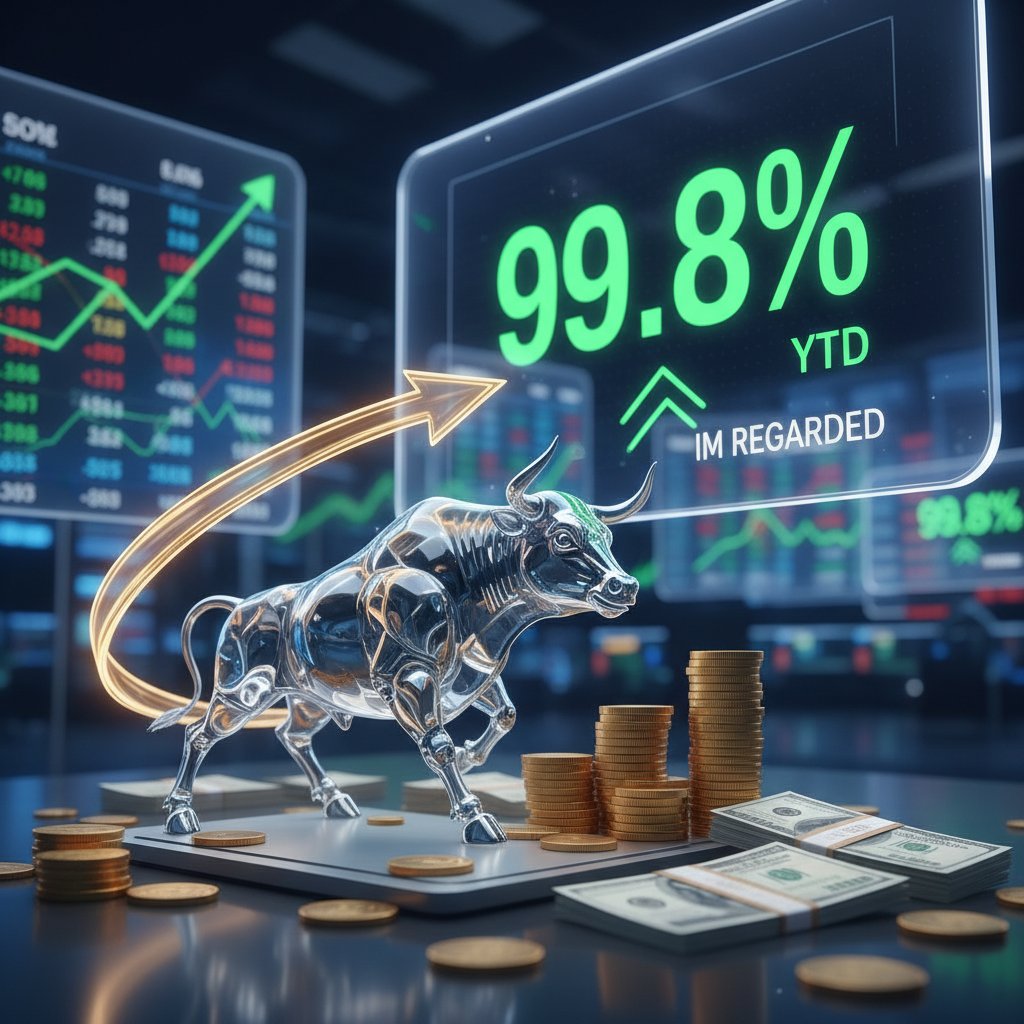
“The market’s way of teaching humility is swift and brutal,” says James K. Galbraith, a veteran risk management consultant at London-based firm Fortitude Capital. “When a trader brags about being up 98% YTD, they’re one bad Fed meeting away from a margin call.”
That’s exactly what happened to a Reddit user who posted under the handle u/RegardedTrader on r/WallStreetBets last week. The post, titled “Almost hit 100% YTD and I’m regarded,” featured a screenshot of a brokerage account showing a staggering 98.4% year-to-date return as of October 14. By October 21, after a sharp selloff in AI-linked stocks, the same account had cratered to a -12.3% loss.
The thread went viral, racking up 14,000 upvotes and hundreds of comments. It’s a story that feels all too familiar in this bull market-but it carries real lessons for anyone chasing triple-digit returns in a frothy environment.
The 100% Club, A Dangerous Obsession
In 2024, the S&P 500 is up roughly 22% YTD, and the Nasdaq Composite has surged 31%. Yet for many retail traders, a 20% gain feels like failure. The allure of doubling your money in months-or weeks-has never been stronger, fueled by meme stocks, leveraged ETFs, and crypto volatility.
According to data from Robinhood Markets, the average active retail trader in Q3 2024 held a portfolio concentration of 72% in a single sector, typically tech or crypto. “When you see a YTD number north of 80%, you’re almost certainly looking at a concentrated bet, usually with options or margin,” explains Sarah Lin, a quantitative analyst at New York-based boutique firm Alpha Research Partners.
u/RegardedTrader’s portfolio was no exception. The screenshot revealed heavy positions in MicroStrategy (MSTR) call options and a leveraged Bitcoin ETF (BITX). Both vehicles amplified gains during the summer rally-but also magnified losses when the market turned.
The phrase “regarded” is a deliberate misspelling of “retarded” that has become a badge of self-aware irony on WallStreetBets. It signals a trader who knows they’re taking reckless risks but does it anyway. “It’s a defense mechanism,” says Dr. Emily Torres, a behavioral finance professor at the University of Chicago Booth School of Business. “By calling themselves regarded, they preemptively deflect criticism. But it also normalizes dangerous risk-taking.”
Anatomy of a Blow-Up, How RegardedTrader Lost It All
The timeline is instructive. On October 11, MicroStrategy announced it had purchased an additional 10,000 Bitcoin, sending the stock up 12% in a single day. u/RegardedTrader’s MSTR Jan 2025 $200 calls-bought at $4.50 each-were suddenly trading at $18.70. That single position accounted for 68% of the portfolio’s value.
Then came October 18. The Federal Reserve released minutes from its September meeting, signaling a slower pace of rate cuts than markets had priced in. Bitcoin dropped 8% in two hours. MicroStrategy, trading as a Bitcoin proxy, fell 14%. The call options, leveraged to the hilt, lost 80% of their value.
“Leverage is a double-edged sword,” notes Galbraith. “It works until it doesn’t. And when it doesn’t, the drawdown is catastrophic. A 50% loss requires a 100% gain to break even-most retail traders don’t account for that math.”
By the time u/RegardedTrader posted the update showing a 12% loss YTD, they had also sold some of the options at a panic low and bought into a small-cap AI stock that later fell further. The final blow came from a margin call on October 21, forcing liquidation of the remaining positions at a loss.
“It’s like watching a car crash in slow motion,” says Lin. “The worst part is, he could have locked in 98% gains and walked away. But the addiction to ‘more’ is what gets you.”
The Psychology of Being Regarded, Self-Awareness or Self-Destruction?
The term “regarded” has evolved from a simple insult into a complex cultural marker in retail trading communities. It acknowledges stupidity while simultaneously embracing it. But when real money is on the line, self-awareness without action is just a rationalization.
Dr. Torres points to a 2023 study from the Journal of Behavioral Finance that found traders who use self-deprecating language in online forums are 45% more likely to exhibit loss-chasing behavior. “The joke is a cover for emotional attachment to a losing bet,” she explains. “They know they’re being reckless, but the dopamine hit from a potential win overrides logic.”
u/RegardedTrader’s story is not unique. Since the pandemic, the number of brokerage accounts has surged by 40% in the US alone, according to data from Charles Schwab. Many of those accounts belong to young, inexperienced investors who learned trading from Reddit and YouTube. “They’ve never seen a real bear market,” says Galbraith. “2022 was a correction, not a crash. When the real thing hits, we’ll see blow-ups on an order of magnitude larger.”
The term “YTD” itself has become a weapon of validation. A 98% return looks incredible-until you realize it’s completely unsustainably. “A good year is not a good strategy,” Lin emphasizes. “Survivorship bias is rampant. For every RegardedTrader who almost hits 100%, there are a hundred who blew up in March and never posted.”
Lessons for the Bullpen, What Smart Money Does Differently
So what separates the professional from the regarded? It’s not intelligence or luck-it’s risk management. “We use position sizing, stop-losses, and hedging,” says Michael Chen, a portfolio manager at Toronto-based Blue Oak Capital. “Our target return is 15-20% annually, not 100% in nine months. The math of compounding works against high volatility.”
Chen adds that his firm’s largest single position rarely exceeds 5% of the portfolio. By contrast, u/RegardedTrader had 68% in one trade. “That’s not investing. That’s gambling with a keyboard.”
For retail traders who still want to chase growth, experts recommend the following:
- Set a profit target and take partial profits. If a position doubles, sell half and let the rest ride.
- Use stop-losses on every trade. A 20% drawdown should trigger an automatic exit.
- Avoid margin. Leverage magnifies gains but can vaporize a portfolio overnight.
- Diversify across sectors. Even a 5-stock portfolio is better than a single-name bet.
“The market will always find a way to humble you,” says Galbraith. “The question is whether you learn the lesson with a small loss or a catastrophic one.”
Looking Ahead, Volatility Is Coming
As we head into November, the macroeconomic picture is shifting. The US presidential election, corporate earnings season, and a potential slowdown in AI spending could create sharp reversals. The VIX, currently at 18, is expected to spike into the 25-30 range by December.
For retail traders, the environment will test discipline. “The RegardedTrader story is just a preview,” warns Lin. “If you’re up big YTD, don’t get cocky. The market has a way of taking back everything it gave-and then some.”
u/RegardedTrader’s account is now closed. In a final post, they wrote: “See you guys in the next cycle. I’ll be back, but maybe with some risk management this time.” It’s a sentiment echoed by many before, and likely many after. The 100% club has its allure, but the membership fee is often your entire portfolio.
The next time you see a screenshot of a 98% YTD return, remember: it’s not a victory lap. It’s a warning sign.