






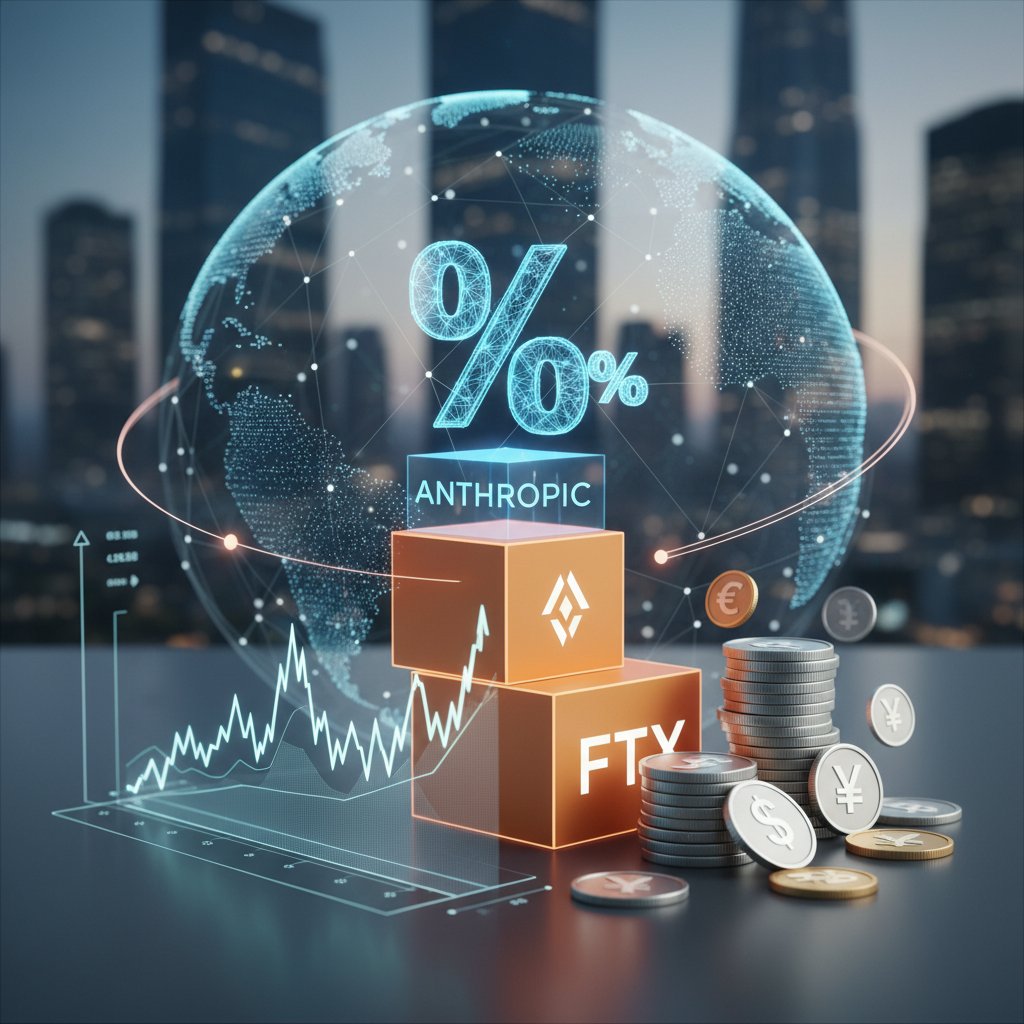
Picture this: You’re a bankruptcy trustee for a failed crypto exchange, sifting through a digital wreckage of lost user funds, tangled corporate debts, and questionable investments. Then, buried in the balance sheet, you find a 7.84% equity stake in one of the most promising artificial intelligence startups on the planet-Anthropic, the company behind the Claude AI model and a direct rival to OpenAI. That is the reality facing the FTX estate today.
On a quiet Tuesday in late February, as markets digested the latest Federal Reserve minutes on inflation, a less-noticed financial ghost resurfaced in bankruptcy court filings. The FTX debtors’ estate, which collapsed in November 2022 amid one of the largest fraud scandals in financial history, still holds a 7.84% ownership slice of Anthropic. At current private market valuations, that stake is worth roughly $1.4 billion-a sum that could dramatically reshape the payout landscape for the millions of customers and creditors left holding bags when Sam Bankman-Fried’s empire imploded.
The Stake That Won’t Go Away
Let’s rewind the tape. In 2021, before the house of cards came tumbling down, FTX’s venture arm-led by Bankman-Fried himself-poured $500 million into Anthropic’s Series B funding round. At the time, it was a bet on the frontier of large language models and AI safety, a space that Anthropic’s co-founders (former OpenAI executives Dario and Daniela Amodei) had carved out as their own. The investment gave FTX a roughly 7.84% equity position, with warrants and rights that could have expanded that share.
Fast forward to today. Anthropic has since raised additional capital-including a $4 billion strategic investment from Amazon in September 2023 and a $2 billion round from Google in October 2023-which has diluted FTX’s original stake but still left it with a meaningful minority position. According to the latest docket filings from the FTX bankruptcy proceedings in the U.S. District Court for the District of Delaware, the estate is now actively evaluating how to monetize this asset.
“The 7.84% stake in Anthropic is arguably the most valuable single asset in the FTX estate that isn’t a pile of cash or crypto,” said Dr. Sarah Chen, a senior fellow at the Yale Program on Financial Stability. “It’s a high-growth, high-liquidity-adjacent asset in a sector that is currently attracting massive institutional interest. The question is: how do you sell it without triggering a tax event or losing value to a fire sale?”
For context, Anthropic’s most recent private valuation-based on the Amazon and Google deals-sits at approximately $18.4 billion. That 7.84% slice, at face value, is worth roughly $1.44 billion as of the latest mark-to-market estimates in the bankruptcy filings. But here’s the catch: private market stakes are notoriously illiquid. There’s no ticker symbol, no daily volume, no ready market to dump a billion-dollar block of shares.
What It Means for the Creditors
If you are one of the estimated 1.7 million FTX customers who had funds trapped when the exchange halted withdrawals on November 11, 2022, this Anthropic stake is a glimmer of hope-but also a source of uncertainty. The bankruptcy plan, which was initially filed in December 2023 and is still under court review, proposed a recovery of roughly 90% of customer claims based on the value of assets at the time of the petition. But that valuation was a moving target.
Cryptocurrency prices have surged since then. Bitcoin has more than doubled from its November 2022 lows of around $16,000 to current levels above $50,000. Ethereum has rallied similarly. But the Anthropic stake is a different beast: it’s not crypto; it’s equity in a private AI company. The estate’s ability to sell that stake-either to a third-party buyer, through a secondary market transaction, or by holding it until a potential IPO-will directly affect how much cash is available to distribute to creditors.
The bankruptcy trustee, led by John J. Ray III (the same lawyer who oversaw the Enron collapse), has been clear: they are pursuing a “dual-track” strategy. One track is selling the stake outright. The other is holding it and participating in any future liquidity event, such as an Anthropic IPO-which some analysts speculate could come as early as 2026, given the company’s rapid revenue growth and the AI arms race with OpenAI and Google’s DeepMind.
An AI Goldmine in a Crypto Wreckage
This is where the story gets interesting for the broader market. Anthropic is not just any AI startup. It is the company behind Claude 3, a large language model that has been benchmarked as competitive with-and in some tasks, superior to-OpenAI’s GPT-4. The company has a strong focus on “constitutional AI,” a framework that attempts to align model behavior with human values without heavy-handed censorship. That philosophical positioning has made it a darling of both Silicon Valley libertarians and institutional investors who see AI as the next trillion-dollar platform shift.
In January 2024, Anthropic reported annualized revenue run-rate of $850 million, up from virtually nothing two years prior. That growth trajectory-combined with the $7.3 billion in total funding the company has raised since inception-means the 7.84% stake is not just a “hold and pray” asset. It is a potential home run for the FTX estate, provided they can avoid a forced sale at a discount.
“The FTX estate’s position in Anthropic is a textbook example of the ‘unexpected asset’ in bankruptcy,” said Mark Thompson, a partner at restructuring firm Kroll & Associates. “You have a failed crypto exchange sitting on a piece of the next-generation AI infrastructure. It’s almost poetic. The question is whether they can extract full value before the creditors get impatient and demand liquidation. The clock is ticking.”
For now, the clock is not ticking loudly. The bankruptcy court has granted the estate until September 2024 to file a final reorganization plan, giving them a window to negotiate the sale of the Anthropic stake. Sources close to the matter say the estate has already held preliminary discussions with at least two major venture capital firms and one sovereign wealth fund interested in acquiring the position. The asking price? Likely north of $1.2 billion, reflecting a discount to the private valuation but still a massive windfall for the estate.
The Broader Implications
For readers in the US, UK, and Canada, this is more than a bankruptcy footnote. It is a reminder that financial markets are increasingly interconnected. A crypto exchange’s bad bet on leveraged trading and fraudulent balance sheets can end up owning a piece of the most transformative technology since the internet. The FTX-Anthropic connection is a case study in what happens when venture capital meets crypto hype-and when bankruptcy law meets the AI boom.
The resolution of this stake will set a precedent. If the estate can sell it at a premium, it could boost recovery rates for FTX creditors to over 100% of their original claims-a rare outcome in a bankruptcy of this scale. If they sell at a discount or hold too long, it could become a drag on the proceedings, with creditors accusing the trustee of “speculating” with their money. Either way, the next six months will be critical.
Looking ahead, keep an eye on the docket in the Southern District of New York, where the next hearing is scheduled for March 15. That is when the estate will update the court on its progress monetizing the Anthropic shares. For now, the market is watching, the creditors are waiting, and the AI world is wondering: will a crypto exchange’s ghost own a piece of the future?