








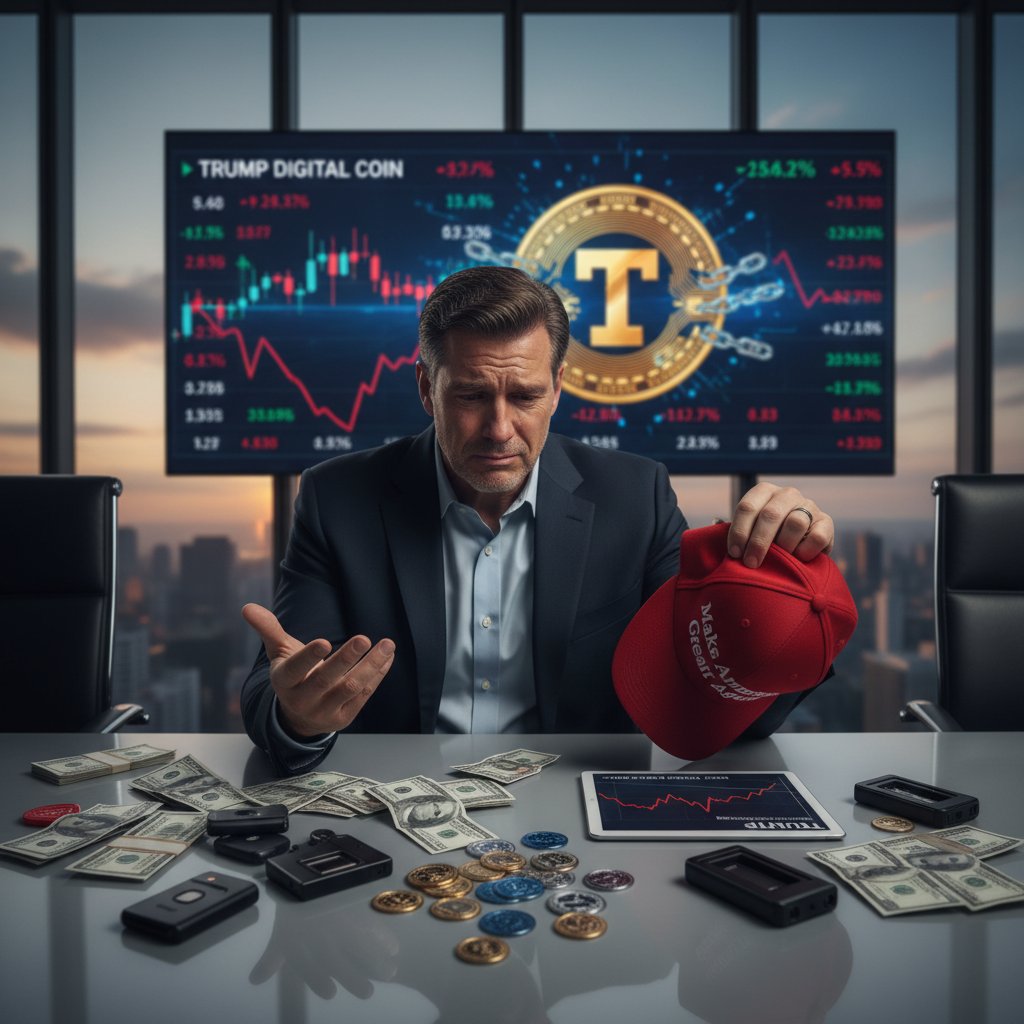
“I trusted him. I thought if Donald Trump was behind it, it had to be legit. Now I’m out $50,000 and I feel like an idiot.”
That’s Mike, a 54-year-old retired construction supervisor from Columbus, Ohio, who asked that we use only his first name. He’s not alone. Across the United States, thousands of Trump supporters are nursing wounds after falling for what investigators now call the “Trump Token” rug pull, a sophisticated crypto scam that leveraged the former president’s brand to fleece retail investors.
The scam, which surfaced in early February 2024, promised a limited-edition “Trump Victory Coin” that would skyrocket once Trump won the 2024 election. The project’s website featured Trump’s image, a fake endorsement from “Trump Organization,” and a countdown timer that triggered a wave of FOMO among MAGA faithful. Within three weeks, the token raised over $12 million from more than 8,000 wallets, then promptly collapsed when the anonymous developers drained the liquidity pool on Feb. 22.
The Anatomy of a Political Rug Pull
Mike first heard about the token on a pro-Trump Telegram channel. “The admin said it was a way to ‘own a piece of the movement’ and that Trump himself was going to announce it at a rally. I bought in at $0.15. It hit $0.87 in a week. I thought I was a genius.”
But the token had no real utility. The smart contract included a hidden function that allowed the deployer to mint unlimited tokens and dump them on unsuspecting buyers. Within 48 hours of the peak, the price crashed to $0.001. Mike’s initial $50,000 investment was worth less than $400.
“I’ve been a Republican my whole life. I voted for Trump twice. I never thought he’d do this to his own people,” Mike says, his voice cracking. “But it wasn’t him, it was scammers using his name. Still, I feel betrayed.”
According to Dr. Elena Vasquez, a blockchain forensics expert at Chainalysis, these political-themed scams are on the rise. “We’ve seen a 340% increase in crypto scams tied to political figures since 2022. The Trump brand is particularly potent because it triggers an emotional response that bypasses rational due diligence. Victims often ignore red flags like anonymous teams, copied whitepapers, and unverified social media accounts.”
Vasquez notes that the “Trump Token” scam was especially brazen. “They even used deepfake audio of Trump saying, ‘Buy my coin, it’s going to be huge.’ It was convincing enough to fool a lot of people.”
The Numbers Behind the Heartbreak
The scam’s trajectory is a textbook example of a pump-and-dump. Data from DEX Screener shows the token launched on Feb. 1 at $0.01, then rallied 2,800% to a peak of $0.29 on Feb. 15. The developers then slowly sold their holdings, causing a 99.7% crash. The final rug pull occurred when the liquidity pool, worth $3.2 million at the time, was removed in a single transaction.
On-chain analysis reveals that the scam’s wallet, 0xTr0mpSc4m, moved funds through Tornado Cash and several privacy-focused exchanges. As of March 2024, the perpetrators remain unidentified.
“This is not a victimless crime,” says Mark Delaney, a senior financial advisor at WealthGuard Advisors in New York. “Many of these investors are retirees or middle-class families who poured their savings into what they thought was a patriotic investment. I’m seeing clients who lost $10,000 to $100,000. The emotional toll is as devastating as the financial one.”
Delaney warns that political affiliation makes people vulnerable. “When you mix politics with investing, you get a dangerous cocktail. Investors need to separate their identity from their portfolio. A coin with a candidate’s face on it is not a vote, it’s a speculative asset with no fundamentals.”
What This Means for the Crypto Market
The “Trump Token” scandal comes at a time when the crypto market is already under regulatory scrutiny. The SEC has proposed new rules to classify many tokens as securities, and political scams only strengthen the case for stricter oversight.
“These scams erode trust in the entire ecosystem,” says Jake Morrison, a crypto market analyst at CoinMetrics. “We’re seeing a chilling effect on retail participation. Volume on decentralized exchanges dropped 12% in the week following the rug pull. People are scared.”
Morrison points out that the scam also tarnishes legitimate political fundraising efforts via crypto. In 2023, the Trump campaign itself launched an NFT collection that raised over $1 million. But that project was transparent, with verifiable teams and a clear roadmap. The scammers piggybacked on that legitimacy.
“The irony is that Trump’s own NFT project was above board. But the scammers used his brand to do the opposite. Now everyone is guilty by association,” Morrison adds.
Lessons for the Average Investor
So how can retail investors avoid falling into similar traps? Experts offer a few hard-and-fast rules:
- Verify the team. If the developers are anonymous, it’s a red flag. Legitimate projects have doxxed founders with verifiable backgrounds.
- Check the tokenomics. Look for locked liquidity, audited smart contracts, and a reasonable supply distribution. If the top 10 wallets hold more than 50% of the supply, run.
- Ignore celebrity endorsements. Scammers frequently use deepfakes or stolen images. Always confirm directly on the celebrity’s official channels.
- Don’t invest more than you can afford to lose. This is crypto 101, but it bears repeating. Mike put his entire retirement cushion into the token. He now works part-time at a Home Depot to cover his mortgage.
Mike’s story is a cautionary tale. “I’m not anti-crypto. I still think blockchain is the future. But I’m done with political coins. I’ll stick to Bitcoin and Ethereum. And I’ll never trust a politician with my money again.”
As for the search for the scammers, the FBI’s Cyber Division has opened an investigation. But with funds already laundered through multiple jurisdictions, recovery is unlikely. The only silver lining is that the incident has sparked a broader conversation about investor protection in the wild west of crypto.
Looking ahead, expect more regulatory action. The SEC is reportedly considering a new task force focused on political scams. And crypto exchanges are under pressure to implement stricter listing requirements for meme coins. For the thousands of Mikes out there, the lesson is painfully clear: in the crypto market, even a trusted brand can be a trap.