



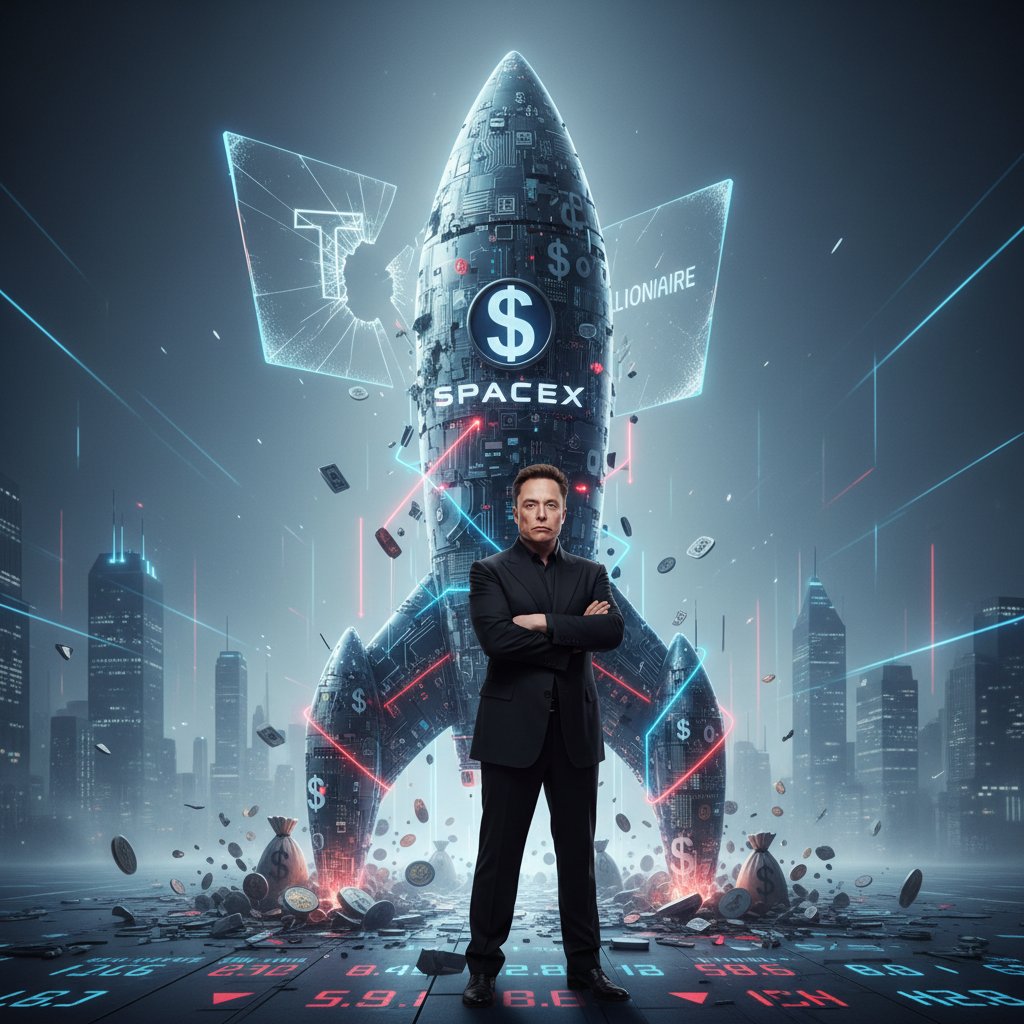
Nobody is talking about this, but Elon Musk is no longer a trillionaire. That headline evaporated on Tuesday as a brutal global tech rout erased billions from the world’s richest person, pulling him back below the twelve-figure threshold he first crossed just months ago. And sure, you’ve heard about Tesla’s stock slump. But the real story isn’t the electric car maker. It’s SpaceX.
Look, Musk’s fortune has always been a wild ride, a mix of Tesla shares, SpaceX equity, and a few other bets. But this selloff didn’t just hit public markets. It slammed the private valuation of SpaceX, the rocket company that’s been his shining star. And that’s what pushed him off the trillionaire perch.
The Tech Rout That Broke the Billion-Dollar Ceiling
The global tech selloff started in Asia, spread to Europe, and cratered New York trading by Tuesday afternoon. The Nasdaq Composite fell 3.2%, its worst single-day drop in six months. Megacap names like Apple, Microsoft, and Nvidia took hits. But Musk’s wealth is uniquely concentrated: roughly 60% of his net worth comes from Tesla stock, and another 20% from his stake in SpaceX. When both assets slide simultaneously, you don’t just lose a few million. You lose $30 billion, in a day.
According to the Bloomberg Billionaires Index, Musk’s net worth dropped to $198 billion on Tuesday, down from $210 billion the day before. That puts him firmly back in ‘mere’ billionaire territory. A trillionaire? Not for now. But the real damage was done to SpaceX’s internal valuation, which dropped roughly 15% in secondary market trading as investors panicked about a broader pullback in high-growth, capital-intensive ventures.
“SpaceX isn’t publicly traded, but its valuation is very sensitive to market sentiment in the broader tech and aerospace sectors,” said Dr. Sarah Chen, a finance professor at Stanford Graduate School of Business. “When investors flee risk, private companies with long-duration cash flows, like SpaceX, get repriced fast. This rout was a wake-up call for the entire unlisted tech ecosystem.”
And it’s not just a paper loss. SpaceX recently raised fresh capital in a record-breaking funding round that valued it at $350 billion. But that round closed in November. Since then, the market for private tech shares has cooled, and the latest trades on secondary platforms like Forge Global suggest the company is now worth closer to $300 billion. That’s a $50 billion haircut in under three months, and Musk owns 42% of the company.
For context, this selloff echoes the pattern we saw in 2022, when the Federal Reserve‘s rate hikes crushed hype-driven tech stocks. Back then, Musk’s net worth fell from $340 billion to $137 billion. But this time feels different, it’s not just monetary policy. It’s a genuine rout in confidence about the future of space exploration, satellite internet, and the broader tech narrative that fuels Musk’s empire.
SpaceX: From Rocket Star to Falling Satellite
SpaceX has been the crown jewel of Musk’s portfolio, the one that kept his net worth floating even when Tesla wobbled. But the company’s recent troubles are compounding. Launch delays for the Starship rocket, increasing competition from Amazon’s Project Kuiper, and a growing skepticism about the timeline of Starlink’s profitability have all weighed on investor sentiment.
Then there’s the valuation math. SpaceX is private, but its shares trade in the secondary market. In January, those shares were changing hands at $112 each. By mid-April, they’d slipped to $96, a 14% decline. That’s not a crash, but it’s a clear signal that the euphoria around space is cooling. When the broader tech rout hit this week, those secondary trades went even lower, with some bids dropping below $90 before recovering slightly.
“SpaceX’s valuation was always a bit of a faith-based asset,” said Mark Thompson, an aerospace analyst at Aviation Capital Group. “Investors were paying for future dreams, Mars colonies, global internet, orbital tourism. But in a bear market for tech, faith is the first thing to get sold off. The fact that Musk’s net worth is so tightly tied to a private company with speculative cash flows makes it extra vulnerable.”
Meanwhile, Tesla has its own problems. The stock has fallen 28% from its 52-week high, as electric vehicle demand softens and Chinese rivals like BYD eat into market share. Musk’s pay package, the $56 billion compensation plan that a Delaware judge struck down, adds another layer of uncertainty. But the bigger hit this week came from the macro: a broad selloff in growth stocks triggered by hotter-than-expected inflation data and a jittery bond market.
Let’s be honest: losing trillionaire status is a headline, but it doesn’t mean Musk is anywhere close to broke. He’s still the richest person on the planet by a wide margin. But the psychological milestone matters, both for Musk’s ego and for the media narrative that fuels investor sentiment. And it raises uncomfortable questions about the sustainability of his wealth if both of his key assets are under pressure.
As we’ve seen with other tech titans, a megacap stock rout can cascade into private valuations. The lesson: no fortune is too big to shrink.
What Losing the Trillionaire Tag Means for the Rest of Us
Yes, it’s a story about the world’s richest person. But the fall of the trillionaire is also a barometer for the broader economy. When Musk loses $30 billion overnight, and when SpaceX’s private market value drops, it signals that investors are pulling back from the most speculative corners of the market. That affects pension funds, venture capital portfolios, and even the IPO pipeline.
SpaceX had been widely expected to spin off Starlink for an IPO in 2025 or 2026. Those plans aren’t dead, but they may be delayed. A lower private valuation means a lower IPO price, which means smaller paydays for early investors and employees. And for everyday people? Higher costs for satellite internet, fewer jobs in the space sector, and a general cooling of the “space bubble” that had inflated expectations for years.
There’s also a personal finance angle. If Musk’s net worth can drop by $30 billion in a single day, it’s a vivid reminder that ultra-high-net-worth portfolios are not immune to market cycles. For normal investors, the lesson is diversification. Putting all your eggs in one basket, even one as glamorous as SpaceX or Tesla, is risky. And if you’re struggling with your own debt, consider that even billionaires aren’t immune to financial stress. Meanwhile, council tax debt hits £9bn in the UK, showing how financial pressure hits everyone, just at different scales.
The Road Ahead: Is Billionaire Status Safe?
So where does Musk go from here? He’s still the richest man alive, but the gap to second-place Jeff Bezos ($130 billion) has shrunk. If Tesla continues to slide and SpaceX’s valuation doesn’t recover, Musk could lose his top spot entirely within months. That would be a seismic shift in the rankings of global wealth, one that’s happened only a few times in history.
The key variable? Interest rates. The Federal Reserve is expected to cut rates later this year, which could reignite the tech rally and lift both Tesla and SpaceX’s valuations. But if inflation stays sticky and the Fed holds steady, the rout could deepen. Musk’s trillionaire status, in that case, may remain a distant memory.
For space investors, the question is whether SpaceX’s fundamentals can justify its massive price tag. The company does have real revenue, Starlink now has over 4 million subscribers and generated $8.2 billion in revenue last year. But its costs are astronomical (pun intended). The Starship development program alone has burned through $6 billion. Profitability is still years away, if it comes at all.
Meanwhile, Musk is fighting multiple battles, legal fights over his Tesla pay, regulatory headaches for SpaceX’s launches, and a PR war with advertisers on X (formerly Twitter). Each of these can weigh on his wealth in subtle ways. The trillionaire era may have been brief, but it taught us one thing: even the most ambitious fortunes rest on fragile ground.
Frequently Asked Questions
How much did Elon Musk’s net worth drop?
Musk lost approximately $30 billion in net worth on Tuesday, according to the Bloomberg Billionaires Index, dropping from $210 billion to $198 billion. That loss was driven by a global tech rout that hit Tesla stock and lowered SpaceX’s private market valuation.
Why is SpaceX affected by a tech rout if it’s a private company?
SpaceX is private, but its shares trade on secondary markets like Forge Global. These markets price shares based on supply and demand, which are influenced by broader market sentiment. When tech stocks crash, investors become risk-averse, lowering the price they’re willing to pay for private tech shares, which directly cuts SpaceX’s implied valuation.
Will SpaceX still go public?
SpaceX has discussed spinning off its Starlink segment for an IPO in 2025 or 2026, but the recent rout makes that timeline less certain. A lower private valuation could lead to a lower IPO price, potentially delaying plans until market conditions improve.