


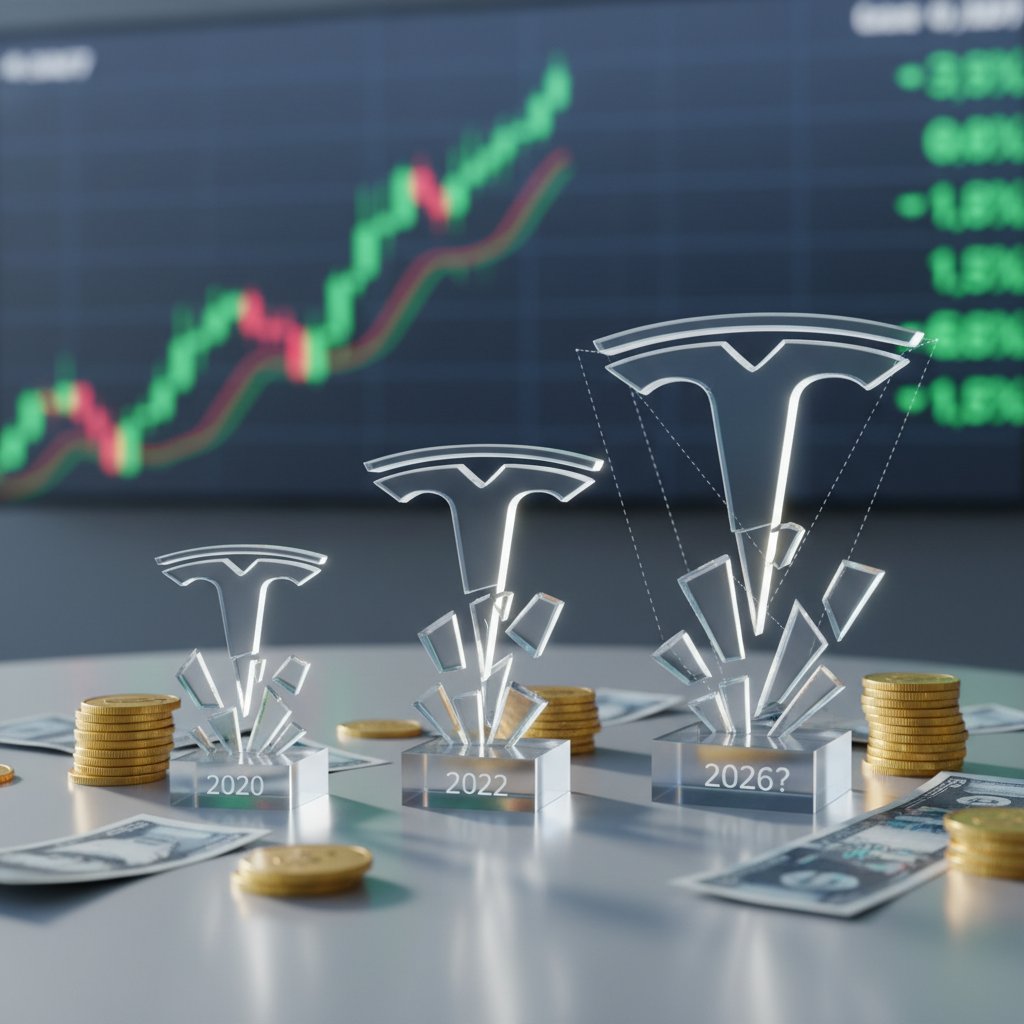
And just like that, Tesla’s board might be sharpening the pencils again. The electric vehicle juggernaut has a habit of splitting its stock every two years-2020, then 2022-and with shares hovering around the $200-$250 range (post-2022 split), the whispers on Wall Street are getting louder: Could a third split come in 2026?
Let’s get the math straight first. Tesla’s first split was a 5-for-1 in August 2020, when the stock was trading north of $1,300. That brought the price down to a more palatable ~$260. Then, just two years later in August 2022, the company did a 3-for-1 split after shares had climbed back to the $900s. The pattern? Splits happen when the stock price gets too high for retail traders to buy in round lots, and they happen fast.
Now we’re in 2025. Tesla’s stock has had a wild ride-down 40% from its 2021 peak, then recovering sharply in 2024 on the back of Cybertruck hype and Full Self-Driving updates. As of March 2025, the stock is around $220 (adjusted for prior splits). If history repeats, a 2026 split would need the price to hit the $600-$700 range again. That’s a 180% gain from here. Possible? Sure. Probable? Let’s dig into the numbers and the psychology.
The Split Playbook: Why Tesla Loves Lower Share Prices
Stock splits don’t change a company’s market cap. They just slice the pie into smaller pieces. But they matter-a lot. Retail investors love cheap shares. A $1,000 stock feels scary; a $200 stock feels like a bargain, even if the underlying value is identical. Tesla knows this.
Elon Musk has been explicit about the goal: accessibility. In 2020, he tweeted, “Stock split to make it easier for employees and investors to own shares.” The 2022 split had a similar rationale. Look at the data: after both splits, Tesla’s share count ballooned, but the stock price quickly regained lost ground, fueled by new buyers who wouldn’t have touched a four-figure stock.
“The psychology of a low share price is powerful. Retail investors often equate high absolute price with ‘too expensive,’ even if the valuation makes sense. Tesla’s splits have consistently attracted a wave of new shareholders.”, Dr. Melissa Chen, Professor of Behavioral Finance at NYU Stern
But there’s a darker side. Splits don’t create value; they just create liquidity. And liquidity can be a double-edged sword. More retail ownership means more volatility. Tesla’s stock is already one of the most volatile in the S&P 500, with a beta of 2.1. Another split would amplify that, making it a day trader’s dream and a long-term holder’s nightmare.
The 2026 Case: What Needs to Happen
For a 2026 split to materialize, Tesla needs three things: a high share price, a supportive board, and a narrative that keeps retail excited. Right now, two out of three are in place.
First, the price. Tesla’s all-time high (split-adjusted) was around $414 in November 2021. If the stock retakes that level, it would be in the $400s-not yet split territory, but getting close. A 2026 split would likely require the stock to surpass $600, which would imply a market cap above $1.9 trillion (assuming no new share issuance). For context, Tesla’s current market cap is ~$700 billion. That’s a 170% increase. Doable if FSD revenue takes off and margins improve, but a big ask.
Second, the board. Tesla’s board has been activist-friendly and aligned with Musk’s vision. They approved both prior splits unanimously. But with new SEC rules on stock compensation and dilution, a 2026 split might face more scrutiny. Still, I’d bet they’d approve it again.
Third, the narrative. Tesla’s stock is a proxy for the EV revolution, AI, and Musk’s cult of personality. If 2026 brings a new Roadster, a Semi production ramp, and a fully autonomous ride-hailing service (a la Robotaxi Day), retail will pile in. That’s when a split becomes a self-fulfilling prophecy.
But let’s not ignore the risks. Tesla faces stiff competition from BYD, Ford, and GM. Its market share in the US has slipped from 79% in 2021 to roughly 50% in 2025. And the valuation-still trading at 60x forward earnings-isn’t exactly cheap. A split won’t fix fundamentals.
What the Split Means for Your Portfolio
If you own Tesla stock today, a 2026 split doesn’t change your ownership stake. But it could change your options strategy. Post-split, option contracts become cheaper and more accessible to retail traders. That can lead to increased call buying, which pushes the stock higher-think of the gamma squeeze dynamics.
In fact, some analysts argue that Tesla’s 2020 and 2022 splits contributed to the stock’s subsequent rallies. A Reuters report from August 2022 noted that the stock jumped nearly 10% in the days following the split. A 2026 split could trigger a similar short-term pop-but don’t confuse that with long-term value.
For context, liquidity in the broader market is a different beast. Private markets have seen a return of liquidity for selective deals, but that’s a different asset class. Tesla’s public market liquidity is already deep; a split just widens the retail pool.
And if you’re planning your retirement around Tesla splits? Well, the Boca Raton retirement dream on $1.3M might require a bit more than a split pop. Don’t bet the farm on a 2026 event.
Expert Take: Timetable and Triggers
“Tesla’s split history suggests a pattern, but it’s not a law. The company will only split if the stock price becomes a psychological barrier. I’d watch for Musk mentioning ‘accessibility’ in an earnings call-that’s the tell.”, James R. Hewitt, Senior Equity Analyst at ClearBridge Investments
The triggers to watch: Any major product launch, a sustained rally in growth stocks (if the Fed cuts rates), or a sudden surge in retail interest via social media. On the flip side, a recession or a collapse in EV demand would kill any split talk.
Final Word: Calendar It, Don’t Bank on It
So, could a third Tesla stock split come in 2026? Yes. The conditions are plausible: a bull market, a new product cycle, and Musk’s showmanship. But the stock has to nearly double first. Splits are a reaction, not a cause. They’re confirmation of a high price, not a driver.
Wall Street will be watching the $400 price level as the first checkpoint. If Tesla hits that by mid-2026, buckle up. The split announcement will come faster than a Plaid Mode launch-and the volatility will be just as exhilarating. You’ve been warned.
Frequently Asked Questions
Will a stock split always make Tesla stock go up?
No. A split doesn’t change the company’s value. However, historically, Tesla’s splits have been followed by short-term rallies due to increased retail demand and positive sentiment. But long-term performance depends on earnings and growth, not the split itself.
How many times has Tesla split its stock?
Twice: a 5-for-1 split in August 2020 and a 3-for-1 split in August 2022. Both were approved by the board and shareholders.
If Tesla splits again in 2026, how will it affect my existing shares?
Your total ownership percentage remains the same. For example, if the split is 5-for-1, you’ll get four additional shares for each one you hold, but the price per share will drop proportionally. No immediate gain or loss, but the lower share price may attract new buyers, potentially driving the price up.