



You think the era of vertical integration in media was supposed to be the endgame. That owning the pipe and the content was the ultimate hedge against disruption. Comcast bought NBCUniversal back in 2011 for that exact reason, a $30 billion bet that cable distribution and studio firepower would reinforce each other forever.
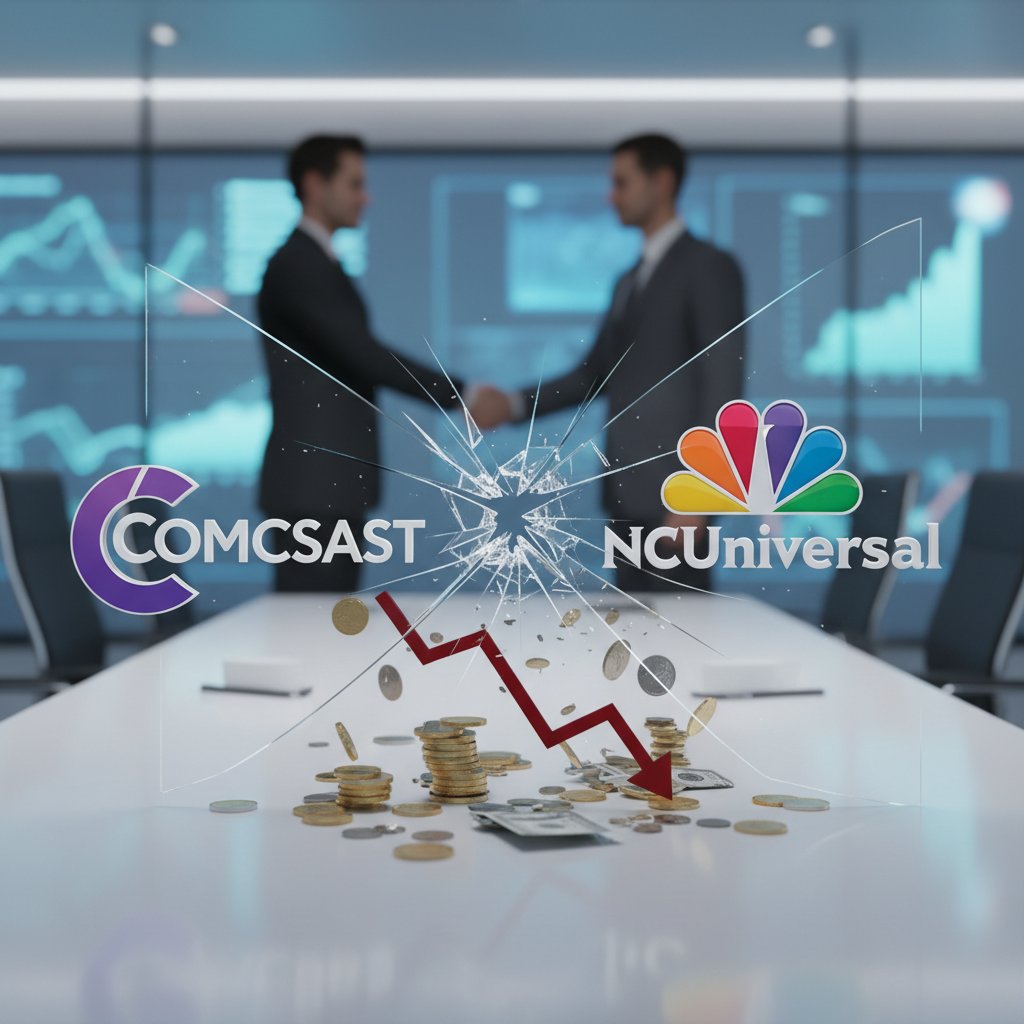
They were wrong. At least, wrong about the forever part. On November 20, Comcast officially announced plans to spin off NBCUniversal into a separate publicly traded company. The marriage is over. And anyone watching the media sector knows this isn’t an isolated breakup, it’s the latest domino in an industry-wide unwinding.
Here’s the raw math. Comcast’s cable and internet business throws off massive free cash flow, roughly $16 billion in 2023. NBCUniversal? It’s a cash guzzler with declining linear TV ratings, a streaming war bill that keeps rising, and theatrical releases that swing wildly from Oppenheimer to box-office bombs. The synergies Wall Street once priced in have become friction points.
So what’s actually happening? Comcast will separate NBCUniversal, including NBC News, Universal Pictures, Bravo, E!, and the theme parks, into a standalone entity. Current shareholders get stock in the new company. Comcast retains its cable broadband and wireless operations. The deal is expected to close in late 2025, pending tax and regulatory approvals.
This isn’t a fire sale. It’s a surgical separation.
Why Now? The Trend Lines Were Clear
Look, media conglomerates have been shedding weight for two years. Warner Bros. Discovery is still digesting the 2022 merger and has flirted with spinning off its own assets. Disney sold off most of its linear TV portfolio in 2023. Even Paramount Global is exploring asset sales. The thesis is straightforward: the streaming revolution turned linear TV from a cash cow into a lead balloon.
Comcast CEO Brian Roberts said in the announcement that the move allows both entities to “pursue their own strategic priorities.” Translation: Comcast doesn’t want to subsidize NBCUniversal’s streaming losses anymore. Peacock alone burned through $2.7 billion in 2023. The cable business, xfinity, broadband, has steady margins but needs capital to upgrade infrastructure for fiber and wireless.
“The media landscape has fundamentally shifted. Vertical integration that made sense in the 2010s is now a drag on valuation because the assets have different risk profiles,” says Laura Martin, senior media analyst at Needham & Company. “Investors want pure plays, they don’t want to own a cable stock that’s also a Hollywood studio, especially when the studio’s streaming costs are opaque.”
Martin’s point hits the mark. Comcast’s stock has traded at a conglomerate discount for years. Since 2020, the shares have returned about 15% total, while the S&P 500 has doubled. Wall Street hates complexity in a bull market.
And let’s not ignore the tax angle. The spin-off is structured as a tax-free distribution to shareholders. That’s a clean exit, no capital gains event for investors. Comcast learned from AT&T’s WarnerMedia disaster, which was a spin-off followed by a messy merger with Discovery that left shareholders holding the bag. Comcast wants to avoid that narrative.
The Details: What Goes, What Stays
The new entity, tentatively called NBCUniversal Corp. but that could change, will inherit roughly $40 billion in debt, according to sources familiar. That’s the legacy debt from the original acquisition plus accumulated borrowings. The company will have about $35 billion in annual revenue, making it a mid-cap by media standards.
Assets that move: NBC broadcast network and owned stations, Universal Pictures, Bravo, E!, Telemundo, Universal Studios Hollywood and Orlando, and the Peacock streaming service. Notably, the Olympics broadcast rights stay with NBCUniversal, which has a deal through 2032. That’s a crown jewel, live sports rights remain the only content that can’t be cord-cut.
What stays with Comcast: Xfinity broadband and cable, Comcast Business (enterprise services), and the wireless mobile division. These are the cash engines. Broadband alone had $21 billion in revenue in 2023, with margins north of 40%. Comcast will also retain its 30% stake in Hulu, which is in the process of being sold to Disney. That sale proceeds will stay with Comcast, likely used to pay down debt or buy back shares.
The separation isn’t cheap. Comcast expects $2 billion in one-time costs, legal, advisory, IT systems separation. But the long-term savings in management distraction and capital allocation clarity is supposed to outweigh that.
“Comcast is admitting that running a media conglomerate is harder than it looks. The future of media is about focus, either you’re a distributor or a content creator, not both,” says Rich Greenfield, media analyst at LightShed Partners. “This spin-off mirrors what we saw in telecom when they spun off directory services, the market rewards simplicity.”
Greenfield’s reference to telecom is apt. AT&T spun off Yellow Pages in 2012. Verizon sold its media assets in 2022. The pattern holds: when distribution and content are under one roof, the content side eventually cannibalizes the distribution side’s cash flow.
What It Means for Investors, and for NBC News
For investors, the spin-off creates two distinct investment theses. Comcast becomes a pure-play telecom with steady growth and a fat dividend (currently yielding 3.8%). Expect management to boost buybacks aggressively, they’ve already authorized $15 billion in repurchases for 2025. Think of it as a regulated utility with broadband tailwinds.
NBCUniversal becomes a high-risk, high-reward media play. It has iconic brands, Universal Pictures, NBC News, theme parks, but also huge liabilities. The linear TV assets (Bravo, E!) are in secular decline, shedding 6-8% of subscribers annually. Peacock is still losing money but showed signs of improvement in Q3 2024, narrowing losses to $436 million.
The theme parks are the wild card. Revenues hit $8.5 billion in 2023, driven by Epic Universe in Orlando opening in 2025. That’s a catalyst, but theme parks are capital-intensive and cyclical. If a recession hits, that revenue stream dries up fast.
Then there’s NBC News. It’s a prestigious asset but not wildly profitable. Cable news ratings have been slipping, and the news division relies on advertising revenue that’s migrating to digital. The spin-off could force NBC News to become more aggressive in digital monetization, or face cost cuts. No one is predicting layoffs yet, but in media, consolidation usually means trimming fat.
For the broader market, this is another sign that the streaming wars are entering a new phase. Companies that went all-in on direct-to-consumer are now pulling back. Even Netflix is buying linear TV assets (remember when they bought the Roald Dahl catalog?). The landscape is shifting from “own everything” to “partner selectively.”
Interestingly, the spin-off also has implications for smaller media players. If you’re a regional cable operator or a niche content producer, you might see similar logic apply. The same trend that pushed Prime Inc. to take on the IRS over a niche tax credit is about focus: sometimes the best move is to isolate assets that don’t fit the core business.
And on the macro side, the spin-off could affect how investors view cable stocks. If Comcast’s separation goes smoothly, expect pressure on Charter Communications and Altice to do the same. The pure-play premium is real, just ask any telco that spun off its tower division.
But there’s a risk here. The new NBCUniversal will carry that $40 billion debt load. Interest costs could eat up 25% of operating income. If advertising markets soften, and with a potential recession looming in 2025, that’s a real possibility, the company could face a credit downgrade. Moody’s has already flagged the spin-off as credit-negative for the media entity.
Final Thoughts: The Death of the One-Stop Shop
Comcast’s decision is a tacit admission that the original vision of a vertically integrated media giant failed. Not because the assets were bad, but because the economics of distribution and content diverged too sharply. One needs capital for infrastructure; the other needs capital for content. Trying to balance both under one CEO is like juggling chainsaws.
The spin-off is expected to close by late 2025. Between now and then, expect a flurry of executive moves, restructuring, and probably a brawl over who gets to run the media company. (Current NBCUniversal CEO Brian Roberts? He’s staying with Comcast. The hunt for a new CEO is on.)
For anyone holding Comcast shares, the tax-free spin-off is a nice bonus. For the media industry, it’s another tombstone on the grave of the conglomerate era. The next big question: who’s next? Warner Bros. Discovery? Paramount? The clock is ticking.
And don’t forget, while you’re watching this corporate drama unfold, the actual business of making TV shows and movies keeps humming. Disruptions in energy markets might be taking attention, but media deals are where the real leverage is. Stay tuned. This isn’t an ending, it’s a corporate reshuffling that will define the next decade.
Frequently Asked Questions
Will the NBCUniversal spin-off affect my Comcast cable bill?
Unlikely in the short term. The spin-off separates ownership, not the existing carriage agreements. Comcast’s Xfinity will still carry NBC channels under existing contracts. But over time, the new NBCUniversal might push for higher retransmission fees, which could trickle down to consumer bills. That’s a few years out, not immediate.
What happens to my Comcast shares after the spin-off?
You will receive shares of the new NBCUniversal entity on a pro-rata basis, likely in a tax-free distribution. The exact ratio hasn’t been announced yet, but typically it’s something like one share of NBCUniversal for every four shares of Comcast you own. You’ll want to hold until the record date to qualify. Consult your tax advisor for specifics.
Is Peacock shutting down after the spin-off?
No. Peacock remains part of the new standalone NBCUniversal. The spin-off doesn’t change Peacock’s strategy, it’s still a loss leader meant to shore up NBCUniversal’s streaming presence. If anything, Peacock may get more focused under a pure-play media company. But don’t expect profitability until at least 2026, according to current projections.