








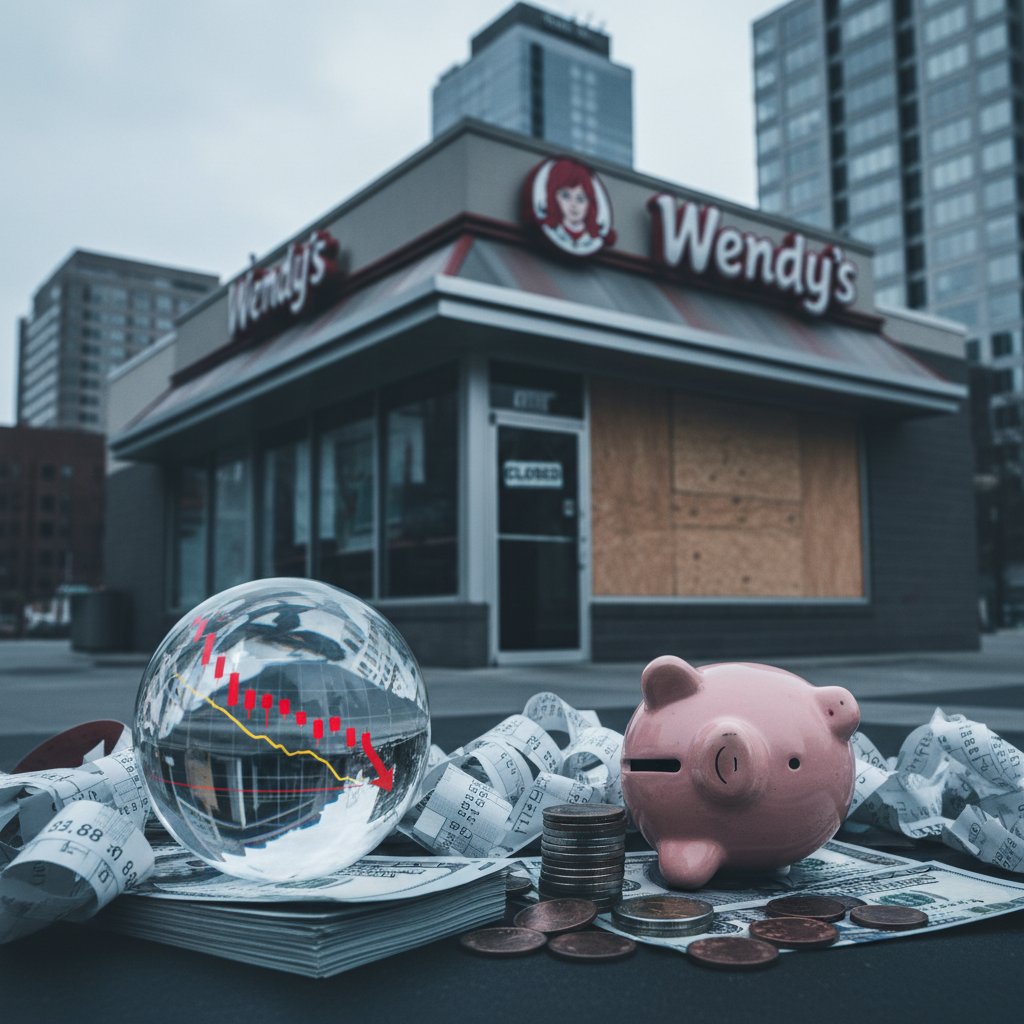
The red-and-white sign went dark last Tuesday on a busy corridor in Columbus, Ohio. The Wendy’s at 4th and Main-the one everyone in the Glenbrook neighborhood knew for its 4-for-$4 deal and the guy who always asked if you wanted a Frosty with that-was locked up by 3 p.m. A notice taped to the door cited “unforeseen operational challenges.” By Friday, the franchise owner had confirmed the closure. 67 employees were out of work.
That Wendy’s isn’t alone. Across the United States, fast-food closures are accelerating at a rate not seen since the 2020 pandemic. According to data from Technomic, Q1 2025 saw 412 fast-food restaurant closures nationwide-up 12.3% from the same period in 2024. Wendy’s, the third-largest burger chain by U.S. locations, accounted for 41 of those. That’s a 17% increase in Wendy’s closures year-over-year.
The Columbus location was a franchise owned by a mid-sized operator with 14 stores in Ohio. The parent company, The Wendy’s Company (NASDAQ: WEN), reports that 95% of its 7,000-plus U.S. restaurants are franchise-run. That means when the economics tighten, it’s the local owners-not corporate-that feel the squeeze first.
The Local Impact
Glenbrook isn’t a food desert-there’s a Chipotle two blocks away and a McDonald’s across the street-but the Wendy’s had been an anchor for the morning coffee crowd and late-night campus traffic. Ohio State University is less than a mile south. The closure leaves a noticeable gap in the dining landscape for a neighborhood where foot traffic has recovered to about 88% of pre-pandemic levels, according to Placer.ai.
What killed this store? Three things: labor costs that have risen 23% in Ohio since 2021, a food-cost inflation rate hovering around 6.5% even as menu prices hit consumer resistance, and a debt load from the 2023 remodel that the franchisee took on to meet Wendy’s new “Fresh, Forward” design standards. That remodel cost roughly $450,000 per location, according to franchise disclosure documents. For a store already running on thin margins-estimated at 3.2% before the remodel-it was a bet that didn’t pay off.
“The model is breaking under pressure,” says David Henke, a restaurant franchise consultant based in Chicago who has advised dozens of quick-service operators. “Corporate sets the menu prices, the royalty fees, the remodeling mandates, but the franchisee absorbs all the local inflation and labor legislation. When one variable spikes-like Ohio raising the minimum wage to $13.75 an hour this year-the math stops working.”
Why Wendy’s? A Broader Trend
Wendy’s specifically has been caught in a squeeze between value pricing and premium positioning. The chain’s “Biggie Bag” and $5 meal deals are designed to undercut McDonald’s on price, but those margins require high volume. The Columbus location had seen foot traffic drop 8% over the past 12 months, according to location data from Gravy Analytics. Customers shifted to drive-thru-only models or simply stayed home more.
Meanwhile, Wendy’s corporate has leaned into digital and AI. In February 2025, the chain announced a partnership with Google Cloud to expand its AI drive-thru ordering system to 300 locations by year-end. That’s great for efficiency on paper, but it leaves franchisees on the hook for the hardware and training-another cost for stores that may not have the transaction volume to justify it.
“The franchisee is caught in a paradox,” says Laura M. Schmidt, a professor of restaurant economics at Cornell University. “They have to invest in technology to keep margins from eroding further, but the payback period is uncertain. If a store is already in a declining traffic zone, that investment just accelerates the bleed.”
Schmidt points to data from the National Restaurant Association’s 2025 State of the Industry report, which found that 47% of franchise operators said they were “very concerned” about profitability over the next 12 months-up from 32% in 2023. Among burger chains, the figure was 52%.
What This Means for Franchise Owners
The Wendy’s closure in Columbus is a microcosm of a larger structural shift. The era of fast-food expansion is yielding to consolidation. Chains that relied on unit growth to drive earnings-Wendy’s opened 62 new stores globally in Q1 2025-are now seeing closures outpace openings in mature markets. In the U.S., Wendy’s had a net negative store count for the first time since 2019.
Franchise owners are feeling the heat on multiple fronts. Insurance premiums have risen 18-25% across the restaurant sector in the last two years, according to data from the Insurance Information Institute. Commodity costs are volatile: beef prices hit a record $5.12 per pound in February 2025, according to USDA data. And the Federal Reserve’s decision to hold interest rates at 5.25-5.5% means debt service on franchise loans is eating up cash flow.
The Columbus operator, who asked not to be named, told a local business journal that the store had been “treading water” for 18 months. The 2023 remodel loan at 8.9% interest was the last straw. “We had two choices,” the owner said. “Close one or close four. We saved the other three.” That kind of arithmetic is playing out across the system.
Wendy’s corporate has pushed back, pointing to same-store sales growth of 2.1% in Q1 2025 and a successful breakfast launch. But breakfast margins are thinner, and the bulk of that growth came from franchised stores in international markets-not the U.S. heartland.
The Bottom Line
For readers in the U.S., UK, and Canada, the takeaway is clear: the fast-food value proposition that defined the post-recession decade is fraying. A $5 meal in 2025 buys about 25% less than it did in 2020, adjusting for inflation. Consumers are pulling back: traffic at U.S. fast-food chain locations fell 2.6% in Q1 2025, according to NPD Group.
Wendy’s stock closed at $18.42 on Friday, down 3.2% on the week. Analysts at Piper Sandler downgraded the stock to “neutral” on Monday, citing “franchisee health” as a growing risk. The last time Wendy’s saw this many closures in a quarter was Q2 2020, when pandemic lockdowns shuttered the industry.
But this time feels different. This isn’t a virus. It’s a slow financial calcification-higher costs, shifting habits, and a model that once seemed bulletproof now showing cracks. The Columbus store is dark, but the question for the industry is how many more will follow before the next earnings call.