








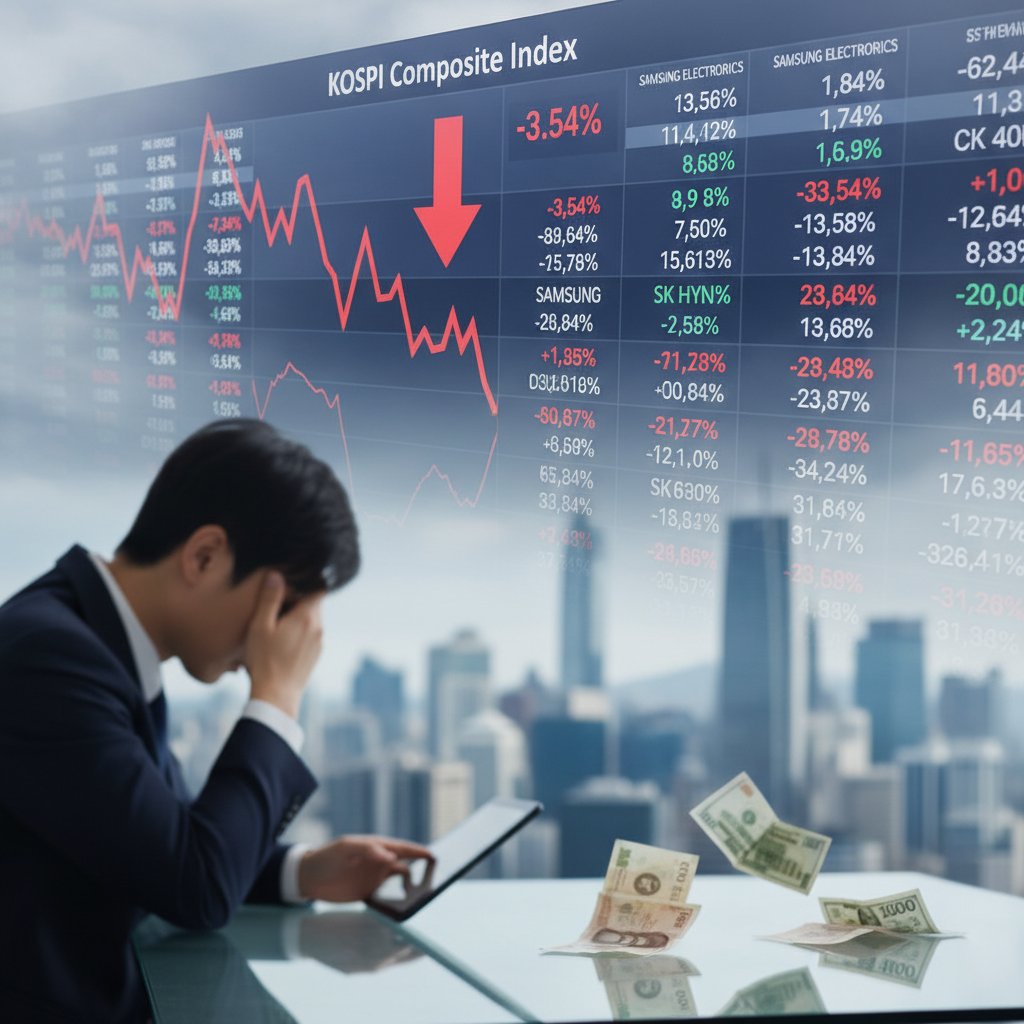
The tech rout on Wall Street deepened Tuesday, spreading to Asia as South Korea’s benchmark KOSPI index cratered 4.1%-its worst single-day drop in over a year. The sell-off, driven by escalating trade tensions and a flight from risk assets, erased nearly $80 billion in market value from Seoul-listed stocks, with semiconductor heavyweights like Samsung Electronics and SK Hynix bearing the brunt of the losses.
The trigger? A combination of renewed U.S.-China tariff threats and a sharp decline in Nvidia and other AI-linked stocks overnight. The Nasdaq Composite fell 2.8% on Monday, its steepest slide since October 2023, as investors rotated out of high-growth tech names amid rising bond yields and hawkish Fed commentary.
The KOSPI Bloodbath: What Happened?
South Korea’s KOSPI index closed at 2,456.45, down 104.3 points, marking its lowest level since January. The sell-off was broad-based: all but 12 of the 900+ listed stocks finished in the red. Samsung Electronics, the country’s largest company by market cap, dropped 5.2%, while SK Hynix-a key supplier of memory chips to Nvidia-tumbled 6.8%.
“The KOSPI is particularly vulnerable because it’s heavily weighted toward semiconductors and tech manufacturing,” notes Dr. Soo-jin Park, a market strategist at Seoul-based Hanwha Investment & Securities. “When global tech sentiment sours, Seoul feels it first.”
The sell-off wasn’t limited to tech. Export-oriented automakers and shipbuilders also took a hit. Hyundai Motor fell 3.1%, and steelmaker POSCO Holdings shed 2.9%. The Korean won weakened 0.7% against the dollar, adding pressure on foreign investors to repatriate capital.
Wall Street’s Tech Wreck Sets the Stage
The carnage in Asia followed a brutal session on Wall Street. The Nasdaq suffered its worst day in five months, led by a 4.7% plunge in Nvidia, a 3.9% drop in AMD, and a 2.5% decline in Apple. The Philadelphia Semiconductor Index, a bellwether for chip stocks, cratered 4.1%.
Analysts attribute the sell-off to a sudden repricing of risk after Federal Reserve Chair Jerome Powell signaled that interest rates could stay higher for longer. “The market had been pricing in three rate cuts this year. Powell’s comments effectively killed that narrative,” says Emily Torres, a senior equity analyst at New York-based Alpine Capital Management. “Tech stocks, especially those with high valuations, are getting hammered because their future cash flows are being discounted at higher rates.”
The yield on the 10-year U.S. Treasury note surged to 4.72%, up 12 basis points from last week, making growth stocks less attractive. The VIX, Wall Street’s fear gauge, spiked 18% to 22.4, its highest since March.
Trade Tensions and a Flash Crash in Korea
The KOSPI’s plunge was exacerbated by a flash crash in the final hour of trading. Algorithmic trading systems triggered a cascade of sell orders after a large institutional block trade in Samsung Electronics hit the exchange. The Korea Exchange briefly halted trading in Samsung shares under its circuit breaker rules, but the damage was done.
“This was a classic liquidity event,” explains Mark Chen, a derivatives trader at Nomura in Hong Kong. “When one big player exits in a thin market, it creates a vacuum. The algorithms see the drop and sell into it, amplifying the move.”
Compounding the anxiety: renewed U.S. threats to impose tariffs on Chinese semiconductors and a potential ban on exports of advanced chipmaking equipment to China. South Korea’s tech sector is heavily exposed-Korea shipped $42 billion worth of chips to China in 2023, representing 28% of its total semiconductor exports.
“Any escalation in trade restrictions would hit Korea’s memory chip makers hard,” says Dr. Park. “Samsung and SK Hynix rely on Chinese demand for about a third of their revenue. The market is pricing in that risk now.”
What This Means for Global Markets and Your Portfolio
For investors, the widening sell-off signals a broader shift in market sentiment. The tech-heavy KOSPI’s collapse mirrors similar declines in Japan’s Nikkei (-2.3%) and Taiwan’s Taiex (-2.8%) overnight. The sell-off is spreading beyond semiconductors: European tech stocks also dropped, with the STOXX Europe 600 Technology Index falling 1.9%.
“This isn’t an isolated event-it’s a global repricing of risk in the tech sector,” cautions Torres. “If you’re overweight in growth stocks, especially in AI and chips, it’s time to reassess your exposure. The easy money has been made.”
Bond markets are signaling caution. The 10-year U.S. Treasury yield’s rise above 4.7% is a red flag for equities, particularly for companies with high debt loads or speculative valuations. Emerging market funds are seeing outflows: $3.2 billion exited Asia ex-Japan equity funds in the past week, according to EPFR data.
Your takeaway: Diversify. Consider adding defensive sectors like utilities, healthcare, or consumer staples. And keep an eye on the Bank of Korea-it meets next week and may cut rates to cushion the blow. But don’t expect a quick recovery. “The KOSPI could test 2,400 before finding support,” warns Chen. “This sell-off has more room to run.”
As the dust settles, one thing is clear: the tech-driven bull market that roared through 2023 is hitting a wall. With trade tensions escalating, interest rates staying higher, and valuations stretched, the path forward for global tech stocks looks bumpy. For South Korea, a nation that bet its economic future on chips, the stakes couldn’t be higher.