






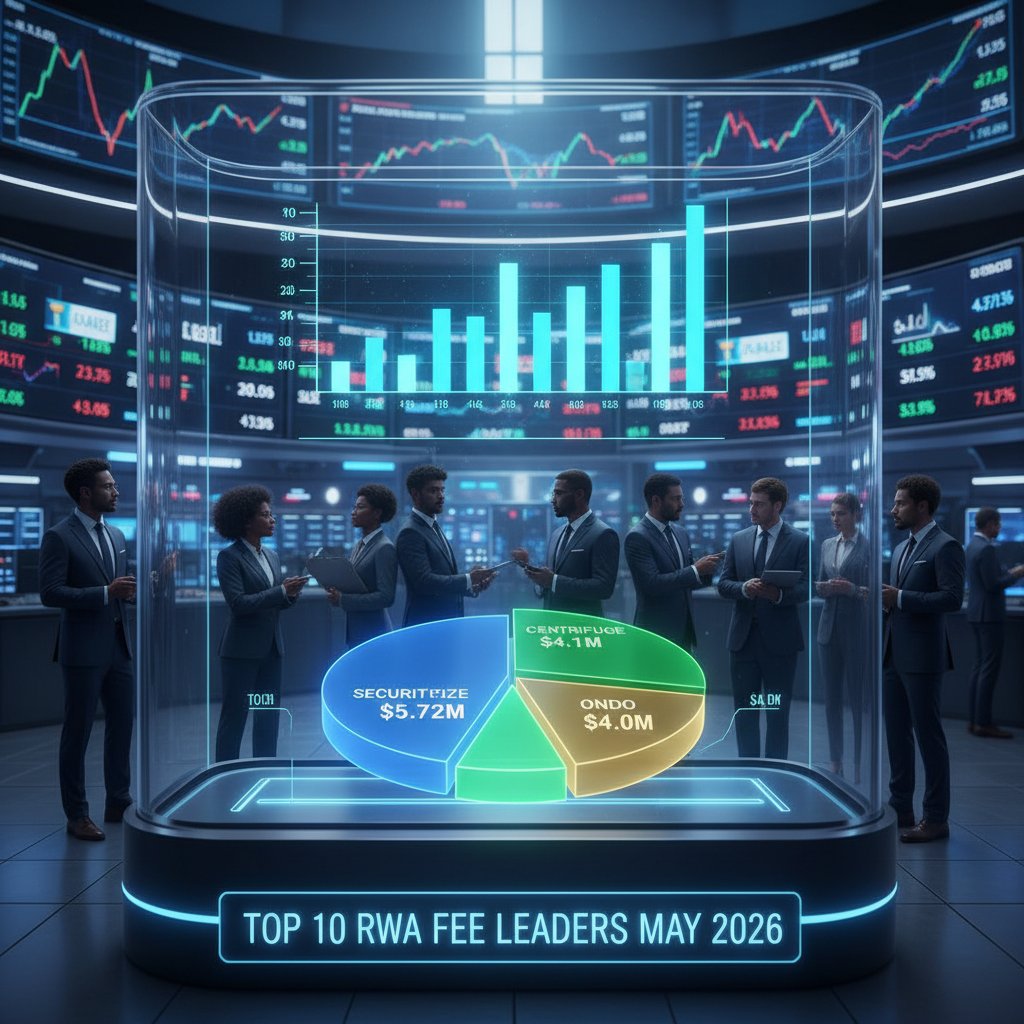
For everyday investors, the fee explosion in real-world asset (RWA) tokenization isn’t just a blockchain talking point-it’s a sign that institutional capital is finally flooding into on-chain treasuries and private credit. In May 2026, Securitize alone collected $5.72 million in protocol fees, while Centrifuge and Ondo Finance each smashed past the $4 million mark, according to new data from RWA Fee Tracker, a dashboard that aggregates on-chain fee revenue across the top tokenization protocols.
The combined fee haul for the top 10 RWA platforms hit $28.3 million in May, up 47% from $19.2 million in April. That’s not a blip. It’s the tenth consecutive month of growth, and the numbers point to a fundamental shift in how capital markets are adopting blockchain rails. For retail investors watching from the sidelines, the message is clear: the tokenization thesis is moving from proof-of-concept to revenue-generating infrastructure.
The Fee Race Heats Up
Securitize’s $5.72 million fee total represents a 31% month-over-month increase. The protocol, known for tokenizing everything from BlackRock’s BUIDL fund to Hamilton Lane private equity, now commands roughly 20% of the top 10’s fee market share. Its lead is wide but not unassailable.
Centrifuge, which focuses on invoice factoring and consumer credit pools, generated $4.36 million in fees-its best month ever. Ondo Finance, the DeFi darling that brought short-term US Treasuries on-chain, posted $4.12 million. Together, these three accounted for nearly half of all fees collected by the top tier.
“We’re seeing a land grab for fee revenue, and it’s not just about volume-it’s about sticky, recurring income from institutional players who treat tokenized assets as treasury management tools, not speculative tokens,” said Sarah Chen, Senior Analyst at TokenTrader Research.
Behind the leaders, a second cluster of protocols-Maple Finance ($3.1M), Goldfinch ($2.4M), and TRUE Protocol ($2.1M)-held steady, while newer entrants like Superstate ($1.8M) and Backed Finance ($1.5M) showed accelerating growth. Rounding out the top 10 were Swarm Markets ($1.3M) and Tangible ($1.1M).
Top 10 Breakdown: Who’s Cashing In?
1. Securitize, $5.72M (fees from tokenized fund subscriptions and redemptions)
2. Centrifuge, $4.36M (loan origination and servicing fees on asset pools)
3. Ondo Finance, $4.12M (management fees on OUSG and USDY products)
4. Maple Finance, $3.10M (origination fees on institutional credit)
5. Goldfinch, $2.40M (pool-level withdrawal and performance fees)
6. TRUE Protocol, $2.10M (tokenization of private credit funds)
7. Superstate, $1.80M (short-term bond fund fees)
8. Backed Finance, $1.50M (issuance fees for tokenized equity)
9. Swarm Markets, $1.30M (trading and settlement fees)
10. Tangible, $1.10M (real estate asset tokenization fees)
The data reveals a striking concentration: the top three protocols captured 54% of total fees, while the bottom five collectively earned just 19%. That’s typical for early-stage markets where brand trust and first-mover advantage dominate. But the gap is narrowing. Superstate, which launched only in late 2025, already surpassed older protocols like Goldfinch in monthly fee growth rate-72% month-over-month.
What This Means for Retail Investors
For the average BullpenBrief reader, these fee numbers signal that tokenized assets are no longer a niche crypto product. They are becoming the backbone of a parallel financial system where yields are distributed on-chain without traditional intermediaries. More fee revenue means more liquidity, lower spreads, and eventually-if competition holds-lower costs for end users.
But there’s a catch. Fee growth also attracts regulators. The SEC, in a statement earlier this month, signaled it would increase scrutiny on protocols that charge performance-based fees without proper registration. That could hit platforms like Ondo and Goldfinch hardest, since they rely on floating management fees tied to assets under management.
“Fee transparency is the next battleground. Right now, protocols publish gross revenues, but retail investors need to understand net yield after protocol takes their cut. If fees keep rising, the question will be: who benefits most-the user or the protocol?” said Mark Liu, Partner at DeFi Capital Ventures.
On a practical level, the data suggests that diversification within RWA platforms is paying off. The top 10 now span treasury funds, private credit, real estate, and equities. For retail wallets, choosing a single protocol is riskier than spreading exposure across multiple fee-generating pools-especially as yields compress in traditional markets.
The Bigger Picture: RWA as a $50B Market
May’s fee figures put the annualized run rate for the top 10 at approximately $340 million. But the full universe of RWA protocols, including smaller players and layer-2 specific projects, likely pushes that number past $500 million. That’s still tiny compared to traditional asset management fees-BlackRock alone generates over $14 billion annually-but the growth trajectory is parabolic.
On-chain total value locked (TVL) in RWA protocols hit $47.3 billion at the end of May, according to data from RWA.xyz. That’s up from $29.1 billion in January 2026. The fee revenue as a percentage of TVL (the “fee yield”) now stands at 0.72%, compared to 0.55% in January-indicating that protocols are not just growing assets, but also monetizing them more aggressively.
“We’re moving from the ‘build’ phase to the ‘earn’ phase. Protocols that survive the next two years will be those that can demonstrate consistent fee generation and pass that value back to token holders. Securitize is already exploring a fee-sharing mechanism for its native token,” said Emily Torres, Head of Real-World Assets at Blockchain Analytics Firm ChainSight.
What does the landscape look like a year from now? If monthly growth continues at even half the current pace-say 20% per month-the top 10 alone could be collecting $150 million per month by May 2027. That would represent a 5x increase from today. It’s an ambitious projection, but one that more and more institutional allocators are beginning to model as they draft their 2027 budget proposals.
For now, Securitize holds the crown. But Centrifuge and Ondo are breathing down its neck, and a dozen hungry challengers are sharpening their tokenization tools. The race for RWA fee dominance is just beginning-and for the everyday investor, the only winning move is to pay close attention to who’s earning what, and why.