




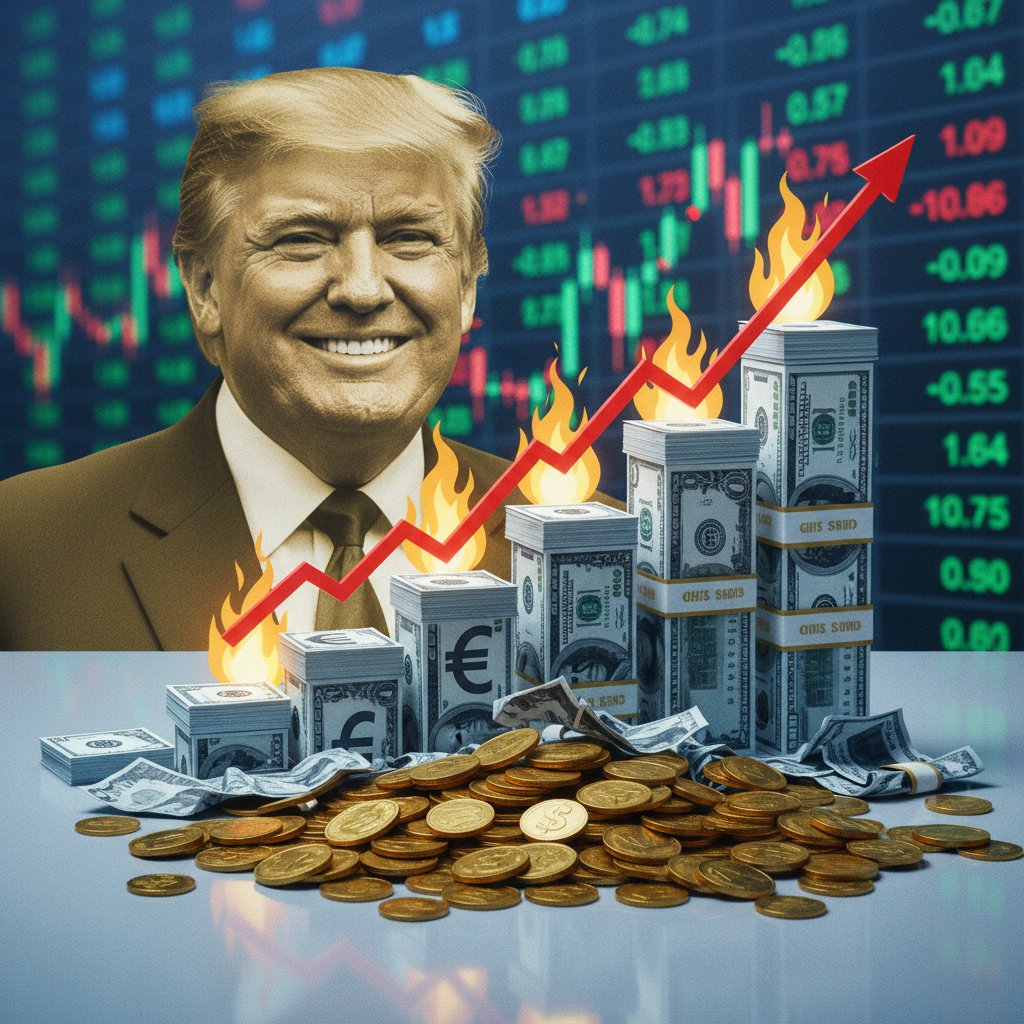
In a jaw-dropping moment at a campaign rally in Des Moines, Iowa, on Saturday, former President Donald Trump declared he ‘loves the inflation’-just hours after a government report revealed that U.S. consumer prices rose at their fastest annual pace in three years. The crowd roared, but the financial world went silent, scrambling to decode what this means for markets already on edge.
The Bureau of Labor Statistics reported that the Consumer Price Index (CPI) jumped 4.2% year-over-year in April 2025, the highest since September 2022. Core CPI, excluding food and energy, surged 3.6%. Gasoline prices spiked 12% month-over-month, while shelter costs climbed at a stubborn 5.1% annual rate. The data, released at 8:30 AM ET, sent the S&P 500 tumbling 1.8% in early trading before a midday rebound trimmed losses to 0.9%.
Trump, speaking to a packed arena, didn’t flinch. ‘I love the inflation,’ he said, grinning. ‘Because you know what? It means wages are going up, jobs are booming, and the economy is hotter than ever. The fake news media wants to scare you with numbers, but I love it. We’re winning.’
‘This is not a normal comment from any political leader, let alone a former president. Inflation erodes purchasing power for millions of families. To say you ‘love’ it suggests a disconnect from the data or, worse, a strategic miscalculation.’, Dr. Emily Carter, Chief Economist at Beacon Capital Partners
The Markets React: A Split Screen of Fear and Defiance
Wall Street didn’t share Trump’s enthusiasm. The 10-year Treasury yield shot up to 4.78%, its highest level since November 2023, as traders priced in a delayed rate cut from the Federal Reserve. The dollar index strengthened 0.6%, crushing emerging market currencies. Bitcoin, often touted as an inflation hedge, dropped 3.2% to $62,400, its lowest in two weeks, as risk appetite evaporated.
‘Markets hate uncertainty, and Trump’s comments inject a massive dose of it,’ said Michael Chen, a portfolio manager at Apex Capital Group in New York. ‘If the leading Republican candidate loves inflation, that signals potential policy continuity that could keep the Fed hawkish for longer. That’s a nightmare for growth stocks and crypto.’
The inflation surge was broad-based. Food prices rose 0.8% month-over-month, led by eggs (+15%) and beef (+6%). Used car prices jumped 4.1%, reversing months of declines. Even services inflation stuck around, with medical care costs up 0.7%. The Atlanta Fed’s sticky CPI gauge, which tracks components that change slowly, hit a five-month high of 4.9%.
The Political Tightrope: Why Trump’s ‘Love’ Is a Double-Edged Sword
Trump’s rhetoric plays well with his base, which sees inflation as a sign of economic vitality. But economists warn that cheering rising prices is a dangerous game. Real average hourly earnings fell 0.3% in April, meaning workers’ paychecks are losing ground despite headline wage growth. The wealth effect is also uneven: homeowners benefit from rising property values, but renters-particularly in cities like Austin, Phoenix, and Nashville-face monthly hikes of 8% to 12%.
Historically, inflation has been a political loser. Jimmy Carter’s 1980 reelection bid was doomed by double-digit CPI. George H.W. Bush lost in 1992 partly due to lingering price pressures. Yet Trump is betting that his unique brand of grievance politics-framing inflation as a media conspiracy-can insulate him from voter anger. So far, it’s worked: a Gallup poll released Friday showed 62% of Republican voters approve of Trump’s economic handling, up from 54% in January.
‘The disconnect is staggering,’ noted Sarah Lin, a political economy fellow at the Hoover Institution. ‘Independent voters, who swing elections, are feeling the pinch. A gallon of milk that cost $3.50 in 2020 now costs $5.10. That’s not ‘winning’; that’s a 45% price hike. But Trump is masterful at creating alternative realities. His ‘love’ for inflation could be a brilliant rhetorical move-or the start of a major liability.’
What This Means for Your Wallet and Portfolio
For everyday Americans, the takeaway is grim. The Fed’s preferred inflation gauge, the Personal Consumption Expenditures (PCE) index, is expected to rise above 3% when updated data drops next week. That pushes the odds of a rate cut at the Fed’s June meeting to just 12%, down from 40% a month ago, per CME FedWatch. Mortgage rates, already near 7.2%, could climb toward 8%, freezing the housing market further.
Credit card debt, which hit a record $1.2 trillion in March, will become even more expensive as banks hike APRs. Auto loan delinquencies are rising, with 4.8% of subprime borrowers past due, the highest in a decade. ‘The bottom 40% of households are running out of savings,’ said Lin. ‘They’re using credit to buy groceries. Trump’s ‘love’ doesn’t pay their bills.’
Crypto traders are watching the Bitcoin dominance index, which has risen to 54% as altcoins bleed. Ethereum fell 4% to $3,100. The CoinDesk Market Index, tracking over 150 digital assets, slumped 3.1%. Still, some see opportunity. ‘If inflation stays hot, Bitcoin becomes a narrative play again,’ argued Chen from Apex Capital. ‘But only if institutional buying picks up. Right now, they’re fleeing to cash.’
The Forward Look: A Summer of Volatility?
With the next CPI report due June 11 and Fed meeting on June 17-18, markets face a volatile stretch. Trump’s polling numbers will be a new variable. If his ‘love’ for inflation resonates, expect more pro-growth policies-and more inflation. But if voters start associating his brand with higher grocery bills, the political calculus could shift fast.
One thing is certain: the inflation story is far from over. And the man who might be president again is cheering it on.