



Everyone assumes AI stocks are unstoppable. Nvidia has tripled in two years. The Nasdaq’s gains are almost entirely driven by seven names. Money is pouring into AI-themed ETFs like it’s 1999 all over again, except this time, people keep muttering the same three letters: dot-com.
But here’s what’s actually happening: cracks are forming. Valuations are stretched to levels that make even the most bullish strategists wince. And while AI adoption is real, the market’s pricing assumes perfection delivered tomorrow, not next decade. That’s a dangerous game.
So is this a bubble? Or is it just an overpriced revolution? We asked strategists, crunched the numbers, and looked back at history. The answer? It’s complicated, but the parallels to 1999 are getting harder to ignore.
The Magnificent Seven and the 2000 Déjà Vu
Let’s start with the obvious: the market’s concentration. The so-called ‘Magnificent Seven’, Apple, Microsoft, Alphabet, Amazon, Nvidia, Meta, Tesla, now account for roughly a third of the S&P 500’s total market cap. That’s a level of top-heavy dominance not seen since the peak of the internet bubble, when Microsoft, Cisco, Intel, and a handful of others owned the index.
Nvidia alone trades at over 40 times forward earnings. Its market cap has ballooned past $3 trillion, more than the entire FTSE 100 combined. And it’s not just Nvidia. The entire AI ecosystem, chipmakers, cloud providers, data center REITs, software firms with an AI pitch, has been bid up to nosebleed multiples.
“The current valuation of AI-related stocks is reminiscent of the late 1990s tech bubble, but with a twist, companies today have actual earnings, albeit at high multiples,” says David Kostin, head of U.S. equity strategy at Goldman Sachs. “That doesn’t make them cheap. It just makes the crash scenario less cataclysmic.”
Goldman’s own research shows that the median AI stock in their coverage trades at 28 times next year’s sales. During the internet peak, the median tech stock traded at 10 times sales. But here’s the catch: many of those 1999 companies had zero profits and barely any revenue. Today’s AI leaders are cash-generating machines, Nvidia, Microsoft, and Google all throw off billions. The question is whether the premium is justified or whether investors are paying for growth that won’t materialize.
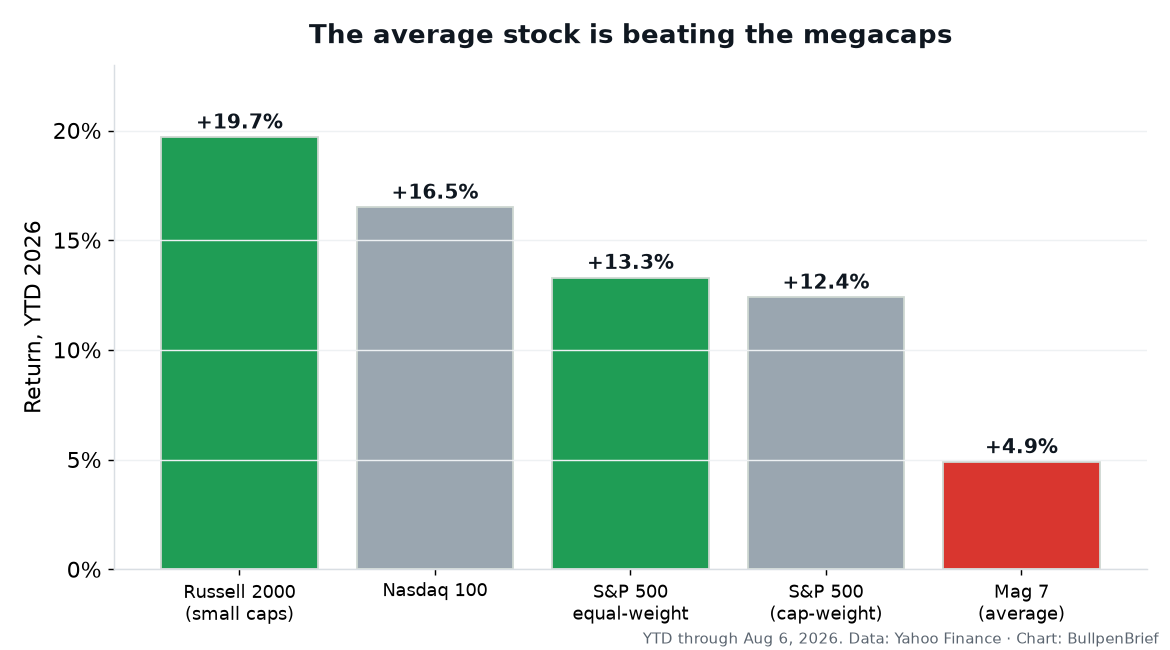
And then there’s the ‘Granite’ effect, a term coined by some analysts for the widening gap between AI leaders and the rest of the market. The S&P 500 equal-weight index is up barely 4% this year, while the cap-weighted index is up 15%. That divergence is eerily similar to 1999, when the equal-weight index lagged by nearly 20 percentage points before the crash.
Strategists Warn: ‘This Time Is Not Different’
Liz Ann Sonders, chief investment strategist at Charles Schwab, has been tracking the breadth problem for months. She points out that less than 40% of S&P 500 stocks are trading above their 200-day moving average, an unusually low number for an index hitting new highs.
“We are not in a bubble yet, but the narrowness of leadership is concerning. When a handful of stocks drive the entire market, it’s a red flag. History shows that these periods of extreme concentration often end with a sharp reversion,” Sonders said in a recent note.
Other strategists are more blunt. Michael Hartnett, chief investment strategist at Bank of America, recently wrote that AI mania is showing ‘textbook bubble behavior.’ He noted that flows into AI-focused funds have hit record levels, while sentiment surveys show retail investors are more bullish on tech than at any point since 2000. BofA’s proprietary ‘Bull & Bear’ indicator is flashing a contrarian sell signal.
That’s not to say everyone is bearish. Some argue that the AI revolution is fundamentally different, a productivity-enhancing technology on par with electricity or the internet itself. But even the bulls admit that valuations don’t leave much room for error. A slight miss on earnings could trigger a 20-30% correction in high-flying names.
Look, this isn’t about predicting the exact top. It’s about recognizing that when everyone piles into the same trade, the exit door gets narrow. The February 2025 mini-crash in AI stocks, where Nvidia fell 15% in a week on a tepid guidance update, showed just how fragile the narrative can be.
For a practical guide on navigating current volatility, check out Weekday Help & Victory Thread: June 22, 2026, Your Survival Guide for a Volatile Market.
What Could Pop the AI Bubble?
Every bubble has a pin. In 2000, it was rising interest rates and a sudden realization that Pets.com wasn’t a viable business model. This time, the potential triggers are multiple.
- Federal Reserve policy: If the Fed holds rates higher for longer to combat sticky inflation, the discount rate on future earnings rises. That directly hurts high-multiple stocks. The tech-heavy Nasdaq is far more sensitive to rates than the rest of the market.
- Regulation: Governments from the EU to China are tightening rules around AI development. The EU’s AI Act, set to be fully enforced by 2026, could impose compliance costs that eat into margins. Worse, a clampdown on chip exports could disrupt Nvidia’s supply chain.
- Earnings disappointment: Analysts expect AI companies to grow earnings by 30%+ annually for the next three years. One slip, from a clearinghouse, a hyperscaler spending pause, or a competitor catching up, and the multiples will contract fast.
- Geopolitical shock: Taiwan remains a flashpoint. An interruption in TSMC’s chip production would bring the entire AI ecosystem to a standstill.
As John Stoltzfus, chief investment strategist at Oppenheimer, put it: “The AI trade is priced for perfection. Any imperfection will be punished harshly.”
But here’s the thing: bubbles don’t burst overnight. The 1999 Nasdaq kept climbing even after Alan Greenspan’s ‘irrational exuberance’ speech in 1996. It took three more years and a Fed tightening cycle to finally pop. The same could happen here, we might have a rally ahead before the reckoning.
For those feeling jittery, our sister article Panic at 30: Why Your 401(k) Is Fine and You’re Not offers perspective on why long-term investors should stay the course, even during turbulence.
How Investors Should Position Themselves
So what do you do? Sell everything? Buy more? The answer depends on your time horizon and risk tolerance. But strategists we spoke to offered a few consistent recommendations.
First, diversify. The AI trade is crowded. Owning only the Magnificent Seven is like owning only tech stocks in 1999, it worked until it didn’t. Consider adding exposure to value sectors like energy, healthcare, or financials, which trade at much lower multiples and offer dividends.
Second, look for ‘real’ AI. Not every company that slaps ‘AI’ on its product is the next Nvidia. Focus on firms with proven revenue, wide moats, and sustainable competitive advantages, think cloud hyperscalers, enterprise software leaders, and chip foundries. Avoid the hype-driven SPACs and pre-revenue startups that bloomed during the 2021 frenzy.
Third, dollar-cost average. Trying to time the top is a fool’s errand. If you believe AI will transform the economy over the next decade, then periodic buys during dips are smarter than a lump sum at current levels.
Finally, hedge. Options strategies, buying puts on QQQ or individual AI names, can cap downside. But don’t overdo it; carrying a full hedge against a 1999-style crash is expensive and rarely pays off unless you’re right on timing.
As a reminder: the last time everyone said ‘this time is different,’ it wasn’t. The companies that survived the 2000 crash were the ones with real earnings and durable business models, Amazon, Apple, Microsoft. The rest vanished. The same sorting process is likely coming to AI.
For context, here’s a look at what strategists are watching: Reuters covered Nvidia’s valuation risks back in May 2024, and AP News recently highlighted bubble fears among retail investors.
Frequently Asked Questions
Frequently Asked Questions
- Are AI stocks in a bubble? Many strategists believe AI stocks exhibit bubble characteristics, extreme valuations, narrow leadership, euphoric sentiment, but whether it’s a full-blown bubble or just an overvalued trend depends on whether earnings can catch up. The historical parallels to 1999 are concerning, but today’s AI leaders have actual profits.
- How does the current AI rally compare to the dot-com bubble? In both cases, a handful of tech names drove most of the market’s gains, valuations soared to historic highs, and retail investors piled in. The difference: today’s AI companies generate real cash flow, whereas many dot-com firms had no earnings. That makes a 2000-style crash less likely, but a sharp correction is still possible.
- What should investors do right now? Diversify away from concentrated tech positions, focus on companies with solid fundamentals, dollar-cost average to avoid timing risks, and consider hedging through options. Long-term investors should not panic-sell but should rebalance gradually to reduce exposure to the most overvalued names.