

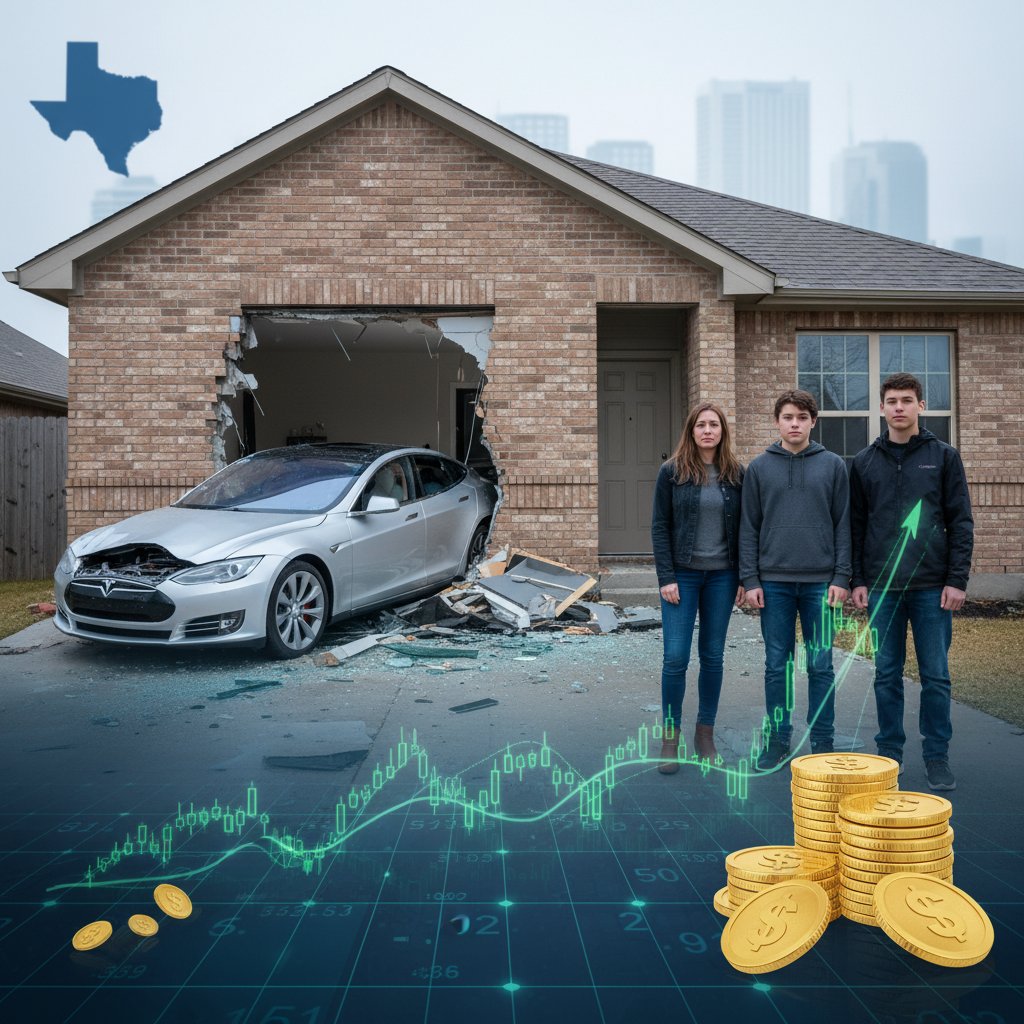
I remember the first time I saw a Tesla glide past me in Austin, silent and unsettling. It looked like the future, until the future started crashing into living rooms. Now a family in Texas is dragging Elon Musk’s automaker into court after a Model Y plowed into their home, killing a 70-year-old woman inside. And the timing couldn’t be worse for a company already battling safety concerns and a stock that’s taken a hit, Musk just lost his trillionaire status as the tech rout erased $150 billion from his net worth.
The Crash That Changed Everything
On the evening of July 18, 2024, a 2023 Tesla Model Y was barreling down a residential street in Spring, Texas, a Houston suburb. Witnesses say the car never slowed. It jumped the curb, tore through a chain-link fence, and slammed directly into the front of a brick house where 74-year-old Mary Hernandez was watching TV in her favorite recliner.
The impact killed her instantly. Her daughter, Linda Reyes, who was in the kitchen making tea, told local reporters she heard “a sound like a bomb” and then silence. The driver, a 32-year-old man whose name has not been released, survived with minor injuries. He told police the car was in Autopilot mode and that he “didn’t have time to react.”
In October, the Hernandez family filed a wrongful death lawsuit against Tesla Inc. in Harris County District Court. The suit alleges negligence, product liability, and failure to warn, claiming Tesla knew its “Full Self-Driving” and Autopilot systems were flawed but marketed them as safe anyway. Attorneys for the family argue the car’s sensors failed to detect the curb, the fence, or the house, a structure sitting less than 30 feet from the road.
“This was not an accident. This was a foreseeable consequence of Tesla rushing an incomplete, dangerous system to market,” said Jessica Tran, lead attorney for the Hernandez family. “They’ve sold the public on a fantasy of autonomous driving, and a grandmother paid for it with her life.”
A Pattern of Deadly Misunderstandings
Look, this isn’t Tesla’s first fatal crash involving driver-assist tech. The National Highway Traffic Safety Administration (NHTSA) has opened more than 40 investigations into crashes where Tesla’s Autopilot was suspected of being engaged. Reuters reported in October that the agency had linked 16 deaths to Autopilot since 2021. But this case is unique, the victim wasn’t in the car. She was minding her own business in her own home.
That distinction matters. Product liability experts say it could open a new front in the legal war against autonomous driving systems. “When the victim is outside the vehicle, the duty of care shifts,” said Mark Delaney, professor of tort law at the University of Texas at Austin. “The car’s manufacturer owes a duty to the occupants and to everyone on or near the roadway, and a home is absolutely part of that zone of danger. Tesla can’t argue the driver assumed the risk for a woman sitting in her living room.”
Tesla’s defense will likely lean on the driver’s responsibility. Section 2 of the owner’s manual states: “Autopilot is a driver-assist system that requires active driver supervision.” The company has repeatedly settled or won cases by arguing that drivers failed to pay attention. But the Hernandez family’s suit claims the system itself was defective, that it didn’t brake, didn’t steer, and didn’t even alert the driver when it approached an object larger than a mailbox.
Court documents obtained by BullpenBrief show that the Model Y’s onboard data recorder logged no steering input for 7 seconds before impact. Speed remained at 45 mph, the posted limit, but the car was 200 feet from the house when a human driver would have clearly seen the fence and the structure. The suit cites internal Tesla emails from 2022 where engineers expressed “concerns about false negatives in stationary object detection at speeds above 40 mph.”
The Ripple Effect on Tesla’s Brand, and Bottom Line
This lawsuit lands as Tesla’s reputation is wobbling. Fatal crashes, a recall of every Cybertruck built so far, and a stock that is down 25% from its 2024 peak have investors nervous. Musk’s personal wealth took a massive hit when SpaceX’s valuation slipped amid a broader tech selloff, he’s now just a billionaire among billionaires. The Hernandez case adds legal liability to the list of headaches.
It also reignites the debate about whether Tesla’s branding of “Autopilot” and “Full Self-Driving” is inherently misleading. In 2023, a California jury ruled in favor of Tesla in a similar case, but the family there was inside the car. This time, the victim had no control, no warning, and no way to consent. Analysts say the risk of a massive punitive damages award is real, especially in Texas, where juries are known for holding corporations accountable (just ask the companies hit with billion-dollar verdicts in the state).
“This case is different because the victim is a completely innocent bystander,” said Laura Chen, a safety advocate with the Center for Auto Safety. “If I’m Tesla’s legal team, I’m terrified. The narrative sells itself: a woman dies in her own living room because a car couldn’t see a house. That’s not a bug, that’s a brand failure.”
What Happens Next?
Discovery is expected to take 12 to 18 months. Tesla will likely file a motion to dismiss, arguing that the driver’s negligence supersedes any defect. But the plaintiffs’ attorneys have already subpoenaed internal Tesla documents related to sensor calibration and software updates. They’re also seeking data from the driver’s phone to determine if he was distracted before the crash.
The Hernandez family isn’t just asking for compensation for medical expenses and funeral costs. They’re seeking punitive damages, which in Texas can exceed $750,000 under cap law, but can be higher if malice or gross negligence is proven. They’ve also asked for a court order requiring Tesla to disable Autopilot on all vehicles in the state “until the system can reliably detect stationary objects.” A long shot, legally, but the publicity alone could pressure Tesla to issue a software fix.
For now, the house in Spring stands empty, boarded up, because the structural damage was so severe the city condemned it. Mary Hernandez’s daughter, Linda, told a local TV station she drives past every day. “I see my mother’s house and all I can think is, that car didn’t even slow down. It just kept going. And Tesla knew it didn’t see things. They just didn’t care.”
This case won’t just be about one family. It could set a precedent for how we treat autonomous tech when it kills people who never got into the car. And that’s a conversation the industry can’t afford to ignore, especially not when the next crash might be into your kitchen.
Frequently Asked Questions
Can Tesla be held liable if the driver was using Autopilot?
Yes, under certain conditions. While Tesla’s terms require the driver to stay engaged, if a system defect (like failing to detect a stationary house) is proven, both the driver and Tesla can be named in a lawsuit. The Texas family’s case focuses on product liability, arguing the car itself was unreasonably dangerous.
Has Tesla ever been sued successfully for Autopilot crashes?
Mixed results. Tesla has won some lawsuits by arguing driver misuse, but it has also settled others confidentially. In 2023, a California jury ruled Tesla liable for a crash where Autopilot was engaged, though damages were reduced. No US case has yet resulted in a major punitive award, but the Hernandez lawsuit could change that.
What should I do if a self-driving car crashes into my property?
Document everything immediately. Call 911, get the police report, take photos of the vehicle, your property, and any data displays. Request the car’s event data recorder (EDR) information. Contact a lawyer experienced in product liability and autonomous vehicle law, standard auto insurance often doesn’t cover claims related to semi-autonomous systems.