






Every token unlock arrives with the same warning: brace for the dump. We tested it on the whole record. Across 5,664 cliff unlocks by 186 projects since 2018, the month after an unlock is worse than a random month for the same token by about two percentage points. That is real, and it is far smaller than the story.
Most of the fall has nothing to do with the unlock
The number that usually gets quoted is the token’s return around the unlock date. That number mostly measures something else: altcoins losing ground to bitcoin all the time. To separate the two, we measured every unlock against 4,678 placebo windows, drawn from the same tokens over the same years but on dates with no cliff unlock within 30 days.
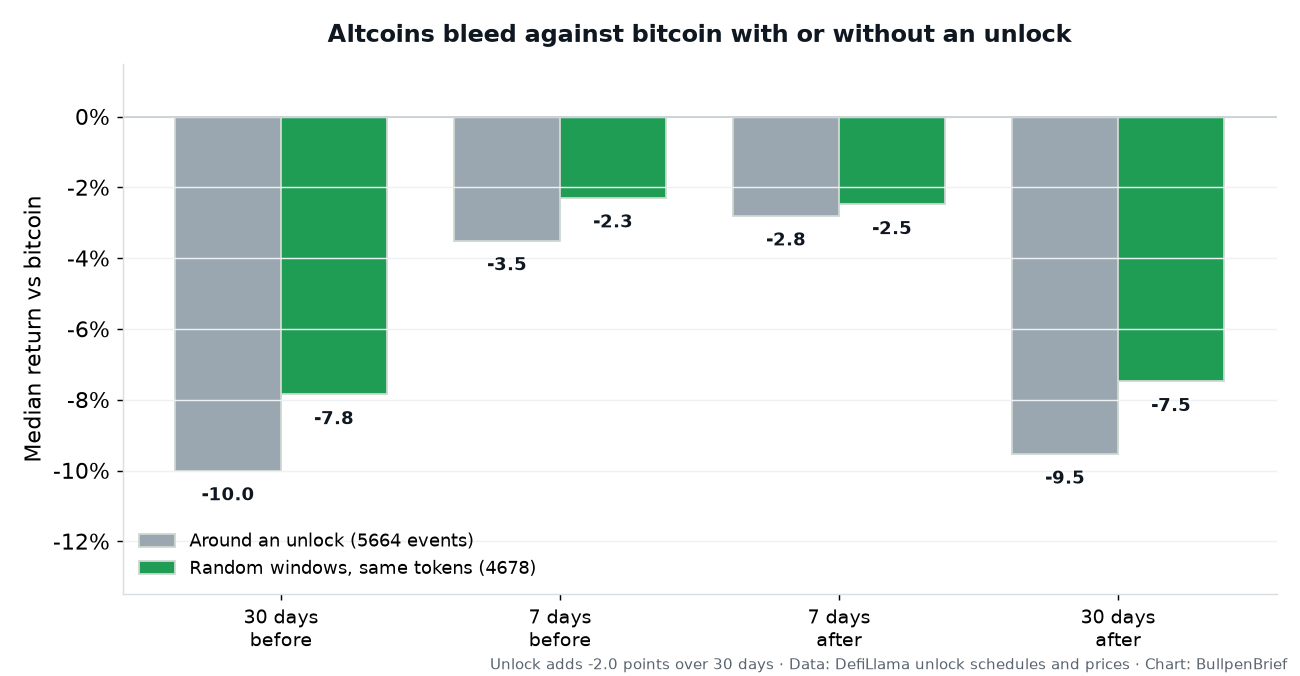
In a random 30-day window, the median token loses 7.5% against bitcoin. Around an unlock it loses 9.5%. Three quarters of the decline that gets blamed on unlocks happens anyway.
The first week is where the claim collapses entirely. Tokens lose 2.8% against bitcoin in the week after an unlock, against 2.5% in a random week. The gap is 0.3 points, with a bootstrap interval of -0.8 to +0.2, which includes zero. We cannot show that the days right after an unlock are worse than ordinary days.
The biggest unlocks do the least extra damage
If supply pressure drove the price, the effect should scale with the size of the unlock. It does not.
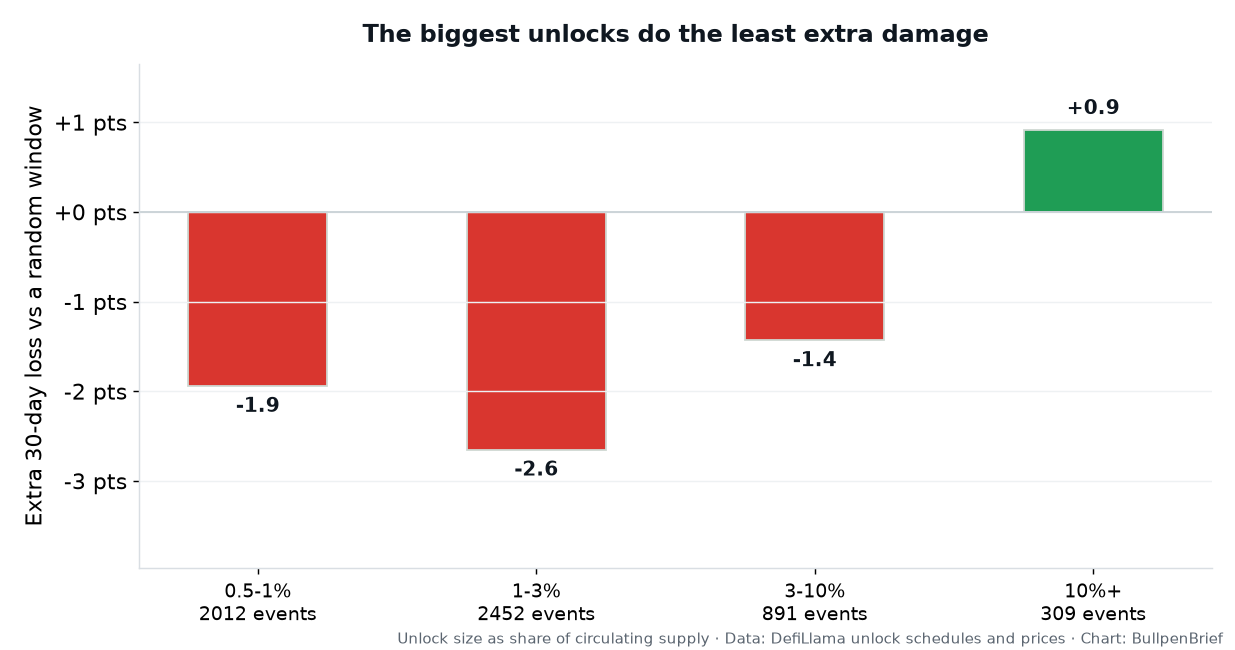
Unlocks worth 1% to 3% of circulating supply underperform their placebo windows by 2.6 points. Unlocks worth more than 10% of supply do not underperform at all, coming in 0.9 points above their control group across 309 events.
The explanation is visible in the month before. Tokens facing an unlock of 10% or more fall 13.7% against bitcoin in the 30 days leading up to the date, then 6.6% in the 30 days after.
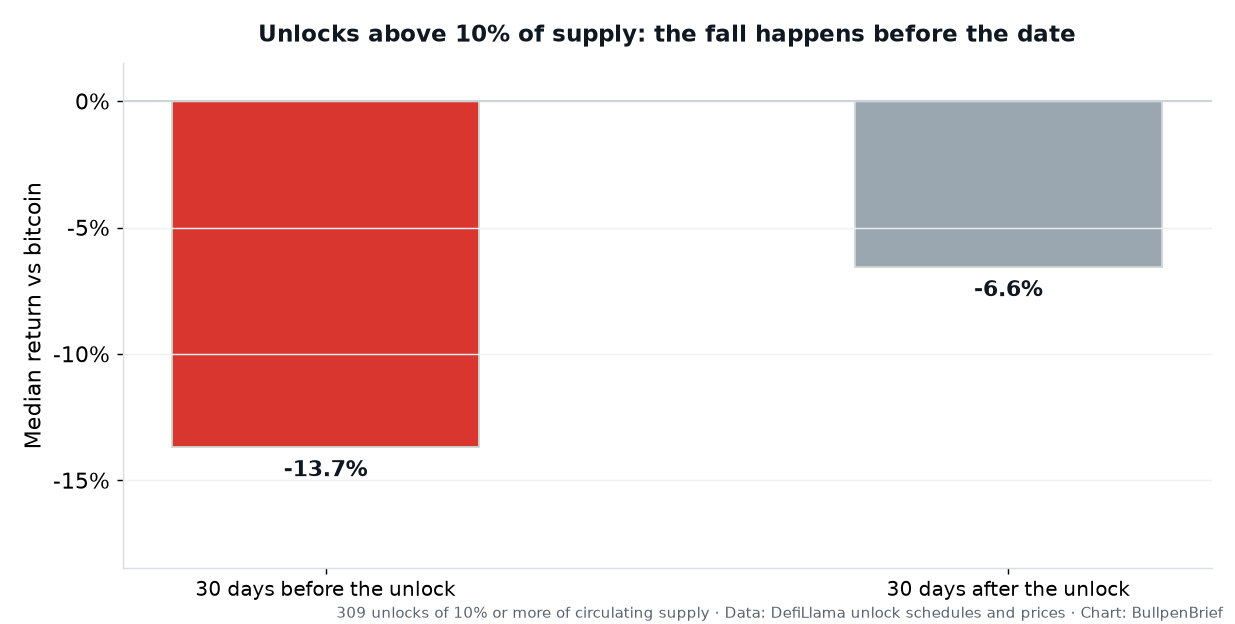
Large unlocks are published years in advance in a public schedule. By the time the date arrives, the selling has already happened. Small unlocks, which nobody positions around, are the ones that still surprise the market.
Who receives the tokens barely matters
Insider and team unlocks are the ones that draw outrage. They underperform by 10.1% over the following month. Foundation and non-circulating allocations, which draw none, underperform by 8.2%. Private-sale unlocks land at 9.6%. Every category sits in the same band, and the band is roughly where the tokens would be anyway.
Why this matters
Unlock calendars are sold as a trading signal and written up as a cause of crashes. On this evidence the calendar tells you little that the token’s own trend does not: the median token bleeds against bitcoin every month, unlock or no unlock. If there is a tradable edge here it is in the run-up to large unlocks, not the aftermath, which is the opposite of how the event is usually covered.
Methodology
Source is the DefiLlama emissions dataset (unlock schedules by project) and the DefiLlama coins API for daily prices, both retrieved 14 September 2026. We used only cliff events, meaning a discrete release on a single date. Continuous linear vesting has no event date to measure against.
An event enters the sample if the released amount is at least 0.5% of the tokens already unlocked at that moment and if complete prices exist for 30 days either side. That leaves 5,664 events by 186 projects between February 2018 and July 2026, with a median size of 1.34% of circulating supply.
All returns are stated relative to bitcoin over the identical window, because a raw altcoin return over a month mostly measures the market. Control windows are sampled at random from the same token’s price history, excluding any date within 30 days of one of its cliff unlocks, two per event. Bootstrap intervals are 2,000 resamples of the difference in medians.
Two limits worth stating. The sample is projects that publish a schedule to DefiLlama, which skews toward tokens with formal vesting and away from the smallest launches. And concentration is low but not zero: the most frequent project accounts for 3.2% of events, so no single token drives the result. Figures, charts and methodology are free to cite with attribution to BullpenBrief.