






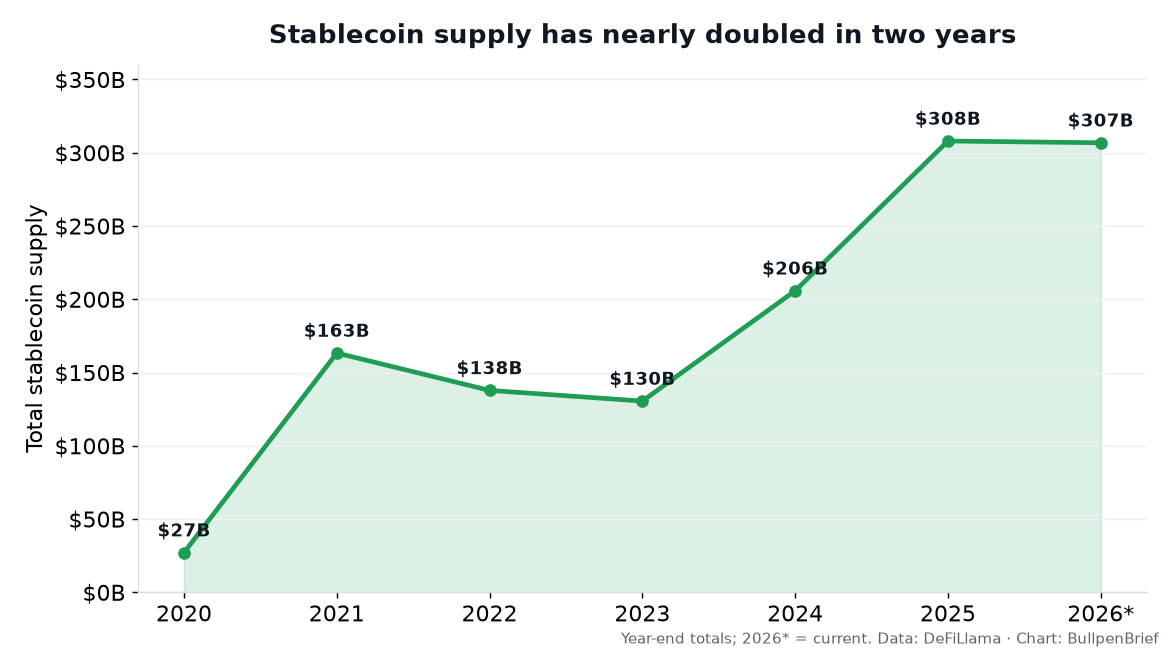
The stablecoin market has swelled to roughly $307 billion in 2026, near its all-time high and up nearly 50% since the end of 2024, but the growth hides a stark truth: two companies now control 83% of it. Our analysis of DeFiLlama data finds Tether alone at $183B (59.7% of the market) and Circle’s USDC at $72B (23.5%), with more than 400 other stablecoins splitting the remaining 17%. And the issuers aren’t just big, they’re the most profitable business in crypto.
Key findings
- ~$307B total supply, near the all-time high, up from $206B at the end of 2024 and just $164B two years ago.
- A duopoly: Tether + Circle = 83.2% of all stablecoins ($183B + $72B).
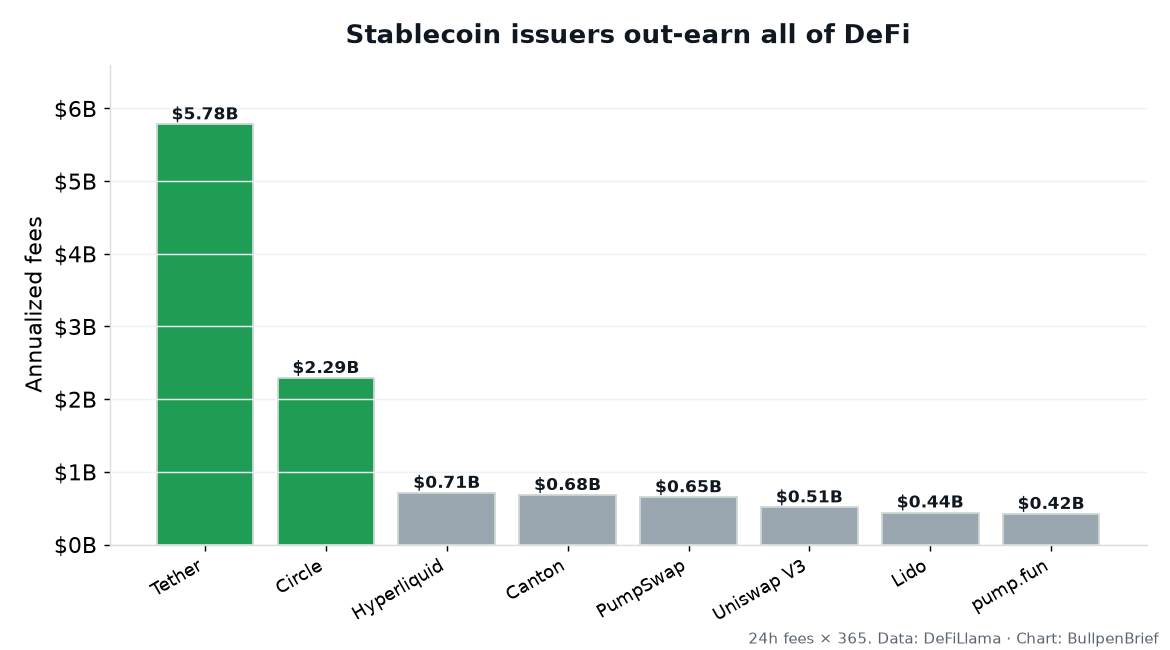
- Issuers out-earn all of DeFi. Tether’s fees annualize to ~$5.8B and Circle’s to ~$2.3B, together more than the next eight DeFi protocols combined.
- Tron quietly settles 30% of stablecoins ($92B), second only to Ethereum ($148B) and six times Solana’s share.
- The chase for the last 17%: TradFi (PayPal, BlackRock), yield-bearing (Ethena, Ondo) and politically-linked (World Liberty Financial) entrants are all scaling fast.
The analyst’s read
Here’s the part the “stablecoins are eating finance” headlines skip: this isn’t a competitive market, it’s a duopoly with a very long tail. Tether and Circle own 83 cents of every stablecoin dollar. The other 400-plus tokens, every VC-backed challenger, every bank pilot, every “next USDC”, are fighting over seventeen cents.
And the reason everyone keeps trying is simple: this is the best business in crypto, and it isn’t close. A stablecoin issuer takes your dollar, hands you a token that pays you nothing, and parks the dollar in Treasury bills yielding 4-5%. At $183B in circulation, Tether’s fee run-rate is roughly $5.8 billion a year, more than Uniswap, Lido, Hyperliquid and pump.fun combined. Circle adds another ~$2.3B. They out-earn the entire DeFi ecosystem that gets all the attention, and they do it with a fraction of the headcount. It’s a money-market fund wearing a crypto costume.
The other thing the size chart buries is where these dollars actually live. Everyone assumes Ethereum, and at $148B it does lead. But Tron sits at $92B, 30% of all stablecoins, because it became the default rail for USDT payments across emerging markets. That’s the quiet story: a huge share of the “digital dollar” isn’t running on the chain crypto Twitter argues about, it’s running on the one moving remittances in Lagos and Buenos Aires.
What I’m watching next: regulation is about to decide whether that 83% ossifies or cracks. Licensed frameworks favor incumbents with compliance budgets, which entrenches Tether and Circle further. But the same rules open the door for banks and asset managers (BlackRock’s BUIDL, PayPal’s PYUSD) who can distribute to customers the crypto-natives can’t reach. The duopoly is safe this year. The interesting fight is who owns the yield-bearing dollar of 2028.
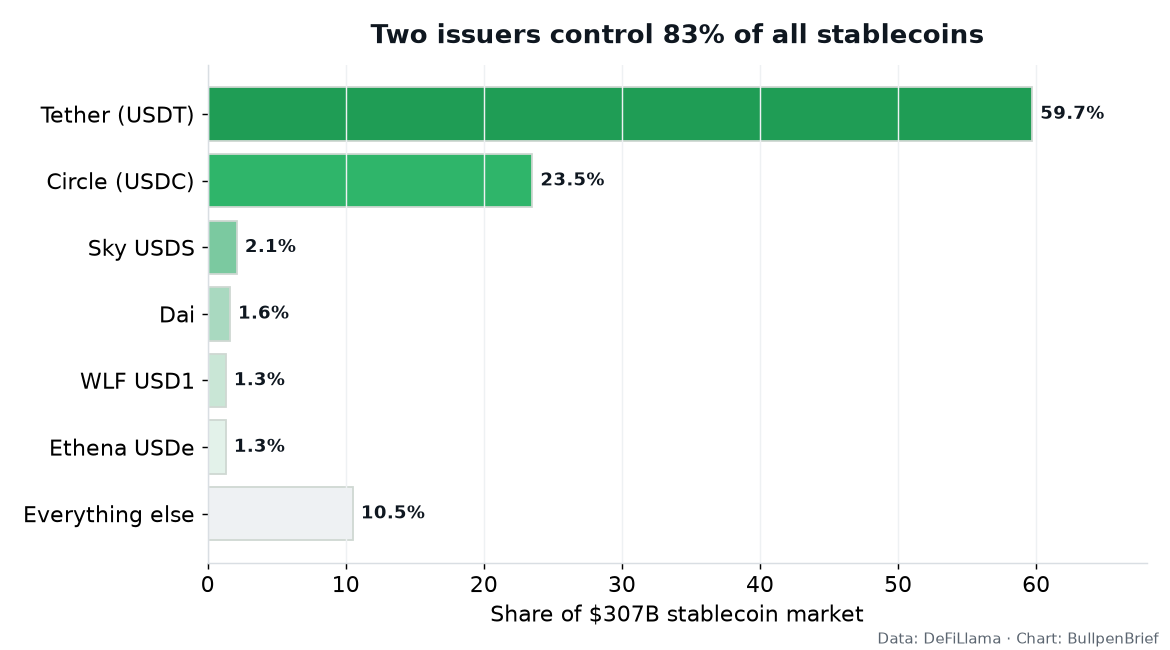
The 12 largest stablecoins in 2026
| Stablecoin | Ticker | Circulating | Share |
|---|---|---|---|
| Tether | USDT | $183.2B | 59.7% |
| USD Coin | USDC | $72.0B | 23.5% |
| Sky Dollar | USDS | $6.6B | 2.1% |
| Dai | DAI | $4.8B | 1.6% |
| World Liberty Financial USD | USD1 | $4.0B | 1.3% |
| Ethena USDe | USDe | $3.9B | 1.3% |
| Global Dollar | USDG | $3.4B | 1.1% |
| Circle USYC | USYC | $3.0B | 1.0% |
| PayPal USD | PYUSD | $2.7B | 0.9% |
| BlackRock USD | BUIDL | $2.7B | 0.9% |
| Ondo US Dollar Yield | USDY | $2.2B | 0.7% |
| USDD | USDD | $1.5B | 0.5% |
The most profitable business in crypto
Stablecoin issuers earn a spread on the reserves backing every token in circulation. At current Treasury yields, that turns idle collateral into a torrent of revenue, with no rewards paid to holders. The result: Tether and Circle generate more in annualized fees than the largest DeFi protocols on earth.
Where the digital dollar actually lives
| Chain | Stablecoins hosted | Share |
|---|---|---|
| Ethereum | $147.6B | 49.0% |
| Tron | $91.6B | 30.4% |
| Solana | $15.7B | 5.2% |
| BSC | $13.9B | 4.6% |
| Hyperliquid L1 | $6.2B | 2.1% |
| Base | $4.8B | 1.6% |
Methodology
Based on DeFiLlama’s public stablecoin and protocol-fee datasets. Circulating supply, market share and chain distribution captured August 1, 2026; annualized fees estimate 24-hour protocol fees × 365 and will vary with market activity. Year-end totals use the last daily reading of each year. Analysis and charts by BullpenBrief, free to cite with a link to this page.
Frequently asked questions
How big is the stablecoin market in 2026?
The total stablecoin supply is about $307 billion as of August 2026, near its all-time high. That is up from roughly $206 billion at the end of 2024 and about $164 billion two years earlier, according to DeFiLlama data analyzed by BullpenBrief.
Which stablecoin is the biggest?
Tether (USDT) is by far the largest at about $183 billion, or 59.7% of the entire market. Circle’s USD Coin (USDC) is second at roughly $72 billion (23.5%). Together the two issuers control 83.2% of all stablecoins.
How do stablecoin issuers make money?
Issuers hold the dollars backing each token in short-term Treasuries and similar assets, earning the yield while paying holders nothing. At current interest rates, Tether’s fees annualize to roughly $5.8 billion and Circle’s to about $2.3 billion, together more than the next eight largest DeFi protocols combined.
Which blockchain has the most stablecoins?
Ethereum hosts the most at about $148 billion (49%), but Tron is a close and often-overlooked second at roughly $92 billion (30%), driven by USDT payments in emerging markets. Solana holds around $16 billion (5%).
What are the fastest-growing new stablecoins?
Beyond Tether and USDC, notable scaling entrants include Sky Dollar (USDS), Ethena’s USDe, World Liberty Financial’s USD1, PayPal USD (PYUSD), and yield-bearing tokens from BlackRock (BUIDL) and Ondo (USDY), all competing for the roughly 17% of the market the two leaders don’t hold.