







Nobody is talking about the weird symmetry of yesterday’s bloodbath. When a crypto liquidation event hits, you expect the longs to get shredded, that’s the usual script. But the Federal Reserve‘s latest rate decision triggered something rarer: an almost perfectly balanced slaughter. Longs lost. Shorts lost too. Roughly $286 million in leveraged positions evaporated across digital asset markets, and the really strange part is that bulls and bears each took roughly half the damage.
According to data from Coinglass, about 90,000 traders got their positions force-closed in the 24 hours surrounding the Fed announcement. Bitcoin swung nearly 4% in either direction before settling near $67,200. Ether tagged a high around $3,450 before sliding back to $3,280. The chop was violent enough to liquidate $142 million in long positions and $144 million in shorts. Yes, really, almost identical numbers.
That’s not how leverage cycles usually work. Typically, a sharp drop punishes overconfident bulls, or a short squeeze torches the bears. This was a whipsaw from both directions, and it suggests algo-driven volatility, not directional conviction. My read: the market priced in a 25-basis-point cut but couldn’t agree on the forward guidance. So it ran in circles until the leverage flushed out.
The Fed Giveth and the Fed Taketh Away
The Federal Reserve delivered exactly what the CME FedWatch Tool predicted, a quarter-point rate cut to the 4.25%-4.50% range. Powell’s press conference was characteristically careful: inflation is still sticky, labor market cooling, no rush to ease further. That non-committal tone is usually fine for crypto. But this time, the options market had loaded up big gamma positions near $68,000 for Bitcoin and $3,500 for Ether. When spot prices bounced off those levels, dealers had to hedge aggressively.
That’s the mechanical trigger for the whip. Dealers sell when price rises above strike, buy when it falls below, amplifying the moves in both directions. Add in 50x and 100x leverage from traders betting on a breakout either way, and you get a feedback loop. Binance alone accounted for $118 million in liquidations, with OKX and Bybit trailing behind. The largest single liquidation order, a $14.2 million short on Bitcoin, hit on OKX.
Now, here’s what this means for you: if you’re holding leveraged positions through macro events, you’re effectively gambling on the volatility of dealer hedging, not on the Fed’s actual decision. The rate cut was a foregone conclusion. The whip was optional. But the leverage made it inevitable.
Historical Echo: The March 2020 Flash Crash Parallel
This isn’t the first time a macro event triggered a two-sided liquidation event. In March 2020, when COVID lockdowns hit and the Fed slashed rates to zero, Bitcoin initially spiked to $10,500 before crashing to $3,800 in two days. That wipeout liquidated about $1.2 billion in positions, and like this event, both longs and shorts got caught in the initial volatility. The difference? In 2020, the crash was driven by a genuine liquidity crisis. In 2025, we’re dealing with a derivative structure that’s too dense for the spot market to absorb.
The crypto derivatives market now dwarfs spot volumes by a factor of roughly 6:1. According to data from The Block, open interest across Bitcoin and Ether futures hit $48 billion in early March. That’s a lot of dry powder waiting to detonate. When the Fed even hints at a change in tone, the derivatives machine grinds up retail traders for breakfast. The 90,000 traders liquidated yesterday weren’t all degens on meme coins, a significant chunk were conservative 5x-10x traders who just got caught in the wrong direction for 15 minutes.
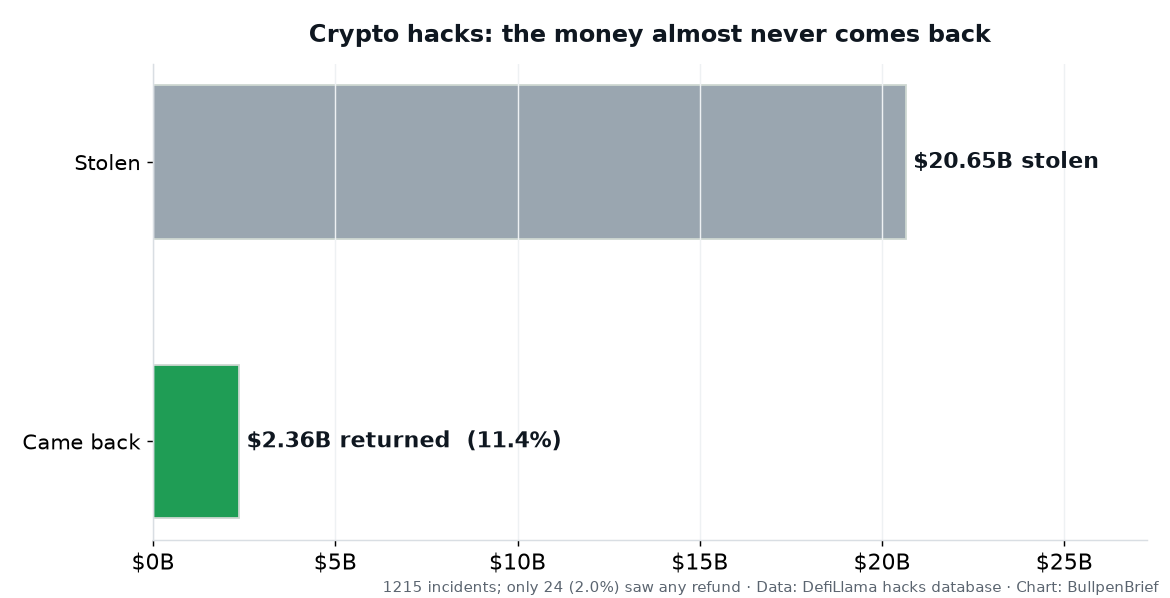
And look, this is exactly the kind of structural risk that goes unnoticed when everyone is staring at price forecasts instead of position sizing. I covered the rising frequency of crypto hacks hitting record frequency in 2026, and just like those exploits, liquidation cascades are a systemic risk that protocols and exchanges aren’t adequately addressing. The industry moves fast, breaks things, and expects retail to eat the losses.
Who Lost? And Who Benefited?
The clearest losers are obvious: the 90,000 traders who got liquidated. But the second-order casualties are more interesting. Market makers who provided liquidity for perpetual swaps likely took a hit when funding rates swung negative to positive inside a single hour. Funding rates on Binance Bitcoin perpetuals went from +0.008% to -0.015% and back, meaning funding payments changed hands three times in under 90 minutes. That’s brutal for hedging models.
Who won? Exchanges, obviously. They collect liquidation fees, typically 0.01%-0.05% per liquidation, and they don’t care which direction the market moves. Binance, OKX, and Bybit collectively pocketed millions in fees yesterday alone. Also, anyone who held cash or stablecoins and bought the dip on the first big move got a nice entry. But that’s a small minority.
In a broader sense, the mere whipsaw reinforces a narrative that crypto is still a risky macro bet, not a hedge. If you’re looking for safety, you’d probably rather read about the privacy backlash against Flock cameras reaching Washington, at least that’s a controversy with a policy fix in sight. Crypto leverage is pure volatility exposed.
The Bullpen Take: What the Smart Money Will Watch Next
Here’s what I’m tracking. The next major catalyst for Bitcoin and Ether is the March 28 expiration of monthly options, nearly $15 billion in open interest is set to roll off. If the market remains range-bound near current levels, the volatility could compress. But if another macro surprise hits, say, a hotter-than-expected PCE print next week, we could see another liquidation cascade.
Also, watch the perpetual swap funding rates. When they stay elevated for more than a few hours, it signals retail is heavily long and a flush is due. Right now, funding rates are back to neutral, which suggests the leverage has been reset. For now. The derivatives clock is always ticking.
So, practical guidance: if you’re trading crypto with leverage, cut your position size by half around FOMC days and options expiries. The math doesn’t lie, 90,000 traders just learned this the hard way. Or just trade spot and sleep better. Your wallet will thank you.
Frequently Asked Questions
Because the price action was a whipsaw, a sharp move up triggered short liquidations, then an equally sharp move down triggered long liquidations. This happens when dealer hedging amplifies moves in both directions around key strike prices, a phenomenon often driven by options gamma and concentrated open interest.
Given the volatility of crypto, and especially around macro events like Fed decisions, anything above 5x leverage carries significant liquidation risk. The data from this event shows that even traders with 10x exposure were wiped out within minutes. Many professional traders recommend spot trading or using 2x-3x max if you must use derivatives.
Not necessarily. The market had already priced in the cut, and Powell’s cautious forward guidance suggests no rush to ease further. Crypto tends to rally when rate cuts signal a loose monetary environment, but if inflation remains sticky, the party could stall. Watch the next PCE inflation report for clues on direction.
Trading with leverage? Check your liquidation price and size trades with our position size calculator first.