




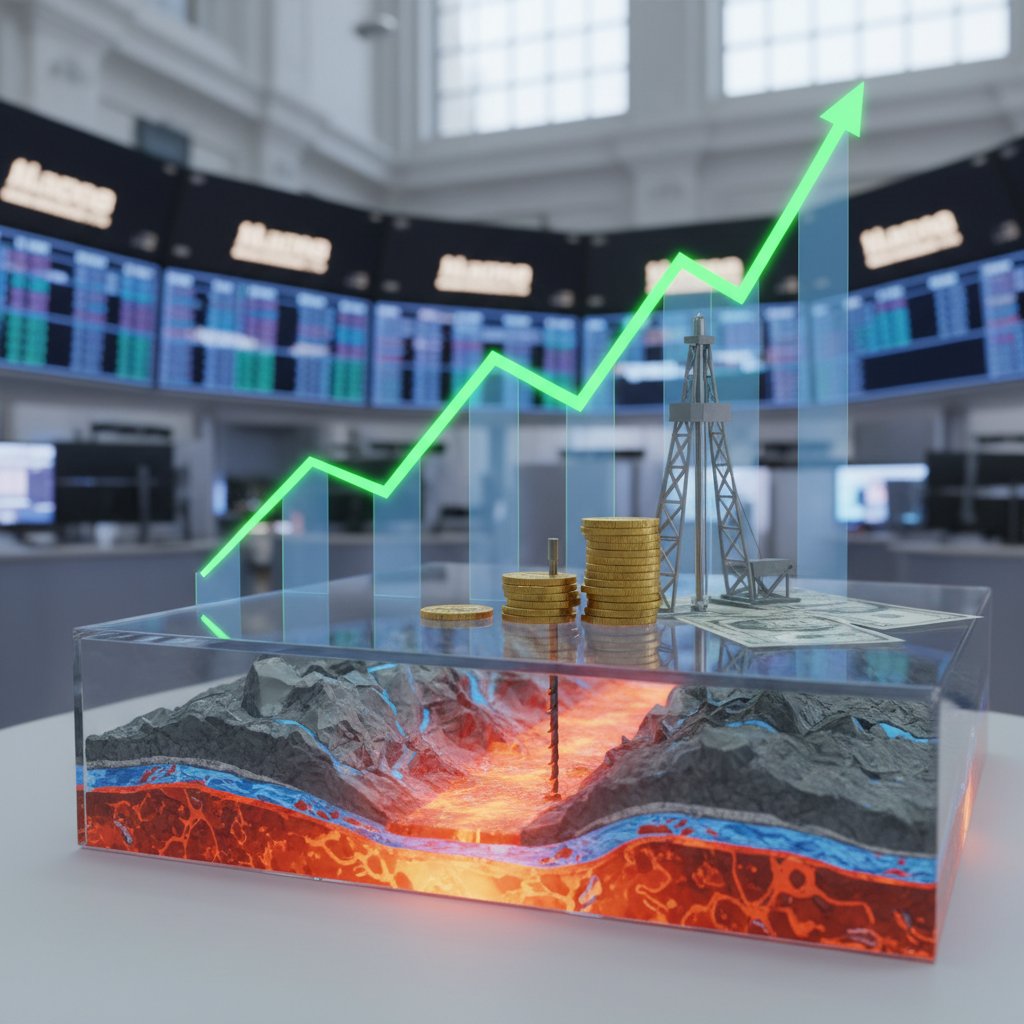
Nobody is talking about the heat beneath your feet. And that’s a problem, because it could be the key to clean, 24/7 energy that never depends on the weather. But there’s a catch. It’s expensive. Really expensive. And the startups trying to fix that are running into the same old wall: drilling costs that make oil wells look like pocket change.
We’re talking about geothermal energy. The Earth’s core is as hot as the sun’s surface, about 5,500°C. That heat radiates upward, and if you drill deep enough, you can tap it to generate electricity or heat homes. It’s abundant, it’s carbon-free, and it runs day and night, rain or shine. But for decades, geothermal has been a niche player, stuck in places like Iceland and California where hot rocks sit close to the surface. Everywhere else? Too deep, too hard, too pricey.
Now a new wave of startups, backed by billions from venture capital and government grants, says it can change that. They’re using oil-and-gas drilling techniques, advanced sensors, and even fracking-style stimulation to create geothermal reservoirs where nature didn’t put them. Think of it as making your own hot spring, but 5,000 feet down.
“The resource is everywhere,” says Dr. Maria Santos, a geothermal engineer at Stanford University. “The challenge is accessing it economically. We’re basically trying to drill through granite at high temperatures, it’s like trying to dig a tunnel through a furnace.”
So the question is simple: can these startups make geothermal cheap enough to compete with solar, wind, and natural gas? And if they do, what does that mean for your energy bills? Because right now, energy bills are crushing Brits and households across the US and Canada. A new baseload power source that doesn’t spike with gas prices? That’s the dream.
The Heat Below: Why Geothermal Has Always Been a Niche Player
Traditional geothermal plants work by finding natural hydrothermal reservoirs, pockets of hot water or steam trapped in porous rock. Drill a couple of wells, bring the steam up, spin a turbine, done. It’s elegant. But it only works in specific geological settings: think volcanic regions, tectonic plate boundaries, or deep sedimentary basins. That’s why the US has most of its geothermal capacity in California, Nevada, and Utah. Globally, geothermal provides less than 1% of electricity.
The problem is that 99% of the Earth’s subsurface doesn’t have those ready-made reservoirs. The heat is there, but the water and permeability aren’t. So you either need to find a way to create your own reservoir, that’s enhanced geothermal systems (EGS), or you need to drill so deep that the rock is hot enough to heat water you inject yourself. Both approaches have been tried for decades, with mixed results.
The US Department of Energy has been funding EGS research since the 1970s. The big breakthrough was supposed to come from the Fenton Hill project in New Mexico in the 1980s. It worked technically, they created a fracture network and circulated water, but the cost was astronomical. “We proved it could be done,” says James Whitfield, CEO of EarthDrill Energy, a startup based in Houston. “But we also proved it was uneconomic. The drilling alone ate up 60% of the budget.”
Fast forward to 2024. Drilling technology has improved enormously thanks to the shale revolution. Horizontal drilling, advanced bits, real-time data analytics, all that know-how is being repurposed for geothermal. And the cost of drilling has come down, but not enough. A typical geothermal well still costs $5 million to $10 million, compared to $1 million for a shallow oil well. And you need multiple wells for a viable plant.
The New Wave: Startups That Are Drilling Deeper and Smarter
So what’s different this time? A handful of well-funded startups are attacking the problem from different angles. One approach, pioneered by a company called Fervo Energy, uses horizontal drilling and fiber-optic sensors to map fractures in real time. They inject cold water, let it heat up, and produce steam. Fervo’s first commercial project in Utah came online in 2023, supplying power to Google’s data centers. It’s a proof of concept, but the cost per megawatt-hour is still higher than solar or wind.
Another startup, Eavor Technologies, has a closed-loop system that circulates a working fluid through a deep, sealed pipe, no water-rock interaction, no fracking. They call it the “Eavor-Loop.” It’s less risky, but also less efficient because you’re relying on conduction rather than convection. They’ve built a demonstration project in Canada and are planning a commercial plant in Germany.
Then there’s the super-deep approach. Companies like Quaise Energy are trying to drill 20 kilometers down using millimeter-wave beams, essentially vaporizing rock with a giant microwave. It sounds like science fiction, and it is. They’re still in the lab. But if they succeed, they could access temperatures above 500°C, making geothermal competitive with any fossil fuel.
“We’re not trying to reinvent the wheel,” says Whitfield. “We’re taking the wheel from the oil and gas industry and putting it on a different car. The challenge is that the car has to go faster and cheaper than anything that’s come before.”
Investors are paying attention. In 2023, geothermal startups raised over $500 million in venture funding, according to the International Energy Agency (IEA geothermal report). That’s still a fraction of what solar and wind get, but it’s a tenfold increase from five years ago. The US government has also chipped in with billions in loan guarantees and tax credits through the Inflation Reduction Act.
The Economics Problem: Why It’s Still Too Expensive
Here’s the brutal math. The levelized cost of electricity (LCOE) for new solar farms is around $30-$40 per megawatt-hour. Onshore wind is $40-$60. Natural gas combined cycle is $50-$70. Geothermal? Traditional hydrothermal plants can produce at $60-$80. But EGS or closed-loop systems? We’re looking at $100-$150 per MWh, or even higher for first-of-a-kind projects.
That’s a huge gap. And while costs will come down with scale, nobody knows how fast. The learning curve for geothermal is steeper than for solar because every site is different, geology varies wildly even within a few miles. You can’t just mass-produce a geothermal plant like you can a solar panel.
“The economics are the elephant in the room,” says Dr. Santos. “We can make it work technically. But until the cost per MWh drops below $80, it’s going to remain a niche solution for places with high electricity prices or specific policy support.”
And that’s where the link to your energy bills comes in. In the UK and parts of the US, electricity prices have soared due to natural gas volatility. Energy bills crushing Brits is not just a headline, it’s a reality for millions. If geothermal can provide stable, low-cost power, it could act as a hedge against gas price spikes. But it won’t happen overnight.
Meanwhile, the oil industry is watching. As oil prices tumble back on geopolitical shifts, the case for drilling for heat rather than hydrocarbons becomes more attractive. But the transition takes capital and patience, two things markets don’t always have.
What It Means for Your Energy Bills
For now, geothermal remains a drop in the global energy bucket. But if the startups succeed in cutting drilling costs by 50%, a target many have set for 2030, it could become a serious player. That would mean more baseload renewable power, less reliance on gas, and potentially lower electricity prices in the long run.
But don’t expect a revolution next year. The technology is moving fast, but the earth is slow. Drilling a well takes months, and permitting can take years. And even when the first commercial EGS plants come online, they’ll be small, 10 to 50 megawatts, not the gigawatts that solar farms produce.
Still, there’s reason for cautious optimism. The same kind of innovation that drove the shale boom is now being applied to geothermal. And unlike oil and gas, this resource doesn’t run out. It’s just sitting there, under your feet, waiting for the price to drop.
Look, geothermal isn’t a silver bullet. It won’t solve the energy crisis by itself. But it could be a crucial piece of the puzzle, a clean, always-on power source that complements intermittent solar and wind. And for homeowners worried about their bills, that’s a future worth watching.
The next five years will tell us whether geothermal’s moment has finally arrived, or whether it remains the energy source that’s always just out of reach.
Frequently Asked Questions
How does enhanced geothermal work?
Enhanced geothermal systems (EGS) create artificial reservoirs by injecting water into hot, dry rock at depth. The water is heated by the rock and then pumped back up to generate steam, which drives a turbine. This allows geothermal energy to be tapped in areas without natural hydrothermal reservoirs.
Why is geothermal so expensive compared to solar or wind?
The main cost driver is drilling. Geothermal wells can cost $5-10 million each, and a typical plant needs multiple wells. Solar and wind have seen dramatic cost declines due to mass production, while geothermal drilling remains a bespoke, high-risk process. Also, geothermal projects have longer development timelines and higher upfront capital requirements.
Can geothermal really lower my energy bills?
In the long term, yes, if geothermal scales up and becomes cost-competitive with natural gas. Because geothermal provides baseload power (24/7), it can reduce reliance on gas-fired plants, which are often the price setters in electricity markets. But the impact on your bill will depend on how quickly costs come down and how much geothermal capacity is built in your region.