


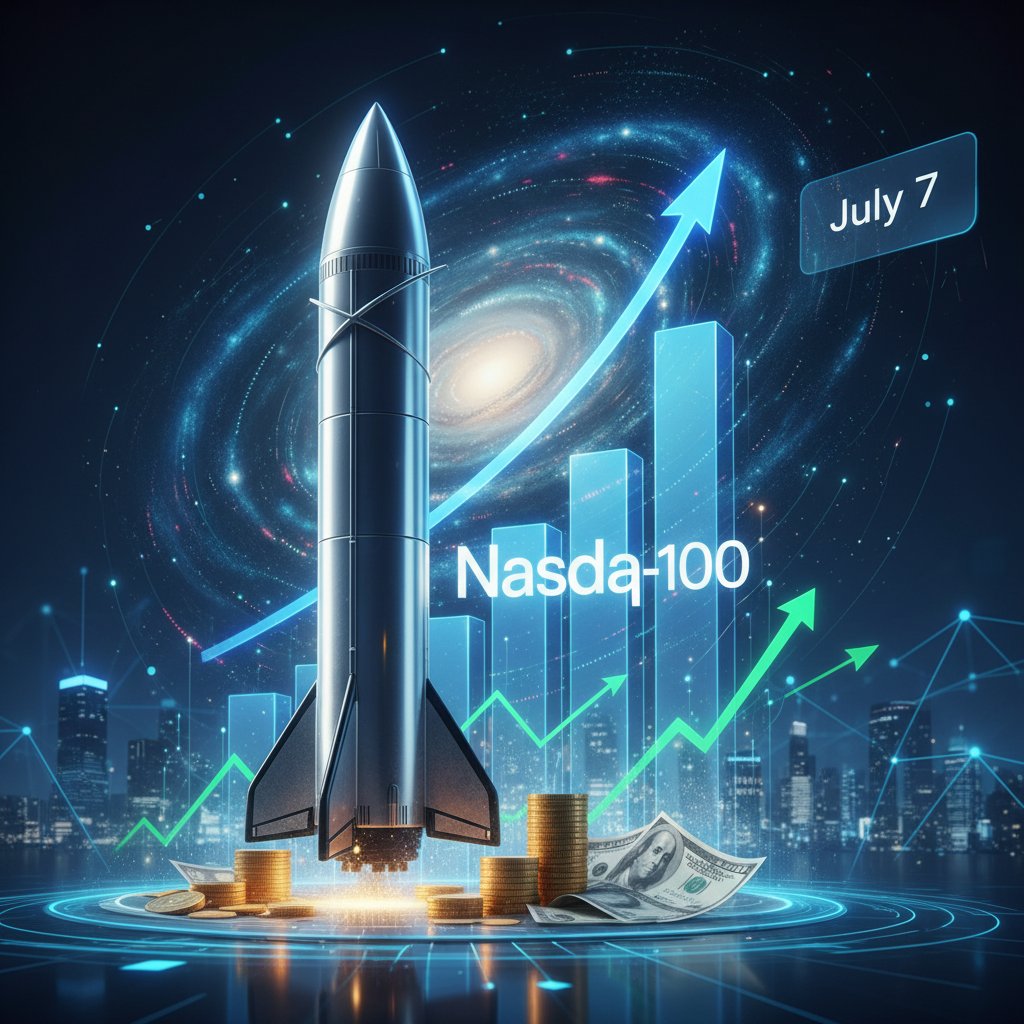
Most people still think of SpaceX as that elusive private rocket company, the one Elon Musk jokes about taking public “when Mars colonists can vote.” But if you blinked, you missed it: SpaceX is now a publicly traded company, and on July 7, its stock will officially join the elite Nasdaq-100 index.
Yes, you read that right. The company that launches Starlink satellites and dreams of a city on the Red Planet is about to get a prime seat on Wall Street’s most watched tech-heavy index. And for investors who’ve been pining for a piece of the space economy without buying defense ETFs or third-party derivatives, this changes everything.
From Private Dreams to Public Reality
SpaceX’s path to a public listing was anything but a straight line. For years, Musk insisted an IPO was off the table, too much short-term pressure, he argued. Then came the 2024 capital markets frenzy for space-related IPOs, and a quiet direct listing in March 2025 that stunned everyone. The stock opened at $140 and quickly soared past $200, valuing the company at nearly $800 billion.
Now, with a market cap comfortably above that threshold, SpaceX (ticker: SPX) meets the Nasdaq-100’s entrance requirements. The index committee announced the addition on June 21, effective after market close on July 6. It’s a watershed moment, not just for SpaceX, but for the entire space industry.
“SpaceX joining the Nasdaq-100 is a stamp of institutional legitimacy that the space sector has been craving,” says Dr. Lina Chen, professor of finance at MIT Sloan. “It signals that space is no longer a speculative dream, it’s a core part of the technology ecosystem.”
The move also reshuffles the index’s composition. Analysts estimate it pushes out a smaller health‑tech firm, freeing up about 1.2% of the index’s weight. For context, the Nasdaq-100 is rebalanced quarterly, but outright additions and deletions are rare, only a handful happen each year.
What the Nasdaq-100 Addition Really Means
Let’s get one thing straight: index inclusion isn’t just a trophy. It triggers a flood of passive buying. Funds tracking the Nasdaq-100, like the Invesco QQQ Trust (QQQ) and many institutional portfolios, must rebalance to hold the new entrant. That means billions of dollars in demand for SPX shares almost overnight.
How much? Rough estimates: the QQQ alone has about $280 billion in assets under management. A 1.2% allocation would translate to roughly $3.4 billion of buying. Add in other index funds and ETFs, and total demand could exceed $10 billion within the first week. That kind of mechanical buying can push stocks higher, at least temporarily.
Short sellers, take note. SpaceX has a relatively low free float, about 35% of shares trade publicly, with the rest held by insiders (Musk’s trust, early SpaceX employees, and funds like Fidelity). That scarcity, combined with forced buying from indexers, could create a short squeeze if bears get too aggressive.
But don’t expect seamless momentum forever. Index inclusion often leads to a “buy the rumor, sell the news” pattern: stocks sometimes surge in the weeks before joining, then flatten or dip after the adjustment date. Investors who bought on IPO day at $140 are already sitting on handsome gains, many may take profits post-inclusion.
Meanwhile, other sectors are feeling different pressures. Small carriers are suing the IRS over a reefer diesel tax credit, a reminder that not every market story is about rockets and index funds. That lawsuit could affect transportation costs, which in turn influences inflation expectations and the broader rate environment, a dynamic the Fed watches closely.
“The mechanical buying from index funds is real, but it’s a one-time event,” warns James Ng, chief market strategist at Aperture Capital. “Long-term returns will depend on SpaceX’s ability to scale Starship and Starlink’s profitability. The index inclusion is a catalyst, not a long-term thesis.”
Index Funds and the $50 Billion Question
One question keeps coming up: why does a company with no dividends, massive R&D spending, and a volatile CEO get into the Nasdaq-100? Because the index isn’t about safety, it tracks the largest non-financial companies listed on Nasdaq, sorted by market cap. And with an $800 billion valuation, SpaceX is now bigger than Cisco, Adobe, and even PepsiCo.
The index committee likely considered liquidity, trading volume, and the fact that SPX shares meet the minimum public float requirement. SpaceX also cleared the Nasdaq’s $50 billion market cap threshold, the unofficial but enforced bar for inclusion. It helps that the stock has been trading over 20 million shares daily since the lockup expiry in April.
For retail investors, the takeaway is straightforward: if you own QQQ or any Nasdaq-100 ETF, you’ll soon own SpaceX. There’s no need to buy the stock directly, your fund does it for you. But if you want pure exposure, buying SPX shares before the inclusion date could give you a boost from the anticipated wave of buying. Just be aware of the potential post-addition dip.
What’s Next for SpaceX Stock?
The July 7 addition is a milestone, but it’s also a spotlight. Analysts are already talking about the next chapter: could SpaceX replace Tesla in the Nasdaq-100’s top 10? (Tesla currently ranks 6th; SpaceX would be around 12th.) More importantly, will Musk use the public platform to raise capital for Starship’s orbital test campaign, or will he keep funding it via Starlink revenue?
Look, the biggest risk is valuation. At $800 billion, SpaceX trades at a price-to-sales ratio of about 18, far higher than the average Nasdaq-100 stock (around 5). That’s not unreasonable for a high-growth disruptor, but it leaves little room for execution missteps. If Starlink subscriber growth slows, or if Starship encounters a setback, the stock could get punished harshly, especially now that index funds hold a big chunk of the shares.
On the flip side, if the Starship program accelerates and wins government contracts for lunar missions or Mars cargo, the upside could be enormous. Oil markets are jittery after fresh Persian Gulf strikes, but space stocks remain remarkably calm, partly because SpaceX has little direct exposure to energy prices. Its launch costs are largely fixed, and satellite broadband is a subscription business.
One wildcard: whether Musk’s public public persona, his tweets, his politics, his simultaneous roles at Tesla and xAI, will create volatility. Some fund managers may limit exposure to stocks with single-person dependency risk. But the index’s rules don’t account for personality; they just weight by market cap. So for better or worse, SPX is now a permanent fixture in the tech index landscape.
July 7 is just the beginning. The real test for SpaceX stock will come in the months after, when the initial wave of index-buying fades, and the market asks the hard question: Is this a $1 trillion company in the making, or a wildly overpriced rocket builder that got lucky with satellite internet? Only time, and the stars, will tell.
Frequently Asked Questions
A: Yes. SpaceX trades under the ticker SPX on the Nasdaq exchange. You can buy shares through any major brokerage like Fidelity, Schwab, or Robinhood. However, the stock is highly volatile, expect large daily swings, especially around the July 7 index inclusion date.
A: Indirectly, possibly. Both companies are linked by Elon Musk’s leadership, but they operate in different sectors. The index rebalancing shouldn’t materially change Tesla’s weight in the Nasdaq-100 since the total number of slots is fixed at 100. That said, some investors may rotate capital from Tesla to SpaceX, but that’s a personal portfolio choice, not an index effect.
A: Analysts estimate about $10 billion to $15 billion of forced buying from funds that track the Nasdaq-100. The Invesco QQQ alone will need to purchase roughly $3-4 billion worth of SPX shares over a few days. This buying can push the stock higher temporarily, but may reverse once the adjustment is complete.