








Forget the flash-loan exploits and the DeFi rug pulls you’ve trained yourself to fear. The $972 million stolen from crypto protocols this year tells a different, far more unsettling story, one that has little to do with code and everything to do with the humans holding the keys. According to Immunefi’s Mitchell Amador, the vast majority of 2026’s haul is leaving through keys, signers and governance, not contract bugs. And his blunt diagnosis cuts through years of industry spin: “We were audited” was never the same as “we are safe.”
Let that sink in for a second. The industry has spent hundreds of millions on smart-contract audits. Every whitepaper boasts about being “battle-tested” or “formally verified.” Yet the attackers aren’t even bothering to find zero-days in the Solidity. They’re going after the operational layer, the messy, human-controlled infrastructure that audits rarely touch.
The $972 Million Breakdown: Where It Actually Went
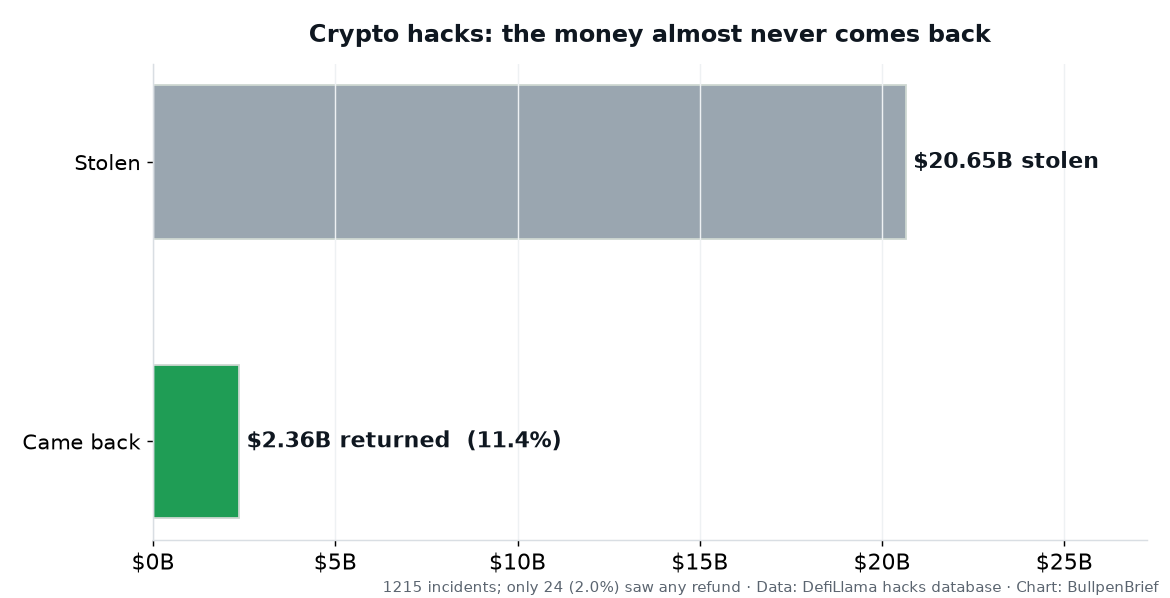
Immunefi’s data cuts through the noise. Of the $972 million stolen across 157 incidents in the first seven months of 2026, a pace that has already surpassed all of 2025, as documented in BullpenBrief’s coverage of the record frequency, over 70% came from compromised private keys, malicious governance proposals, or manipulated signer sets. Smart-contract exploits accounted for less than a quarter.
What does that mean in practice? It means the multisig that was supposed to protect user funds had a signer set that one social-engineering campaign could crack. It means the governance contract that controlled a treasury had a proposal threshold so low a small cartel could pass a drain. It means the hot wallet that moved funds between chains had a single point of failure dressed up in ceremony.
Amador puts it bluntly: “Auditors check the code. They don’t check who holds the keys, how the keys are stored, or what happens when a signer gets phished.” And that’s exactly where the attackers are operating.
Why “We Were Audited” Became a False Comfort
The crypto security narrative has always been a bit of a fairy tale. Raise a fund, hire a top-tier audit firm, get the green stamp, and market the hell out of it. Then sleep easy. But this year’s data explodes that fantasy.
Consider the biggest single loss: the $120 million drain from a cross-chain bridge, not a smart-contract bug, but a compromised relayer key that the team had stored on a cloud server. The audit had checked the bridge logic. Nobody checked the ops team’s password hygiene. Another $85 million disappeared from a lending protocol when a disgruntled developer, who still had signer access, simply moved funds to a fresh address. The code was clean. The people weren’t.
This isn’t just a technical failure. It’s a cultural failure. The industry has prioritized code security over operational security because code security is easier to sell. An audit is a checkbox. A robust key-management policy, a mandatory hardware-signer requirement, a governance threshold that actually requires broad consensus, those are messy, expensive, and impossible to brand as a feature.
But look at the fallout. Every one of these attacks could have been prevented with better opsec. Not better code. Better process.
What This Means for You, The Practical Takeaway
If you’re a user holding assets in any protocol, and yes, that includes the shiny new L2s and the blue-chip DeFi giants, your first question should not be “Who audited it?” It should be “Who holds the keys?”
Here’s what the smart money watches now:
- Multisig composition: Are the signers independent? Are they on hardware wallets? Is the threshold at least 3 of 5, or higher?
- Governance parameters: Can a proposal pass with 1% of token supply? That’s not governance, that’s a target.
- Key rotation policies: How often are keys rotated? Are former employees removed from signer sets within 24 hours?
- Insurance and contingency: Does the protocol have a security fund or insurance to cover losses from key compromise, or only from code exploits?
These aren’t questions most teams will answer on their landing page. But if they can’t answer them in a Telegram group or a Discord, walk. I’m serious. The $972 million says exactly where the risk is.
And for teams building right now: stop treating opsec as a second-class concern. The attacker doesn’t care if your code is perfect. They care if your CTO stores the backup seed in a Google Doc. Yes, that happened. Twice this year.
The security industry has a term for this: the attack surface. Smart-contract bugs are a small part of it. The rest is the people, keys, governance, and the operational decisions that never get audited.
The Second-Order Winners and Losers
This shift has implications beyond individual protocols. The winners are infrastructure providers that focus on key management, hardware security modules, threshold-signature schemes, and decentralized key-storage networks. Expect to see a wave of investment into products that make multisig actually secure, not just a checkbox.
The losers? Every protocol that has been coasting on audit reports. And the audit firms themselves, if they don’t adapt. A smart-contract audit without an opsec review is like a car safety inspection that checks the engine but ignores the brakes. It’s incomplete, and increasingly, it’s misleading.
The regulators are watching too. The SEC’s enforcement division has made it clear that they consider key-management failures as failures of fiduciary duty. The FTX playbook, where a few people controlled everything, is the extreme case, but the principle scales down. If a DeFi protocol loses user funds because a signer stored their key in a Telegram DM, that’s not a hack. That’s negligence.
And let’s not forget the broader market. Every major hack sends a shiver through institutional adoption. The pension funds and endowments that are dipping toes into crypto read headlines about $120 million disappearing from a bridge. They don’t care whether it was a contract bug or a compromised key. They care that the money vanished. That reputational damage is a tax on the entire industry, one that will only be lifted when the industry gets serious about opsec.
The year’s $972 million isn’t a story about bad code. It’s a story about bad habits. And until those habits change, the attackers will keep taking the easiest path, through the keys.
Frequently Asked Questions
Why are most crypto hacks in 2026 coming from key compromises instead of smart-contract bugs?
Attackers have shifted focus because key compromises are often easier to execute and harder to defend against. Smart-contract bugs require deep technical skill and are increasingly rare due to better auditing tools. Compromising a signer’s private key through phishing, social engineering, or poor storage practices requires less specialized knowledge and can yield larger payouts because the attacker gains broad access to protocol funds.
How can I protect my crypto assets from key-based attacks?
Prioritize protocols that use hardware-based multisig wallets with independent signers, enforce key rotation policies, and have transparent governance thresholds. As a user, store your own private keys on a hardware wallet, never share seed phrases, and use separate wallets for different activities (trading, lending, long-term holding). For larger holdings, consider using a multi-signature setup even for personal use.
Does a smart-contract audit still matter if most hacks are now from key compromises?
Yes, audits still matter, smart-contract bugs remain a threat, and an audit is a baseline requirement. But an audit alone is not sufficient. The industry needs comprehensive security reviews that include operational security (opsec), key management policies, governance structures, and incident-response plans. Treat an audit as one piece of a larger security puzzle, not a guarantee of safety.