


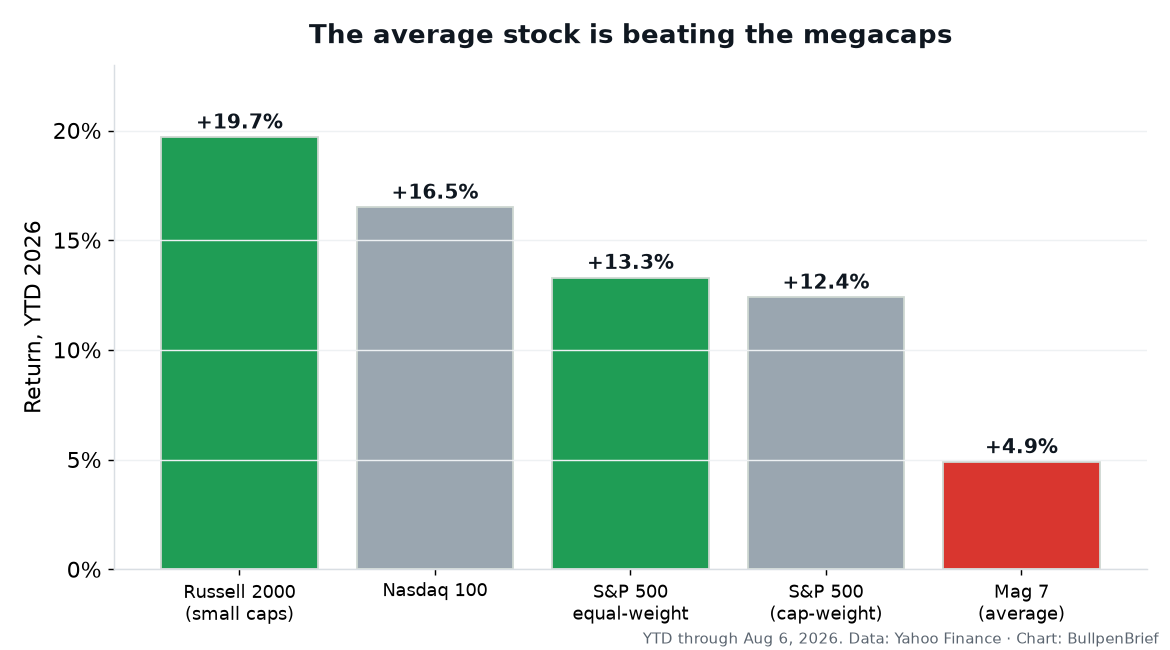
For three years the story of the US stock market was seven companies. In 2026, that story broke. Our analysis of Yahoo Finance data through August 6 finds the “Magnificent 7” up an average of just 4.9% year-to-date, while the S&P 500 gained 12.4%, its equal-weight version rose 13.3%, and small-cap Russell 2000 jumped 19.7%. For the first time since the AI trade began, the average stock is beating the megacaps.
Key findings
- From the first trading day of 2026 to 6 August 2026, the Magnificent 7 rose an average 4.9%, trailing the S&P 500’s 12.4% by about 7.5 points (Yahoo Finance daily closes, unweighted average of seven stocks).
- The equal-weight S&P 500 (RSP, +13.3%) beat the cap-weighted S&P 500 (+12.4%) from the start of 2026 to 6 August 2026, the opposite of 2023 and 2024.
- The Russell 2000 small-cap index gained 19.7% from the start of 2026 to 6 August 2026, the strongest of five major US indices measured (Yahoo Finance).
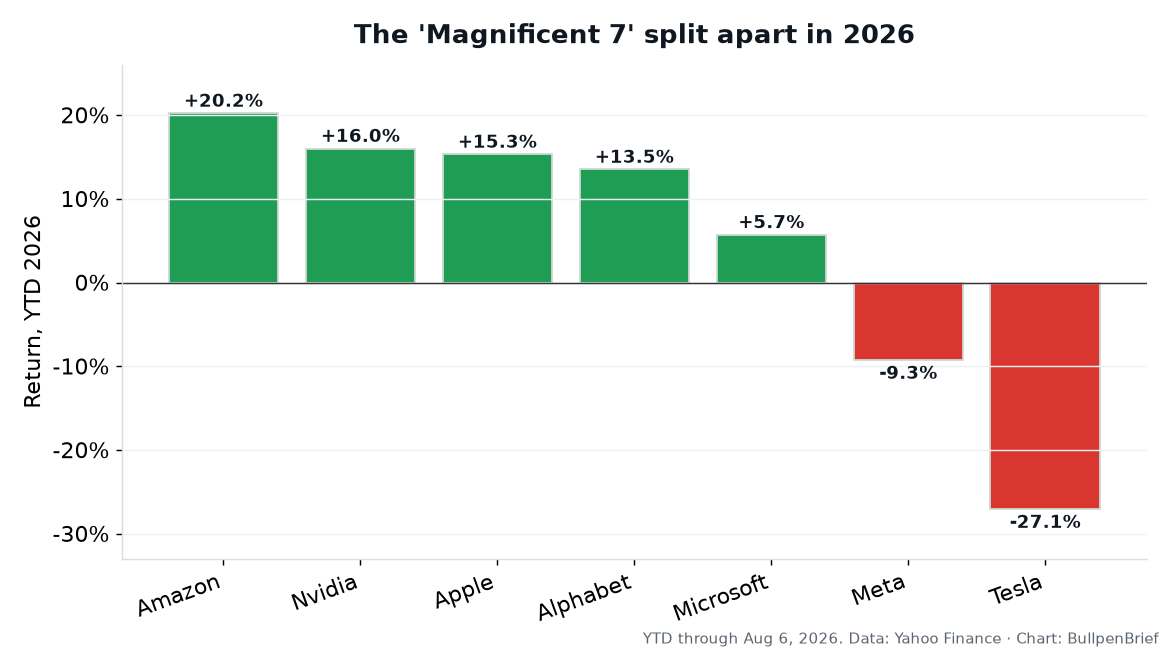
- Within the Magnificent 7, Amazon (+20.2%) and Nvidia (+16.0%) led in 2026 through 6 August while Tesla (-27.1%) and Meta (-9.3%) were down on the year.
- Caveat: returns are year-to-date price changes through 6 August 2026, a single snapshot rather than a trend.
The analyst’s read
Let me be blunt about what this is: it’s the trade everyone crowded into finally cracking. From 2023 through 2025, a handful of megacaps did so much of the index’s heavy lifting that “market cap-weighted S&P 500” was basically a bet on seven stocks. If you owned the equal-weight version, the average company, you underperformed and felt dumb doing it. In 2026 that reversed, and it reversed hard.
The tell isn’t that the megacaps collapsed, most didn’t. It’s the dispersion. Amazon and Nvidia are still carrying their weight, but Tesla is down 27% and Meta is negative on the year. Once the “Magnificent 7” stops moving as a bloc and starts splitting into winners and losers, it stops being a theme and goes back to being seven separate companies with seven separate stories. That’s healthy. It’s also disorienting for anyone whose portfolio quietly became a concentrated megacap bet without them deciding to make one.
The more important number is the equal-weight line beating the cap-weight line. That is the market telling you participation has widened, money is finding its way into the other 493 names and into small caps, which are the classic risk-on, rate-sensitive corner of the market. Russell 2000 leading by a mile isn’t a fluke; it’s what a broadening rally looks like.
What I’m watching next: whether breadth holds through earnings season, and whether the small-cap lead survives the first real volatility spike. Broadening rallies are more durable than narrow ones, a market carried by 500 stocks is harder to knock over than one carried by seven. But “the average stock is winning” is only bullish while the average stock keeps showing up. If breadth rolls over and money sprints back into the megacaps, that’s your signal the risk appetite of early 2026 was a head-fake.
The Magnificent 7, ranked
| Company | Ticker | YTD 2026 |
|---|---|---|
| Amazon | AMZN | +20.2% |
| Nvidia | NVDA | +16.0% |
| Apple | AAPL | +15.3% |
| Alphabet | GOOGL | +13.5% |
| Microsoft | MSFT | +5.7% |
| Meta | META | -9.3% |
| Tesla | TSLA | -27.1% |
| Magnificent 7 average | +4.9% |
Index scoreboard, 2026 YTD
| Index | YTD 2026 |
|---|---|
| Russell 2000 (small caps) | +19.7% |
| Nasdaq 100 | +16.5% |
| S&P 500 equal-weight (RSP) | +13.3% |
| S&P 500 (cap-weight) | +12.4% |
| Dow Jones | +11.4% |
Download the data (CSV)
market-breadth-2026.csv: the article’s tables: the Magnificent 7 and five major US indices, year to date through 6 August 2026. Columns: group, name, year-to-date price return in percent. Free to use and cite under CC BY 4.0 with attribution to BullpenBrief and a link to this page.
Methodology
Returns are year-to-date price changes from the first trading day of 2026 through August 6, 2026, using daily closing prices from Yahoo Finance. The Magnificent 7 average is the simple (unweighted) mean of the seven stocks’ YTD returns. Equal-weight S&P 500 is proxied by the RSP ETF. Analysis and charts by BullpenBrief, free to cite with a link to this page.
Frequently asked questions
How are the Magnificent 7 performing in 2026?
Through August 6, 2026, the Magnificent 7 are up an average of 4.9% year-to-date, trailing the S&P 500’s 12.4% gain. Amazon (+20.2%) and Nvidia (+16.0%) lead, while Tesla (-27.1%) and Meta (-9.3%) are down on the year, according to Yahoo Finance data analyzed by BullpenBrief.
What does “market breadth” mean and why does it matter?
Breadth measures how many stocks are participating in a rally. When the equal-weight S&P 500 (the average stock) beats the cap-weighted index (dominated by megacaps), breadth is widening, a sign the gains are broad-based rather than concentrated in a few names. In 2026 equal-weight (+13.3%) is beating cap-weight (+12.4%).
Are small-cap stocks beating large caps in 2026?
Yes. The small-cap Russell 2000 is up 19.7% year-to-date, the strongest of the major US indices and well ahead of the large-cap S&P 500 (+12.4%), a reversal of the megacap dominance seen in 2023-2025.
Is the Magnificent 7 trade over?
Not necessarily over, but no longer a single trade. The group has split into winners (Amazon, Nvidia) and losers (Tesla, Meta), so it now behaves like seven separate stocks rather than one bloc. The key signal to watch is whether market breadth holds through earnings season.