


In June 2025, traders poured $242 million into a Polymarket contract asking a deceptively simple question: would Volodymyr Zelenskyy wear a suit before July? When it came time to settle, the market didn’t just resolve, it detonated into one of the most-watched resolution fights in prediction-market history. That contract was an outlier in size, but not in kind. We pulled every resolved Polymarket market since the platform began publishing UMA oracle status data and found that 0.38% of them, about 1 in 263, end in a formal resolution dispute. That number sounds small until you see where the disputes actually land.
Key findings
- Of 143,286 Polymarket markets resolved from March 2025 to August 2026 (Polymarket gamma API, UMA oracle status), 545 or 0.38%, about 1 in 263, ended in a formal resolution dispute.
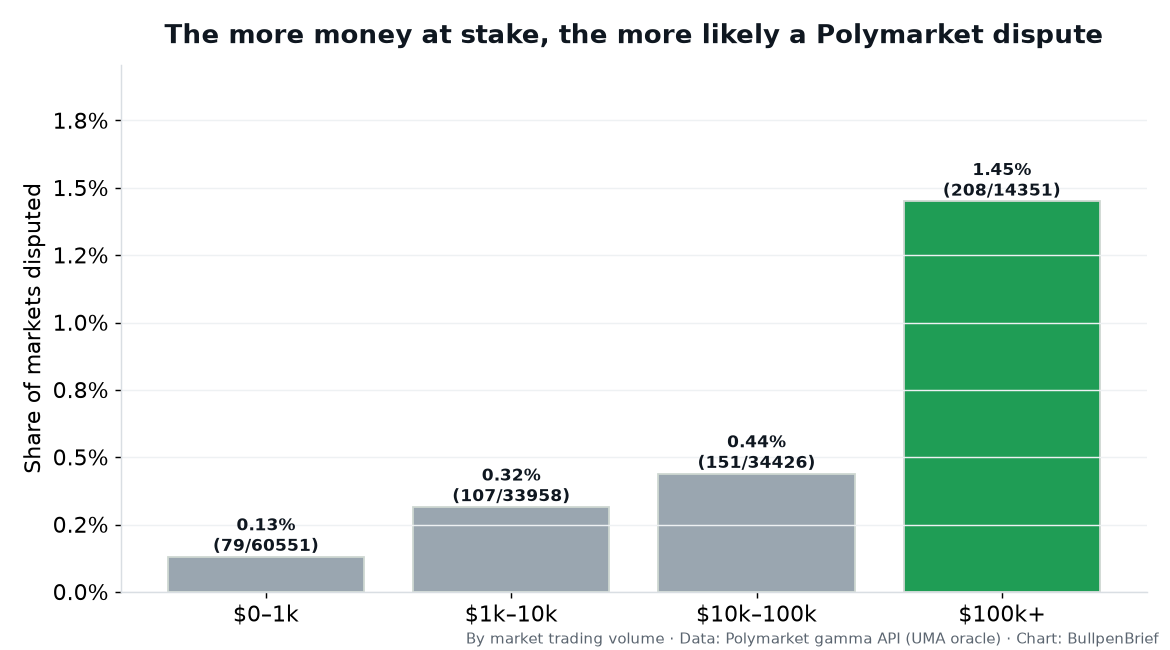
- Polymarket markets with more than $100,000 in trading volume were disputed 1.45% of the time (1 in 69), about 11 times the 0.13% rate for markets under $1,000 (143,286 markets, 2025 to 2026).
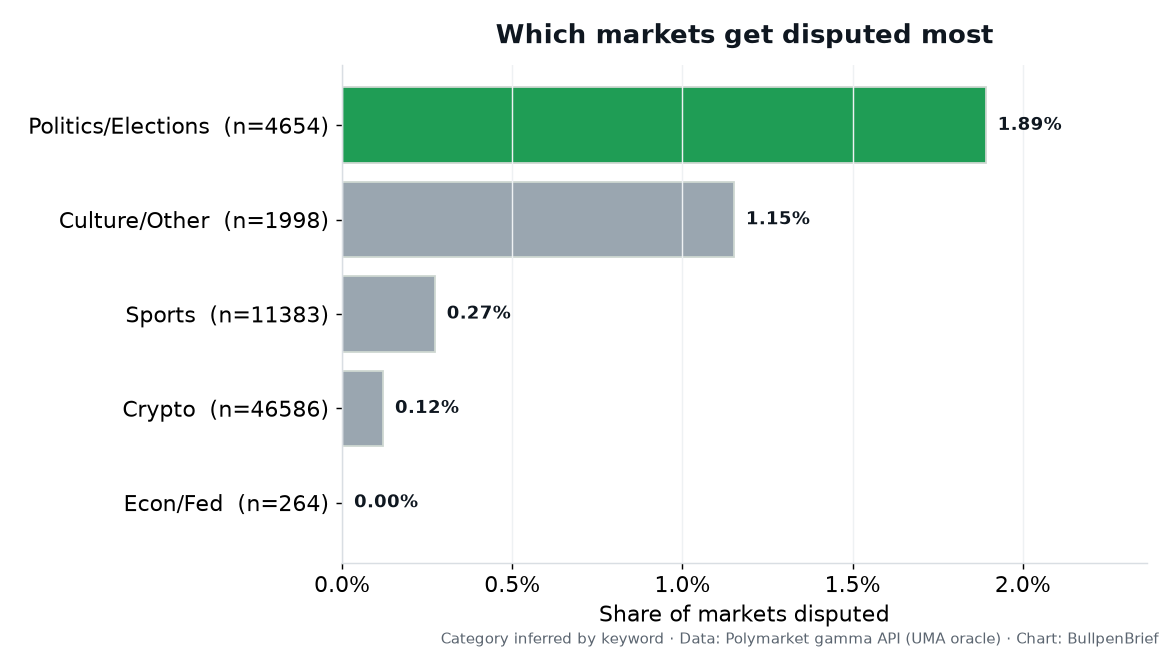
- Political and election markets on Polymarket were disputed 1.89% of the time (1 in 53), about 16 times the 0.12% rate for crypto markets (markets resolved March 2025 to August 2026).
- The largest disputed Polymarket market by volume was the $242 million “Will Zelenskyy wear a suit before July?” contract (June 2025); all five largest disputed markets were political or geopolitical.
- Caveat: Polymarket only began recording dispute status around March 2025, so earlier markets are excluded, and categories are assigned by keyword, so 78,401 markets fall outside the category breakdown.
The analyst’s read
Here’s the thing prediction-market evangelists don’t love to say out loud: the accuracy of a Polymarket price is only as good as the resolution behind it. A market can trade beautifully for months, price in every headline, and then fall apart at the one moment that matters, when a human has to decide what actually happened. Our data says that failure point is rare in aggregate but heavily concentrated exactly where the stakes are highest.
The volume gradient is the real story. A sub-$1k market is essentially never disputed, because nobody with money on the line cares enough to challenge it. Push volume past $100k and the dispute rate jumps eleven-fold. That’s not random, it’s economic. UMA’s optimistic oracle lets anyone challenge a proposed outcome by posting a bond, and when eight figures are riding on the answer, posting a five-figure bond to fight it is a rational trade. Big markets don’t get disputed because they’re poorly worded; they get disputed because it’s finally worth someone’s time to argue.
Category tells the second half. Crypto markets resolve cleanly, “Will BTC close above $100k on Dec 31?” has an unambiguous answer and a price feed to prove it. Political and geopolitical markets are the opposite: “did Zelenskyy wear a suit,” “is this a permanent peace deal,” “was the facility destroyed”, these hinge on definitions, timing, and judgment, and that ambiguity is where disputes breed. Sixteen times the crypto rate is not a rounding error; it’s a structural warning about which contracts you can trust to settle quietly.
What I take away as a trader: treat a large, politically-worded Polymarket contract as carrying resolution risk on top of outcome risk. The price might be right about the world and still hand you a loss, or a windfall, because of how the oracle reads six words of contract text. The disputes are rare, but they cluster precisely on the markets big enough to matter to you.
The biggest disputed markets
| Market | Volume | Resolved |
|---|---|---|
| Will Zelenskyy wear a suit before July? | $242.2M | Jun 2025 |
| US × Iran permanent peace deal by June 15, 2026? | $177.4M | Jun 2026 |
| Trump ends Ukraine war in first 90 days? | $56.5M | Apr 2025 |
| Israel × Iran ceasefire before July? | $51.8M | Jun 2025 |
| Yoon out as president of South Korea before May? | $40.2M | Apr 2025 |
Dispute rate by market size
| Market volume | Markets | Dispute rate |
|---|---|---|
| $0, 1k | 60,551 | 0.13% |
| $1k, 10k | 33,958 | 0.32% |
| $10k, 100k | 34,426 | 0.44% |
| $100k+ | 14,351 | 1.45% |
Download the data (CSV)
polymarket-disputes-2025-2026.csv: summary tables behind the article in long format: totals, dispute rate by volume tier, by category and by month, and the largest disputed markets. Columns: table, item, metric, value. Rates are in percent, volumes in US dollars. Free to use and cite under CC BY 4.0 with attribution to BullpenBrief and a link to this page.
Methodology
We queried Polymarket’s public gamma API for every closed market and read each market’s UMA optimistic-oracle status history (the umaResolutionStatuses field); a market is counted as “disputed” if that history contains a dispute. Polymarket only began populating this field around March 2025, so the analysis is restricted to the 143,286 markets resolved from March 1, 2025 onward (545 disputed), earlier markets return no dispute data and would understate the rate. Categories are inferred from market question text by keyword; markets that matched no category keyword are excluded from the category breakdown but included in every other total. Volume is the market’s lifetime USD trading volume. Analysis by BullpenBrief, free to cite with a link to this page.
Frequently asked questions
How often do Polymarket markets end in a dispute?
Across 143,286 markets resolved since March 2025, 0.38%, roughly 1 in 263, triggered a formal resolution dispute through Polymarket’s UMA oracle, according to BullpenBrief’s analysis of gamma API data.
Which Polymarket markets are most likely to be disputed?
High-volume and political markets. Contracts with over $100k in volume are disputed 1.45% of the time (1 in 69), about 11x the rate of sub-$1k markets. Political and election markets are disputed 1.89% of the time, roughly 16x the rate of crypto markets (0.12%).
What was the most-disputed Polymarket market?
By trading volume, the largest disputed market was the $242 million contract on whether Volodymyr Zelenskyy would wear a suit before July 2025, followed by a $177 million market on a US-Iran permanent peace deal. The five biggest disputed markets were all political or geopolitical.
How does a Polymarket dispute work?
Polymarket settles via UMA’s optimistic oracle: a proposer posts an outcome with a bond, and anyone can challenge it by posting a matching bond, sending the question to UMA token-holders to vote on. Disputes are more common on large markets because the payoff from successfully challenging an eight-figure market outweighs the cost of the bond.