




Prediction markets sell themselves on the wisdom of the crowd. The crowd’s own scorecard is less flattering. We placed all 3.2 million wallets on Polymarket’s public all-time leaderboard on the same curve and counted. On October 12, 2026, 27.7% of them were in profit. The median wallet was down $4.76. And the profit that does exist sits at the very top: the best 1% of wallets, about 32,000 of them, hold 90% of everything the winners have made, roughly $1.44 billion of $1.59 billion.
Most of the winners are not winning much. Only 7.3% of wallets are up more than $100, and 2.5% are up more than $1,000. To make the top 1% a wallet needed about $3,770 in lifetime profit. To make the top 10, it needed more than $8 million.
Key findings
- 27.7% of the 3.2 million wallets ranked on Polymarket’s all-time profit leaderboard were in profit on October 12, 2026 (bounds 27.4% to 27.9%); the median wallet was down $4.76.
- The top 1% of Polymarket wallets by all-time profit, 31,969 wallets, held 90.2% of the $1.59 billion made by all wallets in profit; the top 10 wallets alone held 7.9% ($125 million).
- Only 7.3% of Polymarket wallets were up more than $100 and 2.5% more than $1,000; 178 wallets had made more than $1 million, while about 167,000 had lost more than $1,000 (October 12, 2026).
- Over the last 30 days to October 12, 2026, 44.8% of the 654,000 wallets that traded on Polymarket were in profit for the period.
- In a sample of 7,667 Polymarket wallets, 65% of those with more than $1 million of lifetime volume were in profit, against about 30% of those under $100,000.
- Caveat: a wallet is not a person, one trader can run many wallets, and the profit figures are Polymarket’s own leaderboard numbers, which we did not rebuild from on-chain trades.
Seven in ten wallets are behind
The leaderboard ranks every wallet that has traded on Polymarket by all-time profit or loss, from the biggest winner at number 1 to the biggest loser at number 3,196,895. The rank of any wallet tells you how many wallets have done better. We looked up 7,673 wallets found in the trade history of 1,500 random markets from 2020 to 2026, plus the full top 10,000, and used their ranks to place the line between profit and loss.
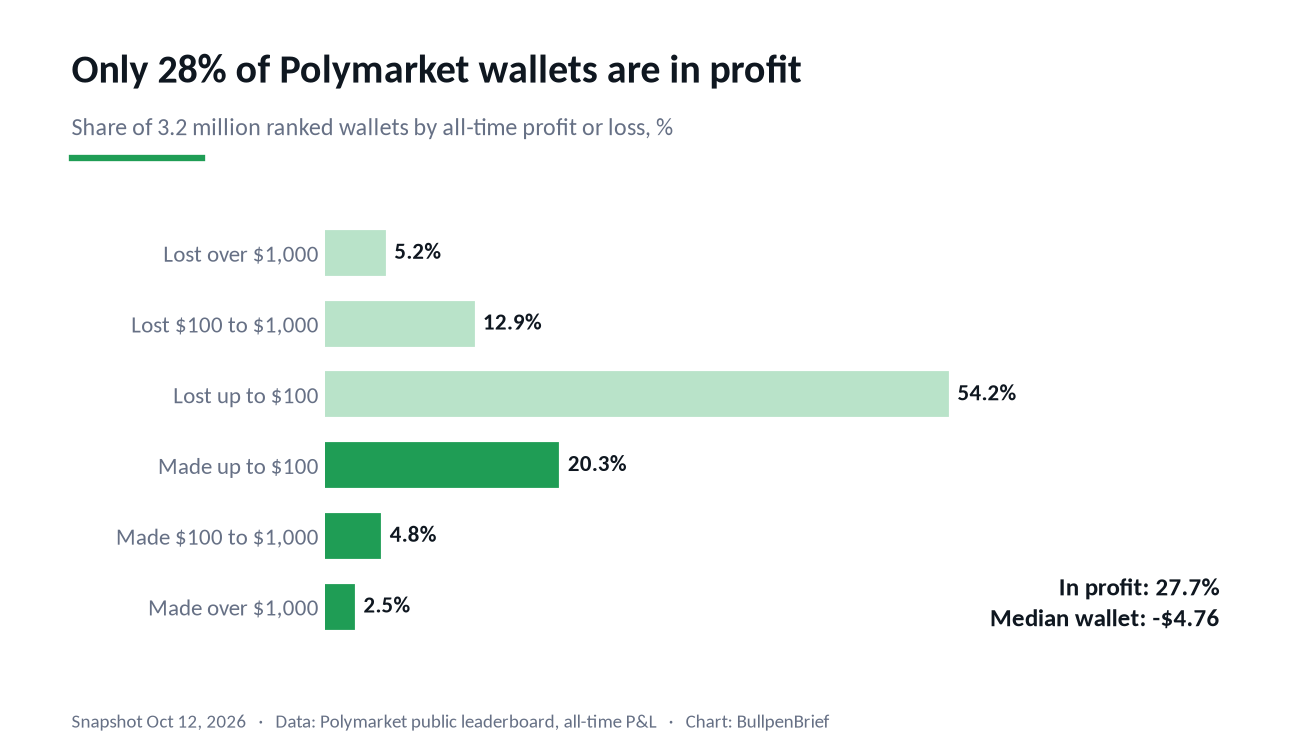
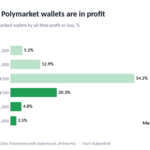
The last wallet in profit sits between rank 875,106 and rank 892,600, so the share in profit is between 27.4% and 27.9%. The largest single group is small losers: 54.2% of wallets are down by less than $100, which looks like people who tried a few bets and stopped. At the other end, 5.2% of wallets, around 167,000, have lost more than $1,000, and about 19,700 have lost more than $10,000. Only about 14,800 wallets have made more than $10,000, 1,890 more than $100,000 and 178 more than $1 million.
The picture is less lopsided over a shorter window. Polymarket also ranks wallets by profit over the last 30 days. Of the 654,000 wallets that traded in that window, 44.8% were up for the month. Losing streaks and winning streaks both exist, but over a whole trading history most wallets end up behind.
Where the money went
Adding up every wallet in profit gives about $1.59 billion in lifetime winnings. The chart shows how much of that sits at the top of the leaderboard.
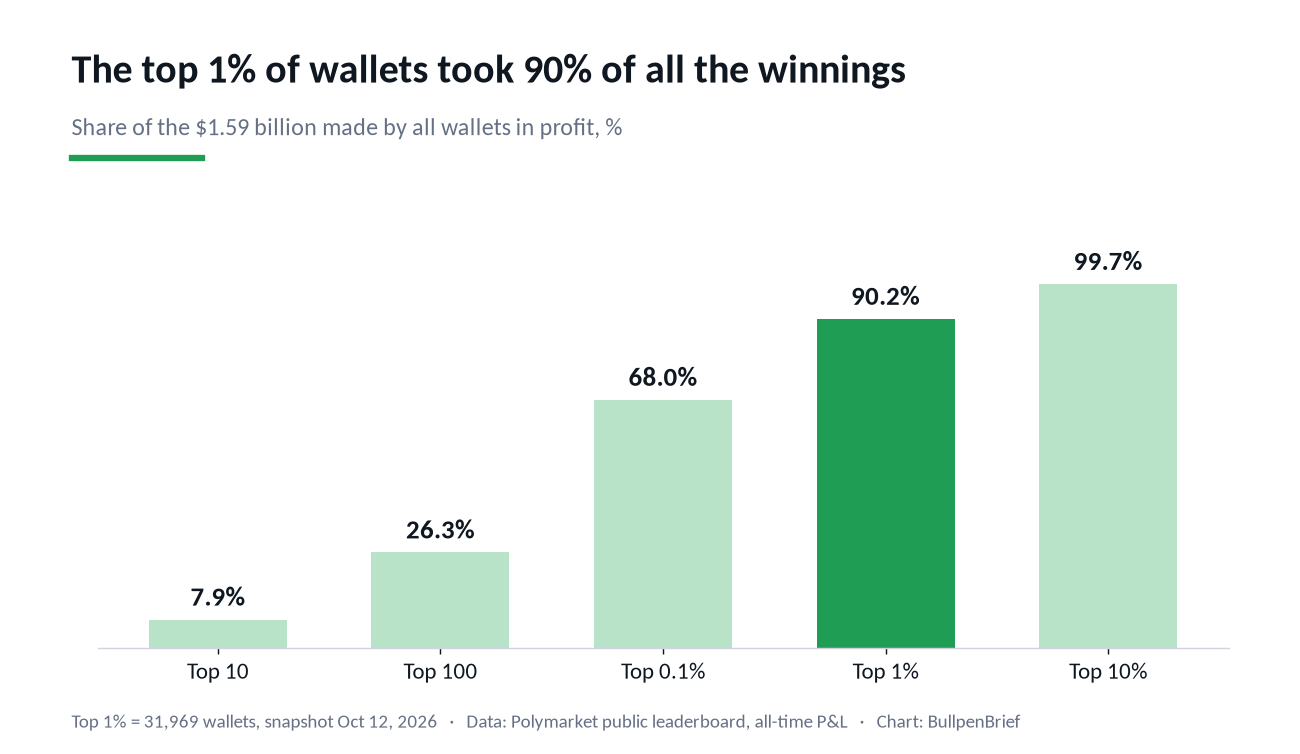
The top 10 wallets alone hold 7.9% of all winnings, $125 million. The top 100 hold 26%. The top 0.1%, 3,197 wallets that each made at least $56,700, hold 68%. The top 1% hold 90.2%, and the top 10% hold 99.7%. Below the top 10%, the other 560,000 or so wallets in profit share about $5 million, an average of less than $10 each.
No single wallet drives this. The number one wallet, Theo4, made $22.1 million, best known for its bets on the 2024 US presidential election. That is 1.4% of all winnings. Without it, the top 1% still holds 90.0%. The top 10 holds two kinds of trader. Seven wallets made their money on $13 million to $77 million of volume, which points to large directional bets. Two others, swisstony and RN1, traded $1.4 billion to $1.9 billion each, which looks like market making or high-frequency trading rather than forecasting.
Bigger traders win more often
For the 7,667 sampled wallets we also know lifetime trading volume. The share in profit is flat at about 29% to 30% up to $100,000 of volume, rises to 36% between $100,000 and $1 million, and reaches 65% above $1 million.
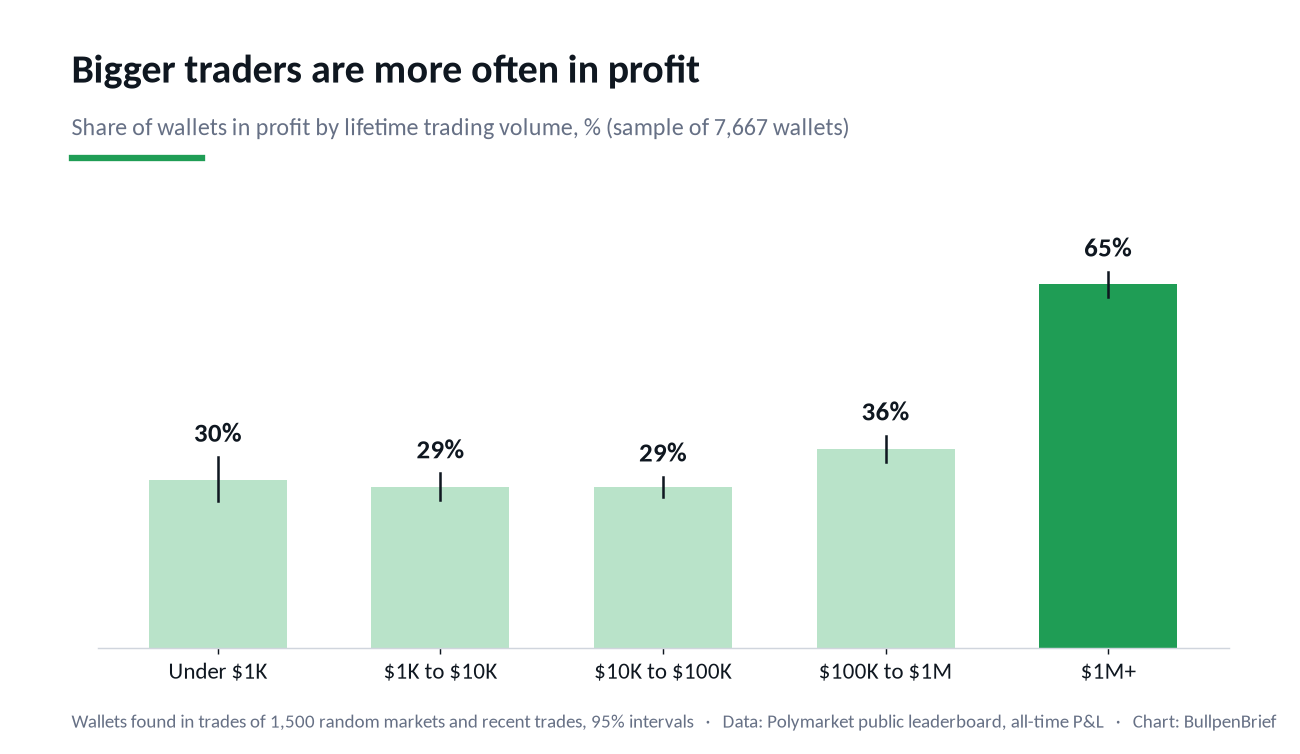
This chart is the one part of the study that rests on a sample rather than the whole leaderboard, and the sample leans toward active wallets: 38.7% of sampled wallets are in profit, against 27.7% for all wallets. So read the levels as too high and the shape as the finding. Part of the shape is survival, too: a trader who keeps winning keeps trading and piles up volume, while one who loses tends to stop.
What this is not
A wallet is not a person. One trader can run many wallets, and some of the largest are trading firms and bots. We cannot say what share of people make money on Polymarket, only what share of wallets do. Many of the 3.2 million wallets made one or two small bets.
The profit and loss figures are Polymarket’s own, the same numbers its leaderboard and profile pages show. We did not rebuild them from on-chain trades and cannot audit how they treat positions that are still open. The losses we can see, at least $1.75 billion, exceed the $1.59 billion of profits; the gap may come from fees, how open positions are valued or wallets the leaderboard does not rank, and we do not try to reconcile it.
And this is a snapshot of October 12, 2026. The leaderboard moves every minute, and a wallet that is down today can be up after one good bet. It is not evidence that prediction markets are rigged, and not evidence that they are not; it shows that, as in most trading, the gains are concentrated in very few hands.
Download the data (CSV)
polymarket-wallet-pnl-2026.csv: one row per looked-up point of the Polymarket all-time profit leaderboard on October 12, 2026 (16,944 rows covering ranks 1 to 10,000 and 6,946 deeper wallets). Columns: leaderboard rank, percentile from the top, all-time profit or loss in US dollars and whether the row came from the leaderboard pages or a single-wallet lookup. Free to use and cite under CC BY 4.0 with attribution to BullpenBrief and a link to this page.
Methodology
Polymarket’s public data API returns its all-time profit leaderboard 50 wallets at a time down to rank 10,000, and for any wallet address it returns that wallet’s rank, profit and loss and volume. Because the rank counts every ranked wallet, each wallet we look up is an exact point on the curve of profit against rank for the whole population, no matter how we found it. We paged the top 10,000 and looked up 7,673 more wallets taken from the trade history of 1,500 closed markets chosen at random from two-day windows between October 2020 and October 2026, plus recent trades; 7,667 of them were ranked. The deepest rank we saw, 3,196,895, is our count of wallets; the true number is at most a few hundred higher.
Profit and loss falls as rank rises, so every wallet between two looked-up neighbours has a figure between theirs. That gives hard lower and upper bounds for any count or sum: the share in profit is 27.4% to 27.9%, total winnings $1.591 billion to $1.594 billion, and the top 1% share 90.1% to 90.3%. Point estimates interpolate linearly between neighbours. The leaderboard was read between about 06:00 and 06:15 UTC on October 12, 2026; ranks that moved in that time were smoothed to keep the curve in order. The 30-day figures use the same method on the monthly leaderboard. The volume chart is a sample statistic with bootstrap 95% intervals. The old Polymarket profit-and-loss subgraph was not used, as its maintainer marked it stale after Polymarket’s V2 migration. Figures, charts and the method are free to cite with attribution to BullpenBrief.