



A stablecoin is supposed to be worth $1. We went through six years of daily prices to see what happens when one is not. Of 74 times a stablecoin with at least $10 million in circulation fell below 97 cents since December 2020, it got back to $1 in 87% of cases, and the median trip back took three days.
The other side is just as clear. A stablecoin that was still off its peg after a month came back less than half the time. Of the 10 that were still off after 90 days, none ever returned to $1. If the dollar does not come back within a quarter, history says it is not coming back.
Key findings
- Of 74 resolved depegs of US dollar stablecoins with at least $10 million in circulation from December 2020 to October 2026 (daily price under $0.97), 86.5% ended back at $1 (95% interval 78.1% to 93.7%), with a median recovery time of three days (DefiLlama stablecoins API, 48 stablecoins).
- None of the 10 dollar stablecoins that were still below $0.99 90 days after a depeg ever returned to $1 between 2021 and October 2026; among those still off after 30 days, 44% later recovered (n = 18).
- Depegged dollar stablecoins whose price stayed above $0.90 in the first three days recovered 95% of the time (58 of 61), against 46% (6 of 13) for those that fell below $0.90, 2021 to 2026.
- On March 12, 2023, after the Silicon Valley Bank failure, 12 dollar stablecoins with $10 million or more in circulation traded under $0.97 on the same day, including USDC ($42.2 billion) and DAI ($5.1 billion); all 12 were back at $1 within two weeks.
- 29% of dollar stablecoins that recovered from a depeg (12 of 41) were dead or below $0.97 in October 2026, against 11% (6 of 56) of stablecoins of the same size that never depegged.
- Caveat: DefiLlama records one price per day at 00:00 UTC, so intraday crashes are missed or look shallower (USDC shows $0.961 on March 12, 2023, after trading below $0.90 the day before); 58 of the 74 depegs lasted a single daily reading.
Most depegs heal within a week
We started from all 333 dollar stablecoins that DefiLlama tracks, including dead ones such as TerraUSD and Neutrino USD, and used the 237 with a usable daily price history. A depeg here means a daily price under $0.97 after at least 30 days at $0.98 or more. A stablecoin counts as back only when it holds $0.99 or more for seven days in a row, so a single bounce does not count. That gives 76 depegs at 49 stablecoins from 2021 to October 2026. Two of them, both in the last 90 days, are still open.
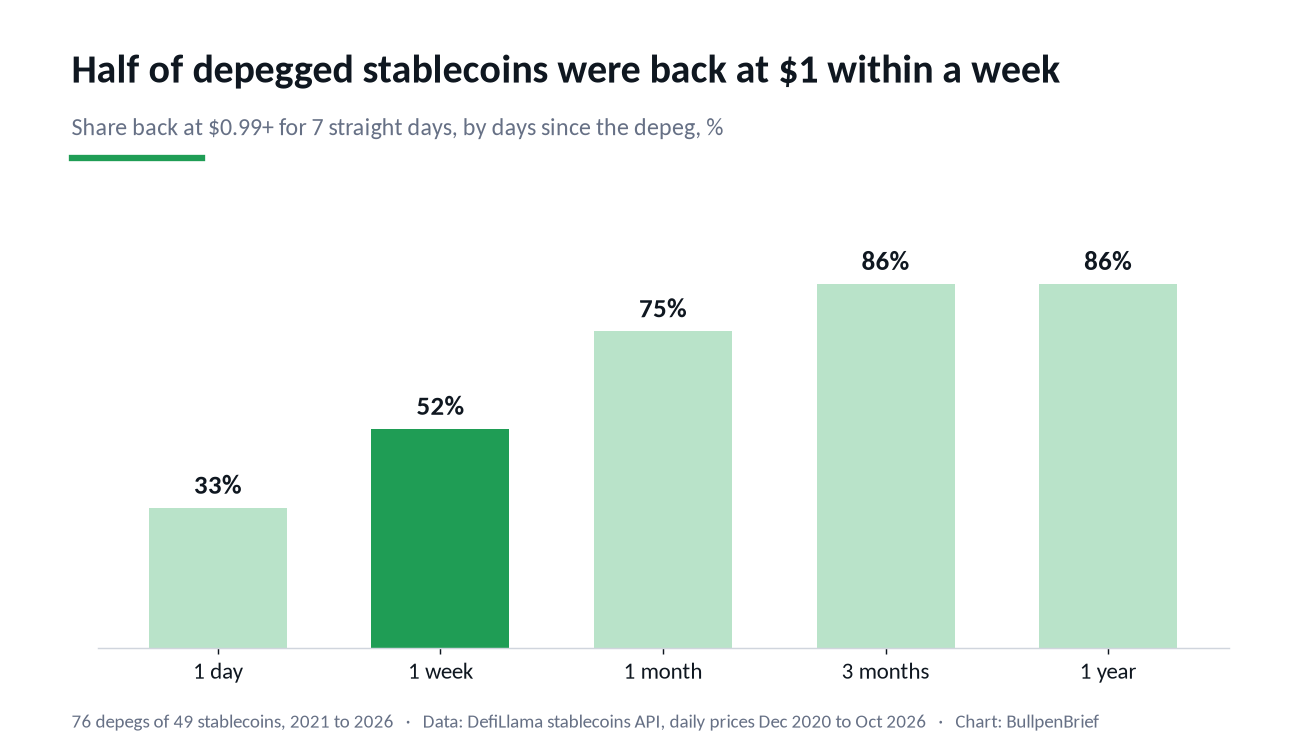
A third were back the next day. 52% were back within a week, 75% within a month and 86% within three months. After that the line goes flat: nothing that had not recovered by day 90 recovered later. Of the 74 depegs that are resolved one way or the other, 64 ended back at $1 (86.5%, 95% interval 78.1% to 93.7%).
The biggest test came on March 12, 2023, after Silicon Valley Bank failed with part of Circle’s reserves inside. Twelve stablecoins went under 97 cents on the same day, including USDC ($42.2 billion in circulation), DAI ($5.1 billion), Frax and USDD. All twelve were back within two weeks, and USDC, DAI and Frax were back the next day.
After a month, the odds flip
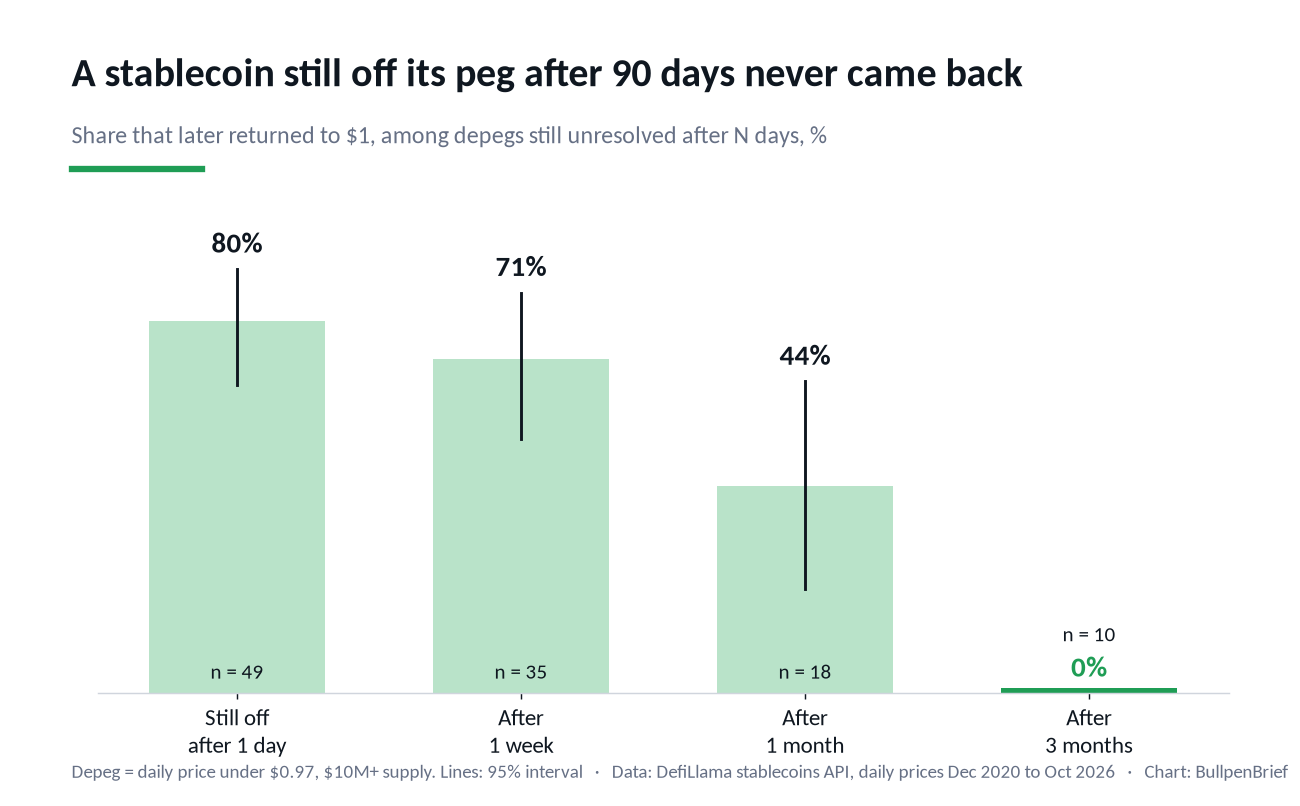
The useful question for a holder is not “how often do depegs heal” but “mine has been off for a while, what now”. Among stablecoins still off the peg after one day, 80% later made it back (n = 49). After a week, 71% (n = 35). After a month, 44% (n = 18, interval 22% to 67%). After three months, 0 of 10.
That list of ten is a who’s who of stablecoin failures: TerraUSD in May 2022 ($18.7 billion before it broke), flexUSD in June 2022, USDR in October 2023, Stables Labs USDX and Elixir’s deUSD in November 2025, Resolv’s USR in March 2026 and Magic Internet Money, which recovered from three earlier depegs before it finally broke in June 2026.
How deep it goes in the first days matters most
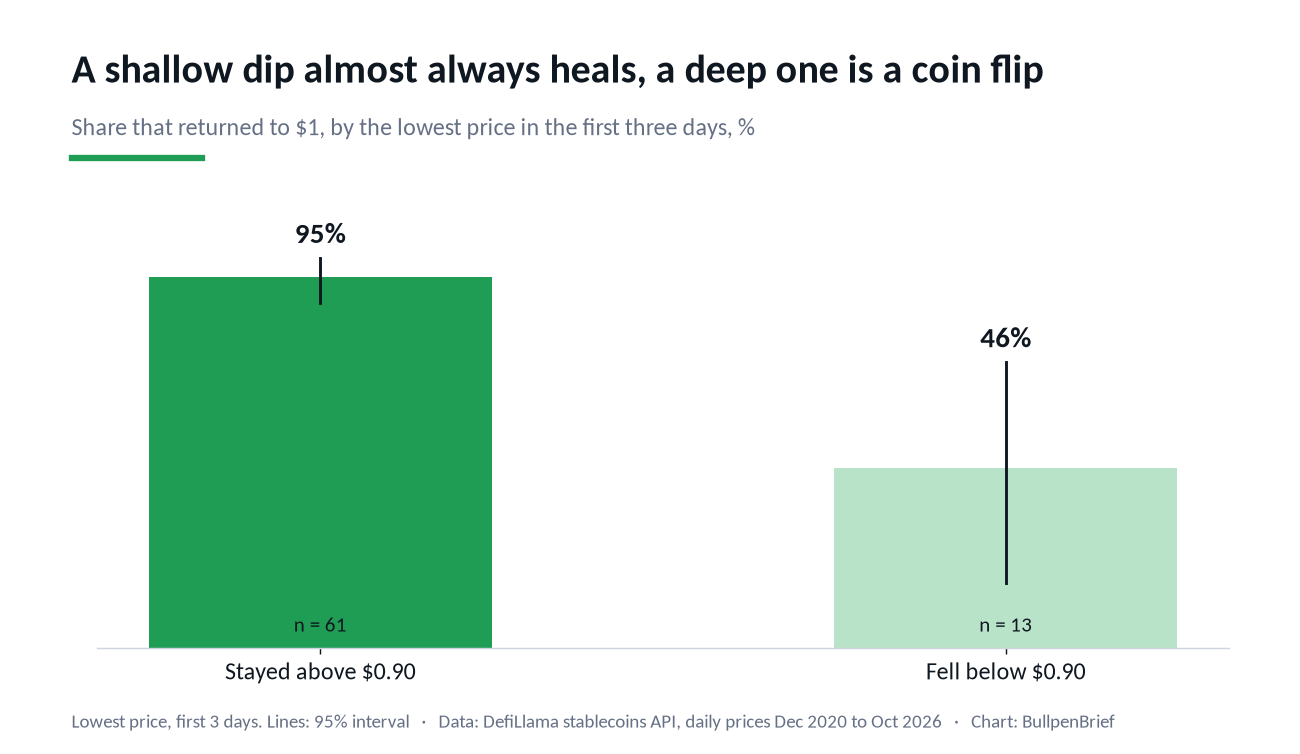
The first three days tell you a lot. When the price stayed above 90 cents in that window, 95% came back (58 of 61). When it fell below 90 cents, 46% did (6 of 13), and it took a median of 14.5 days instead of 2.5.
The backing matters less than you might think, partly because the groups are small. Fiat-backed coins (cash and Treasury bills) recovered all 12 times. Crypto-backed coins recovered 86% of the time (51 depegs) and took a median of five days. Algorithmic designs recovered 73% of the time (11 depegs, interval 38% to 94%), and TerraUSD alone makes up most of the money lost.
Weighted by dollars, the picture depends on Terra. Of $74.7 billion in stablecoins that were in circulation the day before a depeg, 72.6% belonged to coins that got back to $1. Leave out TerraUSD and it is 96.8%.
Coming back is not the same as being safe
We compared stablecoins that recovered from a depeg with ordinary months for stablecoins that had not had one in the past year. In the 12 months after a recovery, 29% of coins slipped under 97 cents again (52 recoveries, interval 18% to 39%). For an ordinary month at a $10 million+ stablecoin, the chance of a depeg in the next 12 months was 23% (1,256 coin-months at 98 stablecoins, interval 16% to 31%). In the short run, a recovered coin looks about as risky as any other.
Over the long run it does not. 29% of the stablecoins that recovered from a depeg are dead or below 97 cents today (12 of 41), against 11% of stablecoins of the same size that never had one (6 of 56). Neutrino USD got back to $1 in 2021 and was dead by 2023. HUSD recovered in August 2022 and now trades at 3 cents. flexUSD recovered in January 2022 and collapsed five months later.
This is our first study of stablecoin prices. Our look at the $307 billion stablecoin market covered who issues them; this one covers what happens when the dollar slips. For what happens to money taken in exploits, see our study of $20.65 billion in crypto hacks.
What this is not
This is not intraday data. DefiLlama records one price per day at midnight UTC, so short crashes are missed or look shallower than they were. USDC fell below 90 cents on March 11, 2023, but the daily record shows 96.1 cents. 58 of the 74 depegs were below 97 cents on a single daily reading. If we count only depegs that lasted two daily readings or more, 56% recovered (9 of 16) and the median took 19 days.
It is a market price, not a redemption price. A holder who could redeem with the issuer may have got $1 even when the market said 96 cents, and a holder on a thin market may have got less than the price shown.
The small groups are small. There are 13 deep depegs, 11 algorithmic ones and 10 that lasted past 90 days. The direction is clear; the exact percentages for these groups are not.
The long-run comparison does not control for age. Some stablecoins that never depegged are newer, so they have simply had less time to fail.
Download the data (CSV)
stablecoin-depegs-2021-2026.csv: one row per depeg of a US dollar stablecoin with $10 million or more in circulation, December 2020 to October 2026 (76 rows, including 2 still open). Columns: depeg date, symbol, name, peg mechanism, circulating supply the day before, price on the depeg day, lowest price and its date, consecutive days below $0.97, status (recovered, failed or open), recovery date, days to recovery, last price and its date, and DefiLlama’s date of death if any. Free to use and cite under CC BY 4.0 with attribution to BullpenBrief and a link to this page.
Methodology
Data come from the DefiLlama stablecoins API, downloaded October 19, 2026: the list of stablecoins with peg type and mechanism (fiat-backed, crypto-backed, algorithmic), each coin’s circulating supply history and date of death where DefiLlama records one, and daily prices for all stablecoins from December 30, 2020 to October 19, 2026. Dead coins stay in DefiLlama’s list, so failures are counted. We used only coins pegged to the US dollar.
Of 333 dollar stablecoins, 67 have no price history and 4 have less than a month. We excluded 12 yield-bearing tokens whose price rises above $1 by design (more than 25% of days above $1.02) and 13 coins with broken price feeds (any daily price above $1.50). We removed 48 isolated price errors, a single reading under 90 cents with readings of 98 cents or more on both sides, and dropped January 2 and 3, 2025, when DefiLlama shows Frax, Liquity USD, Gemini Dollar and alUSD all at about 56 cents at once. We dropped 70 depegs at coins with less than $10 million in circulation the day before, where prices are noisy, and one case where a price feed sat at zero for 13 months and then reappeared at $1.
A depeg starts on the first daily price under $0.97 after 30 days at $0.98 or more. It ends in recovery on the first of seven consecutive days at $0.99 or more. Depegs with no recovery that started more than 90 days before the end of the data count as failures; younger ones are open and are left out of the shares but kept in the time-to-recovery curve, which is a Kaplan-Meier estimate. Intervals are 95% bootstrap intervals that resample whole stablecoins, because one coin can have several depegs. Removing Magic Internet Money, the coin with the most depegs (four), moves the recovery rate from 86.5% to 87.1%. The comparison group is the first day of every month at which a stablecoin had $10 million or more in circulation, had held $0.98 or more for 30 days and had not depegged in the prior year. Figures, charts and the method are free to cite with attribution to BullpenBrief.